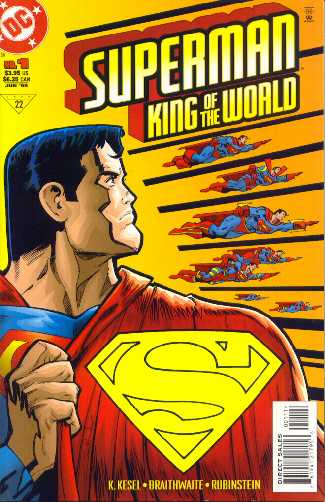
Showing posts with label Class. Show all posts

Friday, October 20, 2006

Scatter-Thoughts

Going on vacation for a week, so new post for a bit.

In the meantime, I leave you with some random thoughts.

Hey, Robert Kirkman, if you want to read about "an inexperienced hero who would get beaten up constantly and probably die," check out this week's Robin. Or Birds of Prey. Or 52.


The only thing that would have made the page of new heroes shouting their stupid names better is if they had shouted them in Logo Font.


Speaking of, Red Tornado looked beyond the veil of universe and saw 52... what? My guess: 52 other universes (which, including the universe he was in at the time, would be a full pack plus a wild card). And they're coming.


If the conversation on superheroes and class is going to keep going, we might want to start defining our terms. I realize in my own arguments I'm getting thrown off my point a lot by confusing aristocracy, wealth, style, education, power, and morality. The original question was whether the superhero genre perpetuates the myth of aristocracy, that some people are just born to rule. That's shifted a bit into whether Batman fights social injustice and why aren't more superheroes classy, with claims of anti-intellectualism thrown in.


The anti-intellectualism claims really bother me, for some reason. There's this odd assumption that having an education, particularly a post graduate education, is synonymous with being upper class, an influential figure on the course of society, which just isn't true. Most of the academics I know toil in obscurity (and read this blog! Hey, Aaron, David, and Jeff)!. As Cole points out, Kal-El is not a lost prince of Krypton. He's the son of a smart but not highly respected scientist. Meanwhile, Bruce Wayne (who we all agree runs Gotham, yes?) never even went to college. And back in the real world... well let's just say that being a total and complete moron doesn't stop you from getting elected President.


Casanova is a heck of good read. As is 100 Bullets, which has started barrelling towards its conclusion.


Has it really been a month since ANY issue of Superman's three ongoings have hit the shelves? And I have to wait till December for more All-Star goodness? C'mon! I'm starting to feel like a Green Lantern fan over here.


Speaking of, sort of, Morrison Batman run filled-in by The Spectre team of Ostrader and Mandrake? Yeah, I'll take that.


Yes, I heard about NextWave. No, I'm not surprised. No, I haven't rent my garments nor gnashed my teeth. Yes, that will be one less Marvel title I'm buying. Yes, I'll probably pick up whatever NextWave limited series come down the pike. No, I'm not buying Thunderbolts.

Thursday, October 19, 2006

Plutocrat

In my People's Superman post, I mentioned that Superman being an anti-aristocratic hero is an exception to the rule, that most superheroes are aristocratic in both background and behavior, and the best example of that is...

Batman.

Yes, Batman.

Batman isn't just "the man," Bruce Wayne is also The Man. He's a rich, white, handsome man who comes from an old money family and is the main employer in Gotham. He owns half the property in the city. In a very real sense, Gotham belongs to him, and he inherited all of it.

Accordingly, Batman has an enormous sense of entitlement. Batman just assumes he's right in every situation. It's his city. If he doesn't like you, he'll tell you to leave. If Batman thinks you're guilty of a crime, he'll put on his pointed white hood black mask and beat the crap out of you. Laws? Civil rights? Due process? Those are for other people. Yes, the people may have elected a mayor, pay taxes to employ the police. Batman could work with them, but they're all corrupt, weak, not as good as him. (Except Gordon. Batman has generously determined that Gordon is worthy to contacted, though he always disappears before Gordon's done talking, just to remind Gordon who's the bitch in this relationship.)

And look at who he fights! Superman fights intergalactic dictators, evil monopolists, generals, and dark gods. Batman fights psychotics, anarchists, mob bosses, the mentally frail, and environmentalists. Superman fights those who would impose their version of order on the world. Batman fights those who would unbalance the order he imposes on Gotham.

Consider the Penguin. He's a criminal, a thug. But what really distinguishes him is his pretensions to being upper class. The tux, the monocle. The fine wine and fine women. Running for mayor. He tries to insinuate himself with actual socialites, some of whom are attracted to his air of danger, but most of whom are repulsed by his "classless" manners. And when his envy and resentment of his "betters" turns to violence, Bruce steps in to teach him his place.

And it's not just Mr. Cobblepot. Hugo Strange, Black Mask, Facade, Catwoman, all villains from lower class backgrounds who want to be upper class, who want to hobnob with the rich and famous at one of Bruce's fabulous fetes, but just can't pull it off (well, Catwoman can, but Selina's in a class all by herself). Even Harvey Dent, before he became Two-Face, envied and resented his friend Bruce Wayne, because Wayne had money and Harvey had to work for everything he got. And then there's the villains who have a vendetta against C.E.O.'s of powerful corporations, either for revenge (Mr. Freeze, Clayface) or out of principle (Ra's al Ghul, Poison Ivy). There's a class war going on in Gotham, and Batman has taken the side of the rich.

Like Superman, there's an Arthurian "king-in-hiding" element to Batman's origin. "Banished" from Gotham by the death of his parents, Bruce Wayne returns to redeem his land and reclaim his throne. But instead of reclaiming it from usurping uncle or foreign invader, Batman must take Gotham back from a rising underclass.

And Batman doesn't even like the upper class he belongs to, either! Shallow, petty, boring, vain. They know nothing of the pain and suffering he sees every night when he hunts killers through the slums of Gotham, every day when he closes his eyes. He mockingly refers to himself as a "plutocrat" in last week's JLA: Classified, dismissing both value of plutocrats and the intelligence of a dictator who courts them. But does he dislike his wealthy peers because they don't appreciate how wealthy they are? Or is it because they aren't wealthy enough to appreciate how much responsibility he has?

And even if he thinks they're upper class twits, he really doesn't do anything about it. He leaves them in place, protects them from harm, flirts with and beds them. They're not the bad guys, after all. It's all those poor evil people. The one's who keep crashing the gate, who happened to be accidentally hurt in the hunt for profit. No reason Batman should try to protect them, keep them from getting crushed under the weight of capitalism.


They're just "penny-ante". And Bruce is a plutocrat!

Wednesday, October 11, 2006

J.L.U.N.

Ahh, that's better. Now I feel like I have some room to breath. Certainly my posts with big images, like my recent post on the myth of aristocracy look a lot better now. And I followed through on my promise of adding a greatest hits section (based on hits and links).

Went to the store today. A slow week for me. The most enjoyable comic was 52, which enjoyably progresses a plotline or three. Nothing surprising, (except maybe the religion bit), but well executed, particularly the tan line. I mean, the line about the tan.

Whatever.

But the most interesting comic, the one that stuck, was JLA Classified #28. Howard Chaykin started from the same basic premise as Gail Simone's run (Justice League intervenes in international politics) and goes in a very different direction. There's a lot of smart writing going on there. The two fictional South American nations featured supposedly have radically different ideologies, one communist, one capitalist, but the rhetoric does little to disguise the fact that they are nearly identical dictatorships. (Though I should note the capitalist dictator welcomes "plutocrat" Bruce Wayne with open arms, while the communist opens up to, of course, that old leftist Clark Kent.) And even though it's clear they're both bad guys, it's not black & white whether the Justice League is doing more good than harm by intervening, which is nice. There's even a crack about the American comics industry that's both nicely done and awfully mean.

The art's good, not great. Tom Nguyen really does make every penciller's work look like Doug Mahnke, but weak Doug Mahnke. And it's a three or four issue story at most, unfortunately told over six issues. But it's a good solid Justice League story where Wonder Woman and Batman actually hit people instead of bitching at each other from across a table, so I'd recommend picking it up.

In other news, Earth Prime has in fact bled into the DC Universe, as Infinite Crisis the book shows up in Gotham book stores. And as before, what is fiction here becomes non-fiction there.

But if Superman, Batman, and Wonder Woman are missing, how did the writer learn what happened on the moon?

Damn it, Frey! Not again!

Tuesday, September 26, 2006

The Myth of "Who's Your Daddy?"

or, "Strange Women Lying in Ponds Distributing Swords is No Basis For a System of Government. "
Once again, what started as a response to Matthew has grown into an entire blog post (including a little anti-Bush rhetoric and, to my surprise, praise for Infinite Crisis). In response to my last post that Superman was in fact a working class hero and his stories are anti-classist, he wrote

Everything you say about Superman is true. But you're talking about what Superman does, and what he thinks and believes and stuff. What I was talking about is who he technically is, and who he is is, basically, the Lost Prince of Krypton. He's like Carrot in the Discworld books.

This way, the Superman writers get to have it both ways. They can draw from the alien-aristocrat superhero archetype, but they don't have to make him act like it. (Contrast: Superman, and Dr. Tachyon from the
Wild Cards novels.) This may actually be one reason (out of all the many reasons) why Superman is such a great character.
I meant to respond right away, but I couldn't tell whether our disagreement over the class of Superman was a minor semantic disagreement over the definition of the word "is" (which would be too minor to even argue) or a major philosophical one over the meaning of social class and the nature of hereditary predestination. I'm going to assume it's the second, even though there is no way to do that justice in one post of my comics blog.

Matthew says that Superman, in the tradition of Oedipus, King Arthur, and Aquaman, may act as a peasant hero but he is in fact a king-in-disguise, that it is his Kryptonian genetic destiny shining through that makes him Superman. That he's a hero because of his elite genetics, no matter how much he pretends he is a commoner.
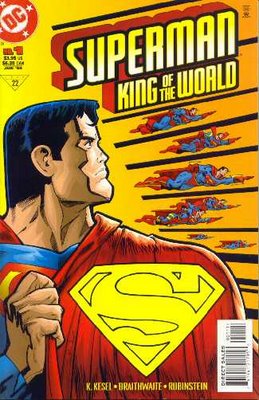
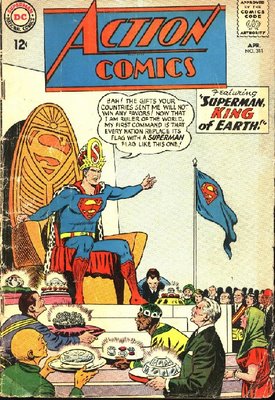
My problem with basing Superman's class on his genetics over his actions is that class is a social construct. It is only through what he and others consider him to be that we know what class he belongs to. And Superman chooses NOT to be a king (stories where Superman chooses to become a king will be ignored because they are terrible) The myth of aristocracy is that class is genetic, that some people are just born good enough to rule, and that this inherent goodness can be passed down from generation to generation (like the X-Gene!)

And Superman's own story proves the myth false. Yes, Clark's blood obviously gives him "powers and abilities far beyond those of mortal men." However, what makes him a good guy can't be his blood, because Kryptonians are the assholes of SPAAAACE (below the comic).

Zod, Preus, the Eradicator, the new Kara Zor-El (possibly)... Those that come to Earth preaching the superiority of Krypton are by and large really, really bad guys. And even under the best of circumstances, Kryptonian society was ruled by arrogant morons who couldn't see their planet was falling apart despite the evidence of the best scientists of the time (cue Global Warming joke). So clearly, just being vulnerable to kryptonite isn't enough to make you better than the masses.

No, what makes Superman a hero is the choices he makes. And whenever Superman is forced to choose between the Kryptonian way and the Earth way, he chooses Earth, every time, and embraces his life as Clark Kent (the end of Kingdom Come, for example). And as long as Superman chooses to live as a middle-class employee, THAT is who he is. Jor-El and Lara may have given him powers, but it's Jonathan and Martha, his "humble" lower class parents, who made him a hero.
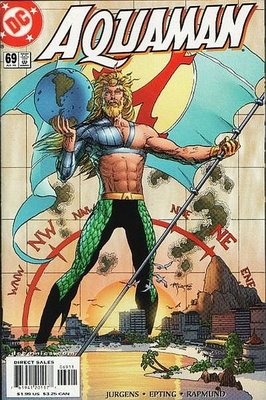
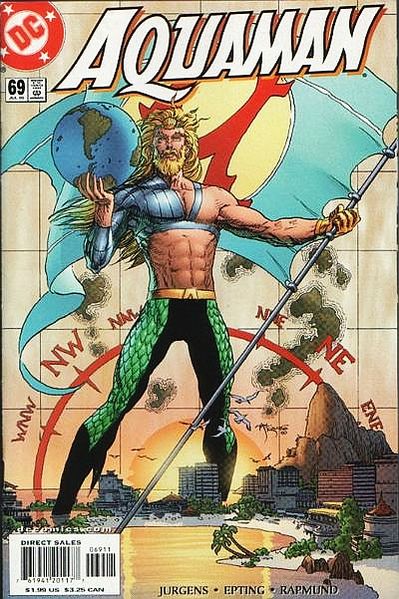
This is unlike almost every other superhero, by the way. Contrast Superman with Aquaman, for example. Like Superman, he was orphaned as a baby, raised in an alien world, and grew up as a human for at least part of his life (where he learned English and was christened Arthur Curry). But when Aquaman learned where he was really from, he rejected the surface world and threw in his loyalties to Atlantis whole-heartedly, in the more traditional Arthurian arch-type. (Ironically, to become King Arthur, he had to reject the name "Arthur.") Even given the chance, Superman would NEVER give up Earth to return to Krypton.
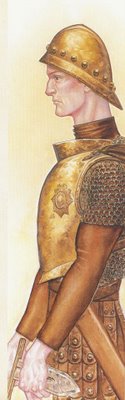
Matthew brings up Carrot Ironfoundersson of the Discworld novels, another heroic king-in-disguise who refuses to take the throne. But that, I think, argues for MY point. Discworld, after all, is a satire of the myth of aristocracy (among many other things). Most of the other characters think Carrot should rule because of his unacknowledged heritage, but those that think that way are idiots and bad guys.

The smarter characters, including Carrot himself, know he's not smart enough to run the city, nor ruthless enough to do half the horrible things he'd need to as King (or Patrician, as the position is called). That having the right name and the right daddy isn't enough, that "the right blood" is in fact close to meaningless (I'd make another joke here...). Carrot may be related to a king, but day to day it's much more important that he learned how to be good man (or dwarf, it's complicated) and can throw a strong right hook.

Carrot, of course, is a deliberate satire, and I doubt Siegel and Shuster were thinking too deeply about Jungian arch-types and Marxist rhetoric when they created their science fiction strong man, but I think Superman is a stronger character because of it. Carrot can really only be that satire: "King Arthur, but not," stuck in an old debate over the divine right of kings and dictators. Superman can be that satire and more, moving beyond that class discussion to a classless society where a man is judged only by his actions.

Which leads me to my defense of Infinite Crisis. I dropped Civil War when I realized it wasn't about anything. And while Infinite Crisis was flawed, I can tell you what it was about: the myth of heroic destiny. Superboy-Prime (and to some extent Alexander Luthor) believed he had the right, the duty, to destroy the universe and remake it in his image because of who his Kryptonian parents were, and that he would ALWAYS be in the right, always be the hero because his name was Kal-El, he was from Krypton, and he had great power. He was wrong. In the end it came down to Superman, our Superman, laying it out for him:
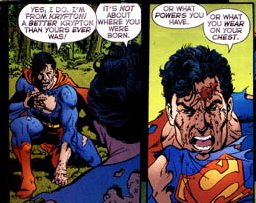

And, after laying Prime out, Clark lets him know what it's all about:
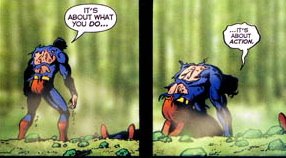

It's about action.


What makes Clark Kent "Superman," and not just another asshole Kryptonian, is his actions. So when judging what class Superman belongs to, whether he's an elite looking down on the masses or one of us, we can only judge him based on "what Superman does, and what he thinks and believes and stuff." Because what else is Superman, in the end, other than those things?

Sunday, September 24, 2006

The People's Superman

Matthew at the Legion Abstract has a great post about class and superheroes that you need to read right now and then come back here. This started as a response but it became very long and I remembered I have my OWN blog. (post on Detective 823 continues to be delayed).

His claim, and it's one I generally agree with, is that superheroes as a genre tends to be "classist." Heroes tend to be either actual nobility, such as Wonder Woman or Aquaman, or very rich, like Batman and Green Arrow, and they fight to save the masses from themselves rather than fighting to change the social structure that keeps the poor in poverty. There are obvious exceptions, but that seems to be true, going back to the proto-typical stages of Zorro and the Scarlet Pimpernel.

My one disagreement with Matthew is that he classifies Superman as an "aristocratic" hero, and quite frankly I feel the opposite is true. Superman did and does fight for social change. In the Superman Archive, he clearly starts out as a populist hero, a champion of the working class, taking on war profiteers, state-run orphanages, crooked boxing promoters and poor mining conditions. Watch Superman lead a party of upper class twits into a mine and then bury them alive to teach them a lesson and tell me that's not a guy who fights the power.

And today he fights against class elitists like CEO (and ex-PRESIDENT) Lex Luthor and monarchic dictators like Darkseid. Compare that to Batman's typically lower class, obviously criminal, more anarchic villains. Superman fights against those who would impose their own version of order on the world, while Batman fights those who would destroy the order HE imposes on Gotham.

And while Matthew's right, it would be morally repugnant for Superman to enforce social change, Clark Kent can and does champion those changes from his job as a reporter for the Daily Planet.

Clark, after all, had a lower middle class rural upbringing and a strictly middle class life style once he became a reporter. Sure, it's a "glamor" career that makes him somewhat famous, I'm guessing he doesn't actually make that much money (Lois might). He might not have Peter Parker's money problems, but Clark almost certainly knows what it's like to worry about the bills.

But Superman is the exception here, not the rule. By nature, a superhero is someone whose unique abilities place them apart and above, sometimes literally above, most of society. That these unique beings then go on to be vigilantes, placing their own personal definition of justice above that of the police and democratically elected government, is elitist, aristocratic, and borderline fascist (I'm looking at you, Batman).

It's something that the best superhero stories tend to examine, from Watchmen and The Dark Knight Returns to Kingdom Come and The Authority (and which Civil War could have explored, but disappointingly cast aside in favor of shocking last pages and easily identified bad guys.)

And it's something the blogosphere should start discussing louder. So let's begin!