Showing posts with label Justice League. Show all posts

Friday, June 22, 2007

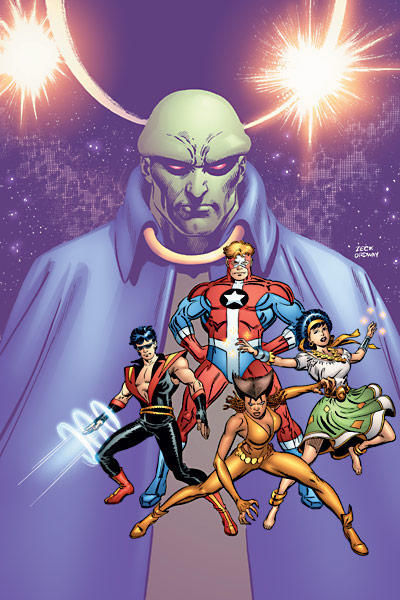
Characters I'd Like to See in Dwayne McDuffie's New Justice League

Superman

Batman

Wonder Woman

Green Lantern (John Stewart, of course)

The Flash (Wally West, I guess...)

The Martian Manhunter (old look, please)

Hawkgirl (I'm a JLU fan, so sue me)

plus...

Aquaman (the new one, actually, He's a fun character)

Firestorm

The All-New Atom

Static (52 Universes. You telling me he's not in one of them?)

Black Canary

Fire and Ice

Green Lantern (Guy Gardner. Seriously, he adds personality to the team)

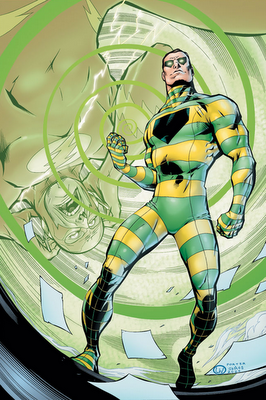
Plastic Man (see above)

Zatanna

Mr. Miracle (Shilo Norman)

Shining Knight (Ystin)

(oh screw it,)

Manhattan Guardian, Klarion, Bulleteer, and FRANKENSTEIN! too

The ghosts of Ralph and Sue Dibny

The Blue Beetle (though he should turn them down, considering they left him in space for a year!)

Zauriel

Red Tornado (shut up. I like him)

Oracle

Prince (Yes, Prince. Seriously, he's like Batman, but short and purple)

Monday, May 21, 2007

When is a Superhero Not a Superhero?

Justice League of America #12: Brad's Meltzer's fantastic run on the JLA concludes with a shocking cliffhanger! “Monitor Duty" is an amazing day in the lives of the world's greatest heroes, as only the League’s artist Ed Benes could envision!


This solicitation neatly sums up what's wrong with Brad Meltzer's Justice League of America, careless typo included.

First, "concludes... with a cliffhanger"? Does someone need to teach Brad (or whoever's writing DC solicitations) what "concludes" means?

Second, and more to the point, the big concluding issue is a Day in the Life story?

It's not that I have a problem with Day in the Life issues, they can be great. The first issue of Astro City is a Day in the Life of the Samaritan. Joe Kelly's first issue on JLA was a fun Day in the Life story. It's a good way to show what superheroes are like when they're not on a life and death mission, when they're just hanging out or dealing with more mundane problems. Day in the Life issues can display hidden depths to characters and humanize superhumans. They are great sources of exposition and as such belong at the beginning of the run!

But Meltzer's entire run has been day in the life stories. What superheroes are like when they aren't acting like superheroes. And it just doesn't work.

It doesn't work because most of the characters in the Justice League already have their own book (or two) to get character work done (and the ones that don't don't belong in the League).

It doesn't work because dwelling on the character stuff needlessly decompresses the story, spreading a two issue plot over six issues, losing narrative drive and reader interest at the same time.

And it doesn't work because the low stakes interpersonal drama ("uh oh, Power Girl wants to kiss Hawkman") looks pretty petty in comparison to the high-stakes superhero drama ("A giant moth is eating Earths' history!").*

I should say I actually enjoy Meltzer's take on superheroes, that the battles are vicious but extremely fast, leaving a lot of time to stand around, talking about books or playing capture the flag, in the right books. I liked his run on Green Arrow, about a man putting his life back together, and even appreciated how Identity Crisis focused on the emotional cost of a single murder; in stark contrast to way casualties in the thousands are usually forgotten by the end of most crossovers. So I might check out whatever he does next.

But Justice League is just not the book for him. It's the crossover action book of the DC Universe about heroes coming together to save lives, and if they are NOT actively engaged in saving lives most of the time, then I don't want to read about it.

I am eager to hear who the new writer for the Justice League will be, what his or (please please please please please) her plans for the team are, and how quickly they'll drop Geo-Force, Vixen, and Red Arrow from the team.


*I have a similar complaint with "24", where people keep wanting to interrupt Jack's search for today's nuclear weapon to talk about their feelings.

Thursday, May 03, 2007

Tales of Earth-1

This post contains spoilers about 52 52, in case anyone cares anymore.

Anyway, the multiverse is back, as we all knew it would be since at least last November. A lot of folks are happy about the return of Earth 4, the Charlton Heroes, and Earth 5/S, the Captain Marvel-verse, Devon's excited about the Wildstorm books officially being incorporated as Earth-50, and Kalinara is excited about her proposed, gender-reversed Earth-25.

But the world I'm eager to see is Earth-1.

Rip Hunter explicitly states that there is "New Earth", the composite Earth most of the DC line are set in, and then there is "Earths 1-51". New Earth is the world we know; Earth-1 is something... else.

Presumably, it's the Silver-Age DC Earth. The world where the first superheroes were Batman and the Martian Manhunter. Where Hal Jordan was the first human called Green Lantern, and Jay Garrick is nothing but a beloved comic book character. It's a world where the Crisis on Infinite Earths never happened; where perhaps even Crisis on Two Earths never happened.

It would be a more stream-lined setting; almost entirely science fiction influenced, with most of its heroes receiving power from either lab accidents or alien sources. It would jettison a lot of confusing character history, so that Hawkman would finally MAKE SENSE! (also: Wonder Girl).

It wouldn't necessarily be a better place to set most of the stories. I prefer the crazy, mixed up jumble that is the Post Crisis universe, but Earth-1 would still be a fun place to visit, I think, for two main reasons:

1) Earth-1 would be far less shackled to the real world than even the normal DCU. This means you could explore how the world would be changed if an Atlantean, an Amazon, a Martian, a Space Cop, and a man who re-writes the laws of physics with every step have been policing the world since 1960.

and 2) It means that crazy, god-like bastard the Earth-1 Superman is still out there, playing tricks on his best friends to teach them lessons and winking at an audience that only he sees. I wonder what HE's been up to the last twenty years.

Wednesday, April 18, 2007

I'm a Sucker

No, I didn't pick up the World War III "mini-series" (but if anyone who read them tells me they're any good, I still might).

No, I'm an idiot for buying Justice League of America #8. I had dropped the series with issue 6, when I figured that a Brad Meltzer Justice League just wasn't for me, but then they go and have a crossover with Justice Society of America, which I am enjoying, so I thought, what could be the harm?

Oy.

This comic pissed me off in so many ways that it's hard to know where to start. As always, the most frustrating thing about Meltzer's writing is that it is has so many good ideas running through it that my hopes get raised, only to be dashed against the rocks of piss poor writing. For example, this issue has a fist fight between BATMAN and KARATE KID! (EDIT: better link here.) Unfortunately, it happens ALMOST ENTIRELY OFF-PANEL so that Meltzer can devote nearly seven full pages to Arsenal being unable to play capture the flag without breaking his neck!

(Update: the fight is actually seen in Countdown #50, which published one month later)

Other things that pissed me off include (but are not limited to):

The cover.

Michael Holt, Mr. Terrific, is, in fact, smart enough to beat BOTH Black Canary and Green Lantern at chess blindfolded without resorting to a trick I learned when I was seven. That's the kind of stunt Robin should be pulling. When the World's Third Smartest Man does it, he just looks like a chump.

That two page spread of the two teams "just hanging" by Shane Davis is just awful. First off, if this is such an emergency that they called in the full roster of both teams in under twenty minutes, maybe they shouldn't be standing around swapping stories and drinking, god help me, espresso out of dainty cups. Then there's the blocking. Though the dialogue suggests they're just milling, they are all facing front and turning awkwardly to talk to each other. If this had just been broken up into four panels on each page, it could have looked so much better.

And then there's the mis-characterization on that page. I know Meltzer has a reputation for "knowing" these characters, but he doesn't seem to here. Why is Stargirl gushing over Wonder Women? They've met before. Heck, they've eaten Thanksgiving dinner together. Twice! Why's Black Canary shutting down her old boyfriend Dr. Mid-Nite? He's giving her a compliment, not hitting on her. Why does Power Girl know Batman's real name? And for the love of God, why is Hawkgirl self-conscious about being at a JSA/JLA team-up? This ain't her first rodeo!

But all of that pales, PALES, in comparison to that last page. (Once again, I lament the lack of a scanner and ask for the aid of someone else in the blogging community. Thanks, uh, Wizard!)


Honestly, it's like a When Fangirls Attack nightmare. Ostensibly, it's supposed to show off the two new chairpersons of the JLA and the JSA, with the kicky awesomeness that both are former Birds of Prey! Yeah, you've come a long way, babies!

But let's face it, that's not the way it plays, is it? First, there's the sub-Greg Land photo referenced faces, which don't match the bodies they're attached to. They're not porn faces, exactly, but Power Girl's come-hither glance and lush, slightly parted lips don't scream leadership either. Black Canary's okay... but she's literally pushed into the background by Power Girl's swinging hips and bulging chest. Are these the leaders of the greatest heroes on Earth, or a couple of party girls?

And then there's the head shots. I know the roll call's traditional, but the five squares with question marks in them makes it look less like a comics page and more like a JLA/JSA fighting game with unlockable Legion of Superhero characters...

... nevermind, I would totally buy that game...

No, what pissed me off was the JSA roll call. Obsidian isn't on it! It's bad enough he was reduced to "wallpaper duty" in the first four issues of Justice Society, now he isn't even on the team? That sucks! Where the hell is he? Where's Todd Rice?

... oh, he's over here in Manhunter. Oh good. Now there's a title that's worth the price!

Tuesday, April 17, 2007

JLA/Batman Syndrome

Hyper-Competency in Team Setting Disorder, or "JLA/Batman Syndrome", is a disease of writing in which an under-powered character, in order to be useful in a team setting with much more powerful allies, is written as much more capable than he is in his own titles. Symptoms include: heightened intelligence, strength and speed, the inability to make or appreciate jokes; a lack of fear; obsessive devotion to "The Mission"; prone to bouts of anger and frustration with his teammates for having neither the training nor commitment he has.

Named for Grant Morrison's handling of Batman in JLA (where a character that occasionally has trouble fighting more than four street punks at the same time could run headlong into four Superman-level Martians and beat them handily, off-panel), this malady has the paradoxical result of taking the most physically human characters and rendering them the most emotionally inhuman.

While Batman is the most famous sufferer of this disease, his sidekick Robin suffers from it that much worse. Batman is always somewhat distant, calculating, and scary, but Robin is much more cheerful and emotional, prone to crack jokes after a fight or freak out a bit when encountering the fantastic.

In fact, in his own title, Robin freaks out A LOT! Seeing a demon baring down on him, Robin gets scared. Losing a lead, he might doubt himself. Captured by the Joker, Robin might begin to panic. Not that his fear cripples him, he still saves the day, but it gives him a relatable moment. In his own title, Robin is allowed to be Tim Drake, teenager, high schooler, awkward dater, recent orphan, and all-around human being.

But put Robin on a team with a kid who runs at the speed of light or an Amazonian powerhouse, and JLA/Batman Syndrome kicks in. To prove that he has a right to stand with these young gods, these teen titans, Robin has to be written as more than human, a Nietzschean Übermensch, who does not let human concerns get in the way of his goal.

It would be neat if this was intentional on Robin's part, if Tim Drake was purposefully putting on an act to hide his insecurities and fears, but I've seen little evidence of that. Only once in Young Justice did I recognize the Tim Drake I knew from his own series. Forced to play baseball to stop a fleet of aliens from invading a planet based on 1930s Brooklyn, Robin just breaks down in the locker room, questioning not only his place in this cosmic and bizarre setting, but also his very sanity. But he realizes he has to suck it up and go back out there, because his team depends on him. That was something I could latch onto, something I could feel for.

But too often it is not an act at all, but the terrible writing disease tearing Robin in two. But there is a cure! Writers on team books just have to remember he doesn't have to be written as Batman-Lite. He can, in fact, be written as Robin, the Boy Wonder, the kid detective, the laughing daredevil, the little ninja, the human protagonist in a crazy world. These are all different, interesting, and, dare I say, FUN ways to approach the character, and they are all already present in his own monthly title. So please, let him be human again, and working together, we can make a better world.

Operators are standing by.

Sunday, April 15, 2007

Who Ya' Got?


OR


Monday, April 02, 2007

Who the Hades is Wonder Woman?


I just don't get Wonder Woman. I don't understand her character. I don't get her appeal.

I get Superman. I get Batman. I get Catwoman, Batgirl, Black Canary, Captain Marvel, Mary Marvel, Supergirl, Power Girl, Big Barda, Manhunter. I understand these characters. I understand what attracts me to these characters (or other fans to these characters). I feel that I have a good idea of what they would and would not do, say and would not say.

But Wonder Woman? Clueless.

Which is to say, I have no idea how to write her, what her reactions to the world are. How would she react to criminal, a dictator, a monster, a killer, in a way that is noticeably different from Superman, or Batman, or any other member of the Justice League?

Even the usually awesome Justice League cartoon couldn't quite get a handle on her, as her character slides from naive teenager in season one (worrying what she is going to say to her mother after running away from home) to angry warrior woman in the first season of Justice League Unlimited to Ambassador and inspirational Leader in the last season.

Who is this woman?

I understand her appeal as an icon, a symbol of women's power. I understand the appeal of a wonder woman, a being who steps out of myths in the "real" world, bringing a era of gods and monsters with her.

But who IS Diana, clay golem, Amazon princess, ambassador for peace, warrior for Justice? What does she like? What does she fear? What amuses her? What angers her? Gods, I don't even know her favorite cookie!

I've heard this complaint before, and people have said the problem is that Wonder Woman doesn't have a civilian identity, a place she can go to be human (arguably, this is what the new Wonder Woman series is about, but it's hard to tell). But I call shenanigans on that! There are plenty of superheroes with negligible civilian identities, but that doesn't mean they lack character!

Take the late Superboy. From 1993 to 1998, he had no name other than Superboy! A clone of Superman, a superhero literally since conception, no part of his background has anything civilian or human to it... but that didn't mean his character couldn't be defined, or his strengths and weaknesses, triumphs and tragedies couldn't be relatable.

Similarly, J'onn J'onzz, the Martian Manhunter, is a shape shifting telepath, FROM MARS, who witnessed the death of his entire planet. We shouldn't come close to understanding him, but we do. We understand his loss, his alienation, his anger, his wry humor, his love for Chocos.

So what the hell is wrong with Wonder Woman? Why can't I know her, why can't I get her? Is there just too much there? Too many writers over too many years imposing their unique visions of a strong woman onto one character, until the original is lost? What is her core, her essence? What the heck is going on?

Wednesday, October 11, 2006

J.L.U.N.

Ahh, that's better. Now I feel like I have some room to breath. Certainly my posts with big images, like my recent post on the myth of aristocracy look a lot better now. And I followed through on my promise of adding a greatest hits section (based on hits and links).

Went to the store today. A slow week for me. The most enjoyable comic was 52, which enjoyably progresses a plotline or three. Nothing surprising, (except maybe the religion bit), but well executed, particularly the tan line. I mean, the line about the tan.

Whatever.

But the most interesting comic, the one that stuck, was JLA Classified #28. Howard Chaykin started from the same basic premise as Gail Simone's run (Justice League intervenes in international politics) and goes in a very different direction. There's a lot of smart writing going on there. The two fictional South American nations featured supposedly have radically different ideologies, one communist, one capitalist, but the rhetoric does little to disguise the fact that they are nearly identical dictatorships. (Though I should note the capitalist dictator welcomes "plutocrat" Bruce Wayne with open arms, while the communist opens up to, of course, that old leftist Clark Kent.) And even though it's clear they're both bad guys, it's not black & white whether the Justice League is doing more good than harm by intervening, which is nice. There's even a crack about the American comics industry that's both nicely done and awfully mean.

The art's good, not great. Tom Nguyen really does make every penciller's work look like Doug Mahnke, but weak Doug Mahnke. And it's a three or four issue story at most, unfortunately told over six issues. But it's a good solid Justice League story where Wonder Woman and Batman actually hit people instead of bitching at each other from across a table, so I'd recommend picking it up.

In other news, Earth Prime has in fact bled into the DC Universe, as Infinite Crisis the book shows up in Gotham book stores. And as before, what is fiction here becomes non-fiction there.

But if Superman, Batman, and Wonder Woman are missing, how did the writer learn what happened on the moon?

Damn it, Frey! Not again!

Monday, October 02, 2006

Tomorrow's Comics: TODAY!

In which I put on the turban and do my impression of Carnak.

But first, let's check in with my last prediction, that the mastermind behind the theft of the Red Tornado's android body is The Top. Well, we got another clue this week when the shadowy figure says he was stupid, but isn't any longer. That REALLY limits the possibilities, down to basically Dr. Light (who was mind-wiped and regained his memory in Meltzer's own Identity Crisis) and, well, the Top (who was brainwashed and regained his memory in Geoff Johns's run on The Flash). So my bet's looking pretty good.

As for the new prediction: Little Barda is Knockout's daughter.

Okay, there's been very little information given about the Big Barda-wannabe. Early speculation was that she was Avia Free, Scott and Barda Free's daughter in the Elseworlds Kingdom Come. This despite ANY evidence that Scott and Barda had a daughter (a teen daughter at that) and just failed to mention it. What we do know about Lil' Miss Thang is that she aspires to be Big Barda some day and has costume modeled on hers. A chance line from Power Boy indicates they are both actually from Apokolips, and not just humans with high aspirations.

Meanwhile, over in Secret Six, Knockout casually reveals that she had a daughter, but hasn't seen her since the girl was three (i.e. just old enough to have memories of her mother). And anyone who read Karl Kesel's run on Superboy knows that Knockout is herself a refuge from Apokolips who fled the Female Furies after being inspired by Big Barda's own escape.

Like mother, like daughter, eh?

Thursday, September 21, 2006

One, Two Punch

Y'know how I said I was working on a post about Detective 823 that I had to be careful writing? This isn't it.

It is about Detective 823, though. (Can you tell I'm procrastinating on the big post?)

So, my major complaint about the issue was the abbreviated ending. The plot's going along fine up till page 20 or so: just as Batman and Robin discover that the plant monster attacking Poison Ivy is made up of the resurrected bodies of her victims (basically putting her on the wrong side of the Swamp Thing origin story), the creature attacks, in the heart of the Batcave, and promises to kill her and anyone who gets in its way. That's a pretty good set-up.

It's a shame that Dini only has two pages left, because the entire resolution is Batman immediately releases some Bat Plant-Repellent and the creature runs away. The end.

The problem, I think, is that Dini decided to lock himself into a single issue format for his run on Detective, where each issue's main plot was wrapped up in that issue. Now, I like a good done-in-one story, but in this case I think the story would have been much better served as a two parter.

Issue one would be basically the same issue, but ending where the creature screams out its name (possibly in logo font)! Issue two would be Batman and Robin, having been put in the uncomfortable position of saving a murderer from the bloody vengeance of her own victims, teaming up with the almost assuredly treacherous but admittedly brilliant Ivy to figure out a way to stop the monster without killing it.

But then I tend to think that two-parters have the perfect pace for modern comics. One issue to explain the plot and get everyone into their positions, ending in a great cliffhanger with a one month intermission for the readers to figure out how our heroes are ever going to get out of this one, and then the second issue to provide the surprising yet ultimately obvious solution, that hopefully involves a lot of kicks to the head. One issue to set 'em up, one issue to knock 'em down.

I do know that some of my favorite stories are the two-parters. The first Zauriel story, for example, does a nice job in the first issue of explaining the four or five problems the JLA faces, including a falling Moon and Rogue Angel General on a tear in San Francisco, and the second issue resolves each conflict, one by one, until peace is restored.

Geoff Johns had a great run on JSA where every other issue ended with certain death ("Oh no, Hawkman and Sand have been poisoned and there's only enough antidote for one!") only to be followed by an issue where the team overcomes the impossible odds in some clever fashion ("Oh, Sand has turned to sand and is thus temporarily immune from poison.")

But mostly, I think the two parter takes better advantage of the serial nature of comics than the done-in-one does, without stretching out a story too much the way a five or six part arc can. The story moves, but it also has the space to get somewhere.

I think.

Tuesday, September 12, 2006

I Think More Superheroes Should Die

(huh, I can already hear Dr. Polaris agreeing. Anyway...)
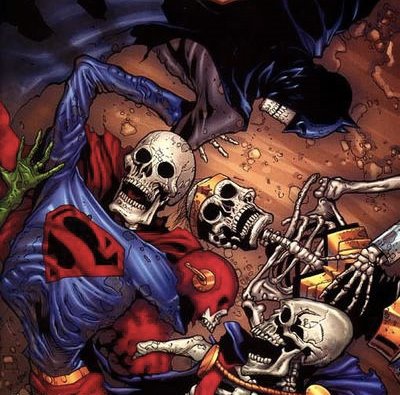


Superheroing is an inherently dangerous activity. Let's face it, the guys in the capes aren't just the police. A superhero is cop, fire fighter, and soldier in one, and what these professions have in common is that each is a person who saves lives by risking and sometimes losing his own. Add to that mortal enemies with world shaking power, and you're looking at people whose day to day living is very precarious.

But if you want me to believe that, at any moment, a superhero could die, then every now and then, one of them has to actually die. The stronger possibility of an unhappy ending is one of the major advantages of on-going, episodic fiction that comics should exploit better. Because when the bad guy puts the hero in his unescapable death trap and looks like he's going to get away, there's a chance he really IS going to get away, if only for someone else to capture him three or four issues later. That's the way to ramp up the DRAMA.*

Now, I don't mean to be morbid about it. I'm not in the "kill 'em, kill 'em all" camp. The deaths should be rare, if only so superheroes don't look like complete incompetants. And while they don't all need to be heroic sacrifices, like Barry Allen--they could be fatal mistakes, like Booster's recent demise, or victims of effective villains, like Vibe's or Blue Beetle's, or even the truly tragic cannon fodder, like Pantha--the deaths need to have an impact, on the plot and on the surviving characters. And because I like deaths to have impact, I'd prefer the dead remain dead, but I understand that any fantasy genre in which The Spectre is one of the oldest characters will have a looser definition of what death means.

And the deaths certainly shouldn't be advertised in advance. One, it's kind of creepy. Two, it robs tension from issues in which a death isn't advertised. I know everyone is going to make it out of an issue if it's not solicited "Someone makes the ultimate sacrifice." Three, it robs tension from issues in which a death IS advertised. Even if it's obvious Captain Lamb is going down with the ship, the death has a lot more impact if you thought there was a chance he could have made it.

And some characters, of course, can't be killed. The editorially protected icons, of course, are practically immortal. No reader would really want Batman (or even the Joker) dead, and more importantly, no one would ever believe he was really dead anyway, no matter how graphic the death. I would have said protagonists of on-going books were safe as well, but blowing up Oliver Queen to make way for Conner Hawke was one of the best moves Chuck Dixon made on his run of Green Arrow.

I though Peter Milligan and Mike Allred's X-Statics nee X-Force handled death brilliantly. Killing off 90% of the team (including the narrator) in the first issue served notice that neither the characters nor the readers could take the success of any mission for granted, and then played out the emotional effect of such a highly dangerous life would have, and then what the effect would be if some people, but only certain people, came back.

Now, I can already hear some objections, notably "comics are supposed to be escapist fantasy and I don't want to be reminded about things I find upsetting, like death." To which I say, "Stop reading superhero comics."

Seriously.

Batman watched a mugger shoot his parents. That's the basics. If you want to remove violent death from superheroes, you have to give up Batman. And Spider-Man. And Superman. And Captain America. Heck, get rid of World War II and all those nasty Nazis.

Superheroes is NOT an escapist genre, not if by "escapist" you mean "a genre in which you don't have to deal with anything in the real world you don't like." Superheroes is kind of the opposite of that, a genre in which VERY REAL PROBLEMS are exaggerated and distorted to be scarier, which somehow allows the reader to deal with these problems through metaphor and analogy. A superhero universe is a worse place to live, where everything we have to deal with exists, but with superpowers. (Cue President Lex joke)

The danger, the very real danger to their lives, the fact that just by signing up for the Justice League a hero puts a target on his back, the fact that they might die alone, or suddenly, and possibly in a painful, undignified way, and they DO IT ANYWAY...

well, to me, that's what makes them a hero.


*One of the reasons I didn't like Grant Morrison and Frank Quitely's Earth 2 was the idea that on "our" Earth, good can't lose. Well, that sucks all the tension out of the story.

Wednesday, August 30, 2006

My Action Reaction!

My "Why I Hate the Mutant Gene" post will have to wait until tomorrow, because tonight I just want to tell you about the greatest issue of Justice League I've read since 2001. No, not JLA Classified (though it was fun seeing what I guess is now the "Watchtower" League back in action.)

Nope, it was in Action Comics #842, which I'm declaring my new HANDS DOWN pick as best comic of the week! (Take that, All Star Superman!)

I mean, first look at that LINE-UP: Superman (of course), Nightwing (who comes across as brave, smart, experienced, funny, and the tightness of his ass is a plot point), Aquaman (the new one), Mr. Terrific (who's more than earned his place on the team), Firestorm (again, the new one, who learns that when his powers go down, his hair goes out), as well as the roguish woman of mystery Live Wire, newly introduced veteran solider The Veteran, Busiek's ego pick Skyrocket, and a character so obscure I have no idea who he is but his adventures sound damn exciting, Blue Jay.* That's a great mix of personalities, powers, icons and old favorites and new faces, enough variety to remind the reader that the DCU is big big place.

Secondly, there's the plot: ALIENS ARE STEALING OUR STUFF! Simple, direct, worldwide, panic inducing, black and white morality. Superhero gold.

Third, there's the pace, which is FAST! If your biggest complaint about Justice League of America #1 was that no one hit anyone, have I got the book for you. Superman fights a giant, almost every superhero in the world is captured, Nightwing and Firestorm fly to the rescue, and Live Wire makes an explosive escape from their plastic wrap like prison. And that's THE FIRST HALF!

Fourth, there's the dialogue. Nightwing's years of crawling through ducts and dating an alien come into play, the new Aquaman goes all fanboy, Blue Jay wants some respect, dammit. And in any other issue, Superman's final words before he leaps off the balcony, about his faith in his new, untested team, would have been the line of the week...

if there wasn't that line about how many Kryptonians there are on Earth.

GO. BUY. NOW.

It's great!


*Seriously, can someone help me out? Who IS Blue Jay?

Monday, August 28, 2006

Random Thoughts re:Justice League

Of the new line up, one is married, five are fathers. One mother.

Where did Clark get a Legion flight ring from? Oh, I know he probably got it from Conner (Kon-El) Kent, who was an honorary member of the Zero Hour Legion of Superheroes, or, failing that, from Supergirl, who's a "current" member. Heck, he might have even pulled it off Booster Gold's crispy fried finger. But I like to think the Legion of Superheroes gave him that ring when he himself was a member of the Legion as a teen. Infinite Crisis almost came out and stated that the adventures of Superman when he was boy are back in continuity, and this could be our first sign.

But the big mystery is who is the shadowy figure behind Felix Faust and Dr. Impossible who is going to such great lengths to keep the Red Tornado out of his robot body? If he was just looking for future tech, Dr. Impossible should have grabbed the Metal Men he disabled as well, so I'm thinking it's someone who actually wants to inhabit the Red Tornado's robot body. And since Brad Meltzer has said that Dr. Impossible is the only new villain, it's probably someone we know.

So who is it? Well, let's narrow it down to the dead, or recently dead. Someone maybe with experience body hopping. Someone smart. Heck, it's Meltzer writing, and it'd be stupid at this point NOT to tie it to Identity Crisis, so maybe someone who had been mind-wiped by Zatanna as well. Someone who specifically wants the Tornado body because it's fast, strong, self-repairing...

spins...


Friday, August 25, 2006

My Justice League

Or, Why the Justice League Isn't the Fantastic Four.

With the release of Justice League of America #1, or more accurately, with the release of the variant cover to Justice League #1, there's been a lot of talk about Brad Meltzer's chosen line-up, who belongs in the League, and who doesn't. But I think that's missing the point. Because you know who I think should be in the League?


EVERYONE


See, to me, the Justice League is what makes the DC Universe a universe, one world where all these separate stories take place (and you know how much I love having one universe). The fun of a Justice League story is that anyone could show up and fight or team up or just eat Thanksgiving dinner. In that way, the Justice League is a crossover event as ongoing series. In fact, its predecessor the Justice Society was the first inter-company crossover!

And unlike the Fantastic Four or the X-Men, there is no set line up or other common factor uniting the members. ANYONE could reasonably be in the League, from Dr. Fate to Robin, Superman to Odd Man, as long as they were committed to saving people. I mean, we all know who founded the League, but the League has grown and changed and completely turned over its membership in past 46 years. So why limit the team to just "big guns" or, in the opposite direction, just people who don't have their own book? Why limit the League at all?

Not only does a larger team give a writer the full gamut of characters to play with, it makes good internal logic as well. A bigger Justice League is better equipped and better organized to handle the big threats that come up. Really, why have only one Green Lantern or one Flash on the team, when you can three or four? Does it HURT to have Captain Marvel, Superman, and Wonder Woman on the same team? If Aquaman can help at all, who cares if his powers are lame?

For that matter, who needs powers at all? One of the most brilliant additions that Justice League Unlimited introduced to the League, the element that MOST needs to be added to the comics, is the large support staff of "civilians." Why should the League be exclusive to meta-humans and boy billionaires? If Oracle as character has any message, it's that one can save the world without necessarily being able to punch Despero in the face. The Justice League could be a giant volunteer organization devoted to saving lives all over the world, like the Red Cross with superior fire power. (How'd you like that on your resumé? "2004-2006, Saved world. Often.")

In contrast, any Justice League that has less than twelve members seems needlessly exclusionary and self-defeatingly handicapped. Not only is the League not as capable of doing good as it could be with more members, story opportunities get cut off as well. Isn't the fun of a superhero universe watching Metamorpho and Wildcat banter with each other? Or seeing Captain Atom fall before the might of Neron, only to have Zatanna pull a magic save out of her, um, hat? Or read about Superman giving his annual St Crispin's Day speech before an assembled crowd of gods, robots, knights and madmen, before they go off to fight yet another all consuming evil?


Isn't that what having a superhero universe is all about?

Thursday, August 24, 2006

Justice League of America #1

I really enjoyed Justice League of America #1. Screw you guys, I don't care what you say, I like me Emo Red Tornado.

'Course, I also liked Identity Crisis.

I liked it for the same reasons I liked this issue;

great art (unless you're looking to be offended, this is some of Benes's best work yet) ,

good dialogue,

a nice grasp of characters and their relationships,

a good mounting sense of dread,

and more good ideas in throwaway lines than some writers have in an entire run (A.I. grapevine and "Hush Tube").

That said, if it turns out Traya is behind the whole thing,

I WILL GRAB A GODDAMN BLACK DIAMOND AND SWEAR BLOODY VENGEANCE ON THEM ALL!

Wednesday, August 23, 2006

Big Pile of Awesome

Damn you people! I'm buying more and more comics because you keep recommending them, including Action Philosophers and Batman and the Mad Monk.

'Course, I couldn't read The Mad Monk without first reading Batman and the Monster Men, which just so happened to come out in a trade today, so I bought that too.

All in all, I bought 10 books this week, including the trade, and half of them I would never have picked up had I not started to seriously read comics blog.

I hope you're happy...

'cause I certainly am!

I have rarely had as high an enjoyment to total ratio as I did today.

The comic I enjoyed the least was Blue Beetle which still isn't living up to its very high potential, and even that was a lot of fun. (Though John Rogers, if you're somehow reading this, pick up the goddamn pace and chain Cully Hamner to a desk).

There's too many to review them all now, so I'll just hit one moment each that stood out.

Blue Beetle: The Phantom Stranger. Just seeing that guy's great.

Astonishing X-Men: Shadowcat-Fu.

Fell: Good old fashioned detective work

Wonder Woman: Twirling. Mother fucking twirling.

Justice League of America: The A.I. grapevine.

Action Philosophers: The Wandering Jew, which may be my next Halloween costume.

Batman and the Monster Men: The shadowy man training on the rings.

Batman and the Mad Monk: Good old fashioned Catwoman.

Batman: Andy Kubert cheeky use of Pop Art and a guest appearance by Sgt. Rock.

52: Montoya's prayer.

Yes, that is in ascending order of enjoyment. 52 was HANDS DOWN the best comic this week, with Joe Bennett bringing his A game to the art to support the head-on collision of two of the major plots, a genuinely tense sequence playing on both mystical fantasy and all-too-real violence, Talky Tawny and Uncle Dudley!!!, Black Adam getting nervous, The Question's role as a step ladder, the pay-off for the rat poison, and what a Marvel wedding looks like, the issue was great.

But what made it truly excellent was Renee Montoya's prayer. A lot has been said about her being a lesbian. Some people remember she's Hispanic (Dominican, to be exact). She's also a former cop and current alcoholic and, when it comes down to it, one of the baddest asses in Gotham.

But she's also Catholic, and her religion is very important to her. It's one of the reasons why she stayed in the closet. It is both a source of strength and of crippling guilt. And the juxtaposition of the Marvel Family wedding, where multiple gods are called upon to throw lightning around super beings flying through the air, and Montoya's quiet prayer to the mother of Jesus in the moment of her greatest need for personal strength, was genuinely moving.

So, what'd you think?

Wednesday, August 09, 2006

It Had to Be Said #3

Crisis on Infinte Earths did not fail in its goal of creating a simpler universe that new readers could understand.

Crisis on Infinite Earths succeeded in its goal of creating a more complicated universe that took better advantage of all the toys that DC had to play with.

Consider, if the purpose of the book was to simplify the universe, they should have just wiped out everything and started over from the beginning. Said THIS is the first appearance of Batman, everything that came before doesn't matter. (With Superman, they kind of did do that, but with the Man of Steel miniseries, not COIE, and it didn't take).

Instead, Marv Wolfman basically said, "You know the past 50 years of comics, spread out over three companies and innumerable separate titles? Yeah, almost all of those stories happened, but all in the same place and over a period of about 10 years." Does that sound like he was even trying to make things simpler?

No, what he was trying to do was create a world where THIS was possible:


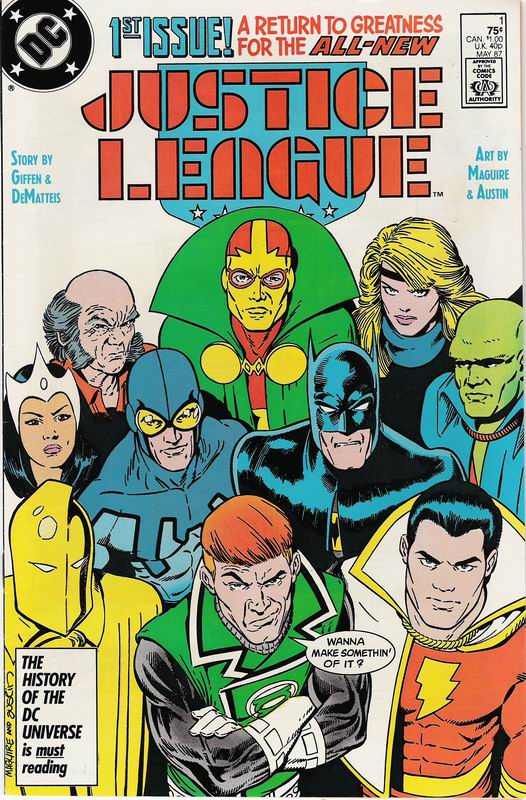
Now, you can either start each issue explaining why Dr. Fate and Captain Marvel are on Earth 1 and just which Batman that is, exactly, or you can just accept that they are all from the same Earth and just go from there. Which would you prefer?

Then there's the fact that ongoing books sell better when they are tied to other, more successful ongoing books. It's one thing to read about Uncle Sam and the Freedom Fighters. But interest is peaked and sales are higher if you know that, at any moment, Wonder Woman might stop by. That's the main reason the Charlton characters were brought into the DC Universe, rather than be relaunched with Watchmen. (On the other hand, somewhere in Hypertime there's a 20 year old ongoing series set in the Watchmen universe, still written by Alan Moore and drawn by Dave Gibbons).

Besides, there's a lot of arrogance that goes into the thought that the DC U needed to be simplified, or still needs to be simplified, for new readers. Remember, we were all new readers, once, and unless you've been collecting since Action Comics #1, there was some piece of backstory you didn't know when you first sat down. Somehow it didn't stop you from having fun, why should it stop someone else? Anyone could understand parallel earths, anyone could understand unified earth, I'm pretty sure everyone will be able to grasp Earth-New.

No, if there's a problem with getting new readers to enjoy current comics, it lies not with the rich, confusing history created by Crisis on Infinte Earths, but with current comic not using that history properly. Comics too worried about correcting, contradicting, clarifying, or simply copying the comics of the past, and not worried enough about creating new stories, new histories, for the comics of the future.

There, it had to be said.

Tuesday, June 13, 2006

Tuesday Night Recommendation #4

JLA CLASSIFIED #22


Vibe, man.

Vibe!

and if you AREN'T Scipio...

JLA CLASSIFIED was the title that was my Justice League fix after JLA proper turned nigh-unreadable.

It is exactly what I think all comics should be. Self-contained stories that are only as much a part of continuity as they need to be: from the deeply grounded in history Gail Simone run to the possibly in continuity, possibly not Warren Ellis run, from the Seven Soldiers launching Grant Morrison run, to the tragic irony of the way WAY out of continuity Keith Giffen and J.M. DeMatties run, this title has been a wonderful playground where the writers can play with the toys they want, without having to worry about sharing them (or BREAKING them).

And it really has been ALL STAR, as these top writers have been matched with some of the finest (if sometimes under appreciated) artists in DC's stable. While Ed McGuinness's name might move some issues, Butch Guice, Jose Luis Garcia-Lopez, and Kevin Maguire are MASTERS of their craft and turned out consistently top-notch work.

And this, I am sure, will be no exception. Comic book veteran Steve Engelhart is teamed with the criminally under-appreciated Tom Derenick to tell the story of JLA: Detroit, the ill-fated attempt at turning the Justice League into the Avengers. It didn't work, mostly because the writing wasn't there to support them before.

I have a feeling that will change.

So pick up JLA: CLASSIFIED to support different format for storytelling, to support two pros in the field are just not given enough props, to support a team of under-developed characters just waiting for the right writer to bring them to life.

But mostly, do it for Vibe.

meng.