Showing posts with label Chuck Dixon. Show all posts

Friday, January 05, 2007

Opposite Man

After reading this interview with Chuck Dixon (which is very good considering it could have been nothing more than a puff piece but instead gets into some real issues) I am a lot more impressed with the man as a writer than I was before. Not for his stance against writing sexual superheroes (a prudish and limiting attitude towards superhero stories that he himself has broken in order to write about teenage pregnancy), but for his ability to NOT inject his own politics into the story he needs to write.

Specifically, he states that he's pro-death penalty, which surprised me, because Joker: The Devil's Advocate is one of the best arguments against the death penalty I have ever read.

Now, I've made no secret of the fact that I'm a Dixon fan but Devil's Advocate is a cut above. Not only does it feature some of Graham Nolan's best art ever, as well as a Joker that is intelligent, vicious, crazy, and actually funny, it presents the ultimate test case for the death penalty: The Joker.

The Joker is guilty; he's irredeemable; he offers nothing to society (which Lex Luthor arguably does or could); and he's a credible future threat. In short, if ANYONE deserves execution, it's the Joker.

And yet... and yet the punchline of the book is that the Joker is actually innocent (of these murders, if not all the other ones) and that executing him would be a mistake! And therefore executing anyone, even the Joker, when you are not 100% certain he did it, would be a mistake as well.

I've used this book as an argument against the death penalty, and to find out its author is actually PRO-death penalty is... surprising, to say the least.

It gives me some hope for the Grifter/Midnighter series, that Dixon can convincingly write a character whose motivations and causes are so different and antithetical to his own. Perhaps more writers should do the same, just to prove that they can.

Maybe they'd learn something.

Tuesday, September 12, 2006

I Think More Superheroes Should Die

(huh, I can already hear Dr. Polaris agreeing. Anyway...)
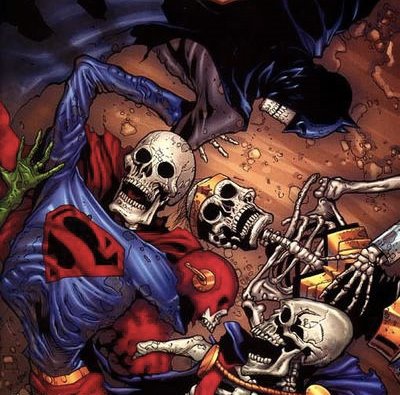


Superheroing is an inherently dangerous activity. Let's face it, the guys in the capes aren't just the police. A superhero is cop, fire fighter, and soldier in one, and what these professions have in common is that each is a person who saves lives by risking and sometimes losing his own. Add to that mortal enemies with world shaking power, and you're looking at people whose day to day living is very precarious.

But if you want me to believe that, at any moment, a superhero could die, then every now and then, one of them has to actually die. The stronger possibility of an unhappy ending is one of the major advantages of on-going, episodic fiction that comics should exploit better. Because when the bad guy puts the hero in his unescapable death trap and looks like he's going to get away, there's a chance he really IS going to get away, if only for someone else to capture him three or four issues later. That's the way to ramp up the DRAMA.*

Now, I don't mean to be morbid about it. I'm not in the "kill 'em, kill 'em all" camp. The deaths should be rare, if only so superheroes don't look like complete incompetants. And while they don't all need to be heroic sacrifices, like Barry Allen--they could be fatal mistakes, like Booster's recent demise, or victims of effective villains, like Vibe's or Blue Beetle's, or even the truly tragic cannon fodder, like Pantha--the deaths need to have an impact, on the plot and on the surviving characters. And because I like deaths to have impact, I'd prefer the dead remain dead, but I understand that any fantasy genre in which The Spectre is one of the oldest characters will have a looser definition of what death means.

And the deaths certainly shouldn't be advertised in advance. One, it's kind of creepy. Two, it robs tension from issues in which a death isn't advertised. I know everyone is going to make it out of an issue if it's not solicited "Someone makes the ultimate sacrifice." Three, it robs tension from issues in which a death IS advertised. Even if it's obvious Captain Lamb is going down with the ship, the death has a lot more impact if you thought there was a chance he could have made it.

And some characters, of course, can't be killed. The editorially protected icons, of course, are practically immortal. No reader would really want Batman (or even the Joker) dead, and more importantly, no one would ever believe he was really dead anyway, no matter how graphic the death. I would have said protagonists of on-going books were safe as well, but blowing up Oliver Queen to make way for Conner Hawke was one of the best moves Chuck Dixon made on his run of Green Arrow.

I though Peter Milligan and Mike Allred's X-Statics nee X-Force handled death brilliantly. Killing off 90% of the team (including the narrator) in the first issue served notice that neither the characters nor the readers could take the success of any mission for granted, and then played out the emotional effect of such a highly dangerous life would have, and then what the effect would be if some people, but only certain people, came back.

Now, I can already hear some objections, notably "comics are supposed to be escapist fantasy and I don't want to be reminded about things I find upsetting, like death." To which I say, "Stop reading superhero comics."

Seriously.

Batman watched a mugger shoot his parents. That's the basics. If you want to remove violent death from superheroes, you have to give up Batman. And Spider-Man. And Superman. And Captain America. Heck, get rid of World War II and all those nasty Nazis.

Superheroes is NOT an escapist genre, not if by "escapist" you mean "a genre in which you don't have to deal with anything in the real world you don't like." Superheroes is kind of the opposite of that, a genre in which VERY REAL PROBLEMS are exaggerated and distorted to be scarier, which somehow allows the reader to deal with these problems through metaphor and analogy. A superhero universe is a worse place to live, where everything we have to deal with exists, but with superpowers. (Cue President Lex joke)

The danger, the very real danger to their lives, the fact that just by signing up for the Justice League a hero puts a target on his back, the fact that they might die alone, or suddenly, and possibly in a painful, undignified way, and they DO IT ANYWAY...

well, to me, that's what makes them a hero.


*One of the reasons I didn't like Grant Morrison and Frank Quitely's Earth 2 was the idea that on "our" Earth, good can't lose. Well, that sucks all the tension out of the story.

Monday, August 14, 2006

Supergirl's New Writer

Supergirl needs a new writer. One who understands how to write teenagers, particularly teenage girls. One with a proven track record of characters who were young and eager to help, maybe confused and over-come with hormones and distrust of adults. One who gets crushes and is more powerful than they realize.

I nominate Chuck Dixon.

In the pro-column:

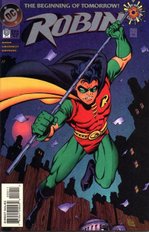
He launched Robin and wrote it for 100 issues.



He launched Nightwing and made him cool.
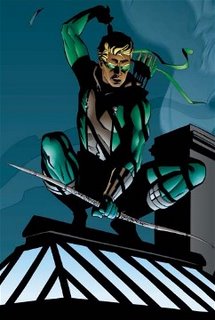


He created Connor Hawke and wrote Ollie's best moment of the '90s, blowing up over Metropolis.


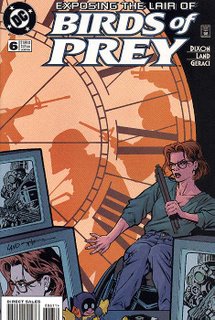
He created the comic and team Birds of Prey.


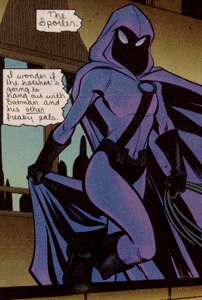
He created Stephanie Brown, a.k.a. The Spoiler.


In the negative column:

Um, Dorian? Do you want to take this one?

He's made some offensive statements about homosexuality not belonging in comics. (Though, I will say that his particular objection was in reaction to a miniseries that was going to reveal the Rawhide Kid was gay. A miniseries that, in retrospect, turned out to be a horrible immature run of wink wink sex jokes that NO ONE liked, so, just maybe, he might have had a point.)

He also has some pretty conservative politics, it seems. So I'm not sure I'd like to have dinner with him.

I don't care. I like the books he writes. He writes fantastic action scenes, and more bad-ass panels per page than should be allowable by law.

More importantly, I like the characters he writes. To take an example chosen completely at random, let's look at, I don't know, Stephanie Brown?

Stephanie could have been a girl completely defined the men in her life. Daughter of supervillain, girlfriend of superhero. Completely reactive to the world around her.

But she wasn't. She had a life of her own. A relationship with her mother that was probably the most important in her life. A desire to be a superhero, that may have started as rebellion against her father and infatuation with Robin, but it grew into an honest need to save people and be a better person. She trained, with Batman and with the Birds. She was smart and funny, but she was also flawed, impulsive and emotional. In short, she was a teenager.

And she was also a mother. Stephanie found out she was pregnant from an ex-boyfriend, refused to have an abortion, and then gave up the baby for adoption. And everyone of those choices were made by HER.

A lot of writers would give a girl an unexpected pregnancy. It's easy drama. And it would take a very brave writer indeed who would have a character have an abortion (name one!). But other writers would have employed the miraculous miscarriage or just saddled her with a baby, where she would suddenly learn to love and cherish it. Dixon went further, and wrote the scene where she gives up her child with enough emotion that the reader understood there was no good option, that any choice she made was painful, deeply painful. (Then, in true superhero fashion, she solves her problems with violence, by beating the ever-loving crap out of her no good dead-beat ex!)

And Dixon wrote all that. Stephanie's greatest moments, her most private pain, her obvious crushes and awkward attempts to become a trusted member of the Bat-team, basically every reason women were PISSED OFF that Stephanie was killed was because Dixon knew how to write her.

And that's what Supergirl needs now. RIGHT NOW. Less "more powerful than Superman," and more trying to be human and fit in and stand out at the same time. Less "where do I come from and am I evil," and more dumb crushes and bone-head plays for attention. Oh, and more butt-kicking, and less butt-grabbing.

In other words, more teenage girl, and more Chuck Dixon.

At least that's my opinion.