Monday, July 31, 2006

Common Courtesy

I was going to post on how the Question has got to be the greatest beneficiary of Hypertime, but Blogger ate the post!

So instead, I'm going give a demonstration on online etiquette. And Philip has helpfully volunteered! (I'd link to his website, or some other way of communicating with him, but he's only posted his first name, so I don't really know who he is).

ANYWAY... You all know the post I did about James Meeley. (Thanks for all your positive feedback about that, I really appreciate it.) Philip thinks I took a cheap shot and that he'd prefer I take the high road. I explain to him, besides his factual errors, it's my blog to take cheap shots if I want. And that, while my mom can expect better of me, I don't really owe anything to people I don't know. Besides, it's not like he paid for anything. And he responds:

Why would you care? No idea. Common courtesy maybe? You do post comments on other blogs. Debating an issue rather than attacking people maintains a sense of decorum. If you can't see the value of this then I really feel sorry for you and I hope you never take this attitude into a situation where it could be used against you.
Where do I start? Caring what a practically anonymous poster prefers is "Common Courtesy"? NO. Not here. Not on my blog. Courtesy is deference to the wishes of others, and here's where I don't have to do that. Here's where I get to say what I want to say and if you don't particularly like it, great! Ignore me. Walk away. I'm just a crazy person talking about alternate dimensions and gay Pied Pipers. I still have no reason to care what you prefer.

I DO post comments on other blogs, that's true. You know what I don't do when I post on some else's blog? Tell them what to do. (Okay, I do tell Blockade Boy what to do, but only when he asks for suggestions and he seems to like my ideas).

Also, I always try to debate the issue and not attack the person, though in this case the issue IS how you come across in your comments (particularly James's comments). For example, Philip, if I said you were an ugly, short, impotent troll with no social life and poor hygiene, THAT would be attacking a person, but I'm not doing that.

If, on the other hand, I said your comments about what you'd prefer, and how you feel sorry for me demonstrates an unwarranted sense of entitlement, THAT would be attacking your argument. And I'd prefer you keep that arrogance to yourself, or at least post about it on your own blog where I could ignore you.

So, to sum up, if you don't like what I've written, go away. If you do like what I've written, but think I've gotten something factually wrong, let me know and I'll correct it. (Grudgingly, perhaps, but I'll do it.) And if disagree with some conclusion I've come to and want to engage me in intelligent debate (about superheroes), fantastic. But you do not get to tell me what you'd prefer I do. You don't tell me what to say, or how to say it, or anything like that.

Not here. Not in my house.

THAT'S Common Courtesy.

Sunday, July 30, 2006

EAT IT, BYRNE!

Don't you hate it when you write a big long post but leave out the point you were trying to make?

Anyway, part of what I liked about Hypertime as a concept was that it acknowledged the pointlessness of trying to retroactively erase a character or concept from existence. No matter how much John Byrne wanted to make Superman the only survivor from Krypton, Krypto, Supergirl, and Kandor just pop up again. Or, if you prefer, Krypto, Supergirl, and Kandor. Or...

But you get the idea. The fact is, unless he went around destroying every back issue and mind-wiping the entire comics community, Byrne could never really erase the idea of Krypto, and as long as the idea existed, there would always be the desire to tell new stories with him, so he finds his way back in.

In other words, once seen, Bat-Mite cannot be unseen.

So don't try erasing the parts of a story you don't like. If it conflicts with what you want to write, just ignore it. No need to say it doesn't exist. It exists just as much as anything else you want to write about (which is to say, not really at all). Relax, have some coffee, and let it go. It will float away into the time stream, and it will come back later.

Saturday, July 29, 2006

Ahead of Its Time

"What is this Hypertime that you speak of?"– Mark Waid at San Diego Comic-Con


Well, Mark, I'm glad you asked.

Hypertime was Mark Waid's [edit: Fine, FINE! and GOD OF ALL COMICS Grant Morrison's] attempt at replacing the parallel universe concept in the DC Comics universe.

Before 1986, most DC Comics were considered to take place in the same, "mainstream" universe and comics published by other comic book companies and even National comics published before the Silver Age were considered to take place in alternate dimensions, crossing over only through extraordinary measures. After 1986, that was changed so that ALL characters created for or acquired by DC Comics existed on the same Earth, which eased character interaction. (This, I consider, was a good thing, because crossovers are fun, create a richer history for the characters, and boost sales of the smaller titles through easier use of "guest stars.")

However, editorial mandate or not, DC Comics continued to publish books that did not take place officially in the DC Universe. Originally called "imaginary stories" and later branded as "Elseworlds," these stories took the familiar characters and either placed them in radically different settings or simply had events that would make an ongoing series difficult (such as, say, death). The most famous Elseworlds is Kingdom Come, by Mark Waid and Alex Ross, though The Dark Knight Returns and Watchmen could be considered Elseworlds as well.

On top of that, there were film, television, print and radio versions of all these superheroes out there, with varying degrees of fidelity to the source material.

The "problem" was that these stories, despite being unofficial, had a habit tying into the main universe. Following the The Dark Knight Returns, the "main universe" Batman began acting more and more like the dystopian, aging, paranoid, sadistic version. Following Kingdom Come, Alex Ross's character re-designs started to appear in the main books, as well as hints that, in fact, Kingdom Come was the future of the DCU. And the Batman Animated Series introduced two important new characters to the Batman mythos (Renee Montoya and Harley Quinn), as well as changing (and improving) the design and origins for most of the characters (notably Mr. Freeze).

Hypertime was an attempt to address this reality. Mark Waid's [edit: and Bald and Beautiful Grant Morrison's] concept had two major differences from the previous theory of the Multiverse.

The first is that it included EVERYTHING. Every imaginary story, every Elseworlds, every movie, musical, every possible appearance by anyone anywhere. Presumably, this also included works that DIDN'T involve DC characters directly, like comics published by Marvel and Dark Horse. It certainly included comics published by Wildstorm, which DC Comics purchased the same year Hypertime was introduced. DC Editor Mike McAvennie once described it to me as "All stories are equally imaginary."

The second difference was that, rather than parallel Earths, the different worlds crisscrossed all the time, feeding into each other. So if, say, Smallville introduced a Lex Luthor who grew up in Smallville, yes, suddenly the DC Universe Lex Luthor had a childhood in Smallville as well. Under the old version, the Smallville Lex would have had to literally tear open a hole in the fabric of time and space and take the non-Smallville Luthor's place in order for that to occur. Under Hypertime, that changed history just sort of happens.

On the macroscale, it meant that any story, anywhere, COULD be an in continuity story for any one particular issue of, say, Impulse. Even if it's a fifty year old comic, or published by the Marvelous competition, or if it's a 19th century proto-horror novel. On the microscale, it means that every individual issue is a current within the main stream, which may or may not affect the other currents. After all, as Kurt Busiek once said, "they're all fairy tales we pretend take place in the same world because it's more fun that way."

BUT... as the quote above suggests, in the wake of Infinite Crisis, Hypertime is concepta-non-grata at DC Comics now. In fact, writer and editor alike act as if Hypertime has been, ha ha ha, erased from time. And the reason is... Hypertime never really worked. No one [edit: Not even 12th level intellects Mark Waid and Grant Morrison] ever did anything particularly interesting with Hypertime. Mostly, writers just treated it as another word for Multiverse, with the added bit that it might include some of our favorite Elseworlds characters (such as one AWESOME (and criminally uncollected) Superboy story).

Why was that? My theory is that Hypertime was too metaphysical a concept. Quite frankly, it was just a description of the way the creative process actually works. If he or she sees a good idea, consciously or unconsciously a writer will incorporate that idea into their work. Acknowledging, in story, that that happens may reduce fanboy whining about what is or is not in continuity (Yes, it's all in continuity), it doesn't actually help tell a better story. (At least not one that I can think of.) And so it's become passe.

Or has it? DC has, for now, stopped their Elseworlds line, though if New Frontier, JLA Classified, Bizarro Comics, Solo and the ALL-STAR line are any indication, they haven't stopped producing comics that are outside established DC continuity. They also still publish the Vertigo books, some of which still have an ill defined connection to the Justice League world, as well as Wildstorm's superhero and non-superhero books.

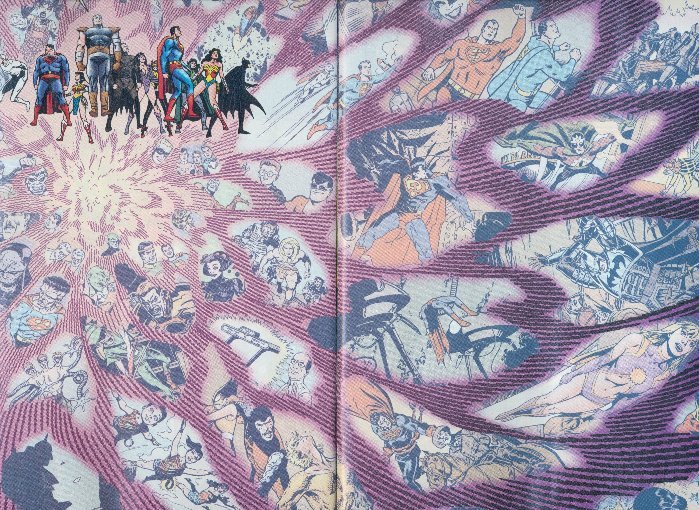
And despite the fact that Infinite Crisis ended three months ago, and DC has been publishing "New Earth" books for two months before that, we still don't know what the structure of the new DC universe is. We know that multiple Earths DID exist, it's been hinted that they still do, but it's also clear that Barry Allen, Jay Garrick, Billy Batson, Eel O'Brien, and Ted Kord were all born on the same earth, or at least everyone in the DCU remembers it that way. Similarly, the two page spread in Infinite Crisis #6 implied that EVERY comic DC ever produced, including the Zero Hour Legion and, ha ha ha, the Tangent Universe ARE also part of the New Earth, in some way. (My personal favorite part of Infinite Crisis #7 was the kids finding the Tangent Green Lantern on a beach).

So, was Hypertime really erased? Could it even be erased, considering it was just a description of the way comics were written anyway, an acknowledgment of the imaginary quality of the stories and the complexities of the world of ideas? Or have only our memories of Hypertime disappeared? For if GOOD ideas can cross from current to current, shouldn't BAD ideas be sluiced out, floating down the stream and getting lost in a sea of forgotten thoughts and half-formed dreams, never to be seen again?

Until, of course, one good writer has one good idea...

Sunday, July 23, 2006

Civil War #3

Now that I have my comments working (that sound you hear is me, repeatedly slapping myself in the forehead), I can see that Jenn of Reappropriate asked for my further thoughts on Civil War.

And the review remains pretty much the same. The art and plot are still fantastic. The photo-referenced pencils and inks give a realistic, weighty feel to the action. Just look at the panel of Iron Man punching Captain America in the face (no scanner, can someone help a brother out?). [Thank you, Lady That's My Skull.]


I've seen more violent, gory punches before, in the Authority or Ultimates, and I just assume that the Hulk has hit Cap in the face harder, but that certainly seems like the most brutal punch I've ever seen. Maybe it's the way Cap's mask is tearing off, or the slanted bloodstains across Iron Man's yellow happy face mask (no, I don't think it's just a coincidence), but the shear amount of detail and "realism" in the image make the whole panel more beautiful and the whole action more ugly.

And again, plotwise, it's really strong. Once the characters have taken their places (and I'll get to characters in a second), the scenes flow into each other with a nice sense of inevitability. You never get a scene which makes you think, "am I reading the same book?" which plagues most massive crossover events. And the question "who shot first" is going to plague Marvel for years (that's a good thing). Was it Iron Man, for setting up a trap in the first place? Or Captain America, who, under the guise of compromise rejected out of hand Iron Man's attempt at negotiation and reconciliation? And then there's that gorgeous last page, implying that the shit REALLY about to hit the fan, which will only be topped when a certain Green Goliath is done playing Spartacus.

But then there's the characterization and dialogue. On the anti-registration side, there is still ZERO doubt that they are in the right, despite the fact that there are STRONG arguments to be made against just letting Hercules beat the crap out of everybody he thinks is a bad guy! But the pro-registration side is worse. Tony I've written off as an asshole, and could deal with that (amazing how much that one moment of self doubt in issue two did for me). And Reed Richards has issues, but he's never been this cold to his wife and brother-in-law before. But the real problem is Spider-Man. Spider-Man is supposed to be the anti-asshole, bantering with his enemies even as he lays the smackdown on them. But here he's calling Daredevil and the Vision "schmucks," being patronizing to the Young Avengers (who are, what, 6, 7 years younger than him at most?). Even if it wasn't "out-of-character," it's still tipping your hand to put all the assholes on one side, and all the guys who just want to help people and play basketball with kids with cancer on the other.

So pretty much same as before. I'll enjoy reading the series through, and since I'm NOT a regular Marvel reader, I don't have to worry about "the long term" effects and just enjoy the story as is. But so far it's just good, and all it would take for it to be great is if the characters and dialogue were as nuanced, detailed, and real as the art.

Saturday, July 22, 2006

I AM A GIGANTIC MORON!!!

I AM A GIGANTIC MORON!!!

I asked for comments, I wondered why I didn't have comments, I got lonely and scared.

Then I realized I had COMMENT MODERATION on and wasn't actually moderating.

D'OH!

Anyway, your comments are all up NOW (and Mike, sorry for hotlinking, won't happen again.) And thanks for the support guys! I read and REALLY enjoy your blogs, and you inspire me more than you know!

So if you'd like to comment again, I swear they'll go up this time. Feel free to comment on some of the older posts as well. I'd love to hear your thoughts on whether Lex Luthor does drugs, Superheroes and the Death Penalty, and best over looked books of the 90s!

See you in the funny pages,

Steven

Evil-Sophie's Choice

(When Fangirls Attack, I apologize in advance.)

So, the end of the (properly reviled) History of the DCU reveals that Jade shouldn't have died in the Rann-Thanagar War,

Donna Troy should have.

Which would bump up the number of times Donna has died in the last 10 years to THREE.

But never mind that.

Nobody likes Donna Troy. Some people liked Wonder Girl, from the Bob Haney Teen Titans, when she might have been a young Diana. And yes Phil Jimenez has some kind of bizarre fixation on her, but for the most part, there isn't a lot there to like. She is literally an editorial mistake muddled by a MUCH BIGGER editorial mistake, so her entire history and character are based around explaining how there was no mistake at all. She doesn't seem to do much any more besides weeping and discovering everything she thought she knew about herself was wrong (and in the History of the DCU, she does BOTH), and that gets old real quick.

But some people actively HATE Jade! As a character she's engaged in some pretty awful behavior, acted, for the most part, like a spoiled princess, to the detriment of her brother, who had to deal with his own abandonment issues ALONE, and we all know how well that turned out.

So I leave it up to you, my dear (three) readers, if you had the Evil-Sophie's choice, and could only kill one of them (in a random and boring way that mostly just sets up Kyle Rayner's maxi-series), which one of these hateful women would get the axe (or lightning to the back, as the case may be)?

(clarification: At no point should anything I have written be taken to imply that they should die BECAUSE they are women, any more than I'm implying that they should die because they are photographers. Yes, they are both women (and photographers), but they need to go because they're boring and hated and are wasting valuable panel time. Both being women has nothing to do with it.)

Tuesday, July 04, 2006

Top 5 Overlooked Comics of the Nineties #1

Over at the Comics Bin, they listed the The Ten Most Important Comic Books of the 1990s. You can read the list for yourself but all you need to know is that Valiant Comics and Harbingers grab the number one spot.

Reading his reasoning, you can see he judged comics only on their collectability (and even that is questionable). Whereas I would have looked at their influence, experimentation, and effect on the comics that followed.

It's easy to look at first issues and claim they made a change, either the first issue of new team or a new character being introduced, the kind of stuff that shoots up in price, but I wanted to look at the comics that CHANGED (superhero) COMICS, but could still be found for cover price in the back issue bins.

(I'm also a DC fanboy, so these are just DC titles. If someone wants to do the Marvel, Dark Horse, Image, or COMPLETE list, please let me know).

Today's entry:

Flash #53 (1991): The Pied Piper comes out! In 1991, Hartley Rathaway, who had been committing crimes since 1959 as the Pied Piper but had recently reformed, casually informed his friend, Wally West, the Flash, that he was gay. Wally's reaction? He ran away.

Since that time, Piper has been through a lot. The last hero standing against Kobra in Terminal Velocity, falling in love with his partner James, fighting a gay-baiting conservative presidential candidate, framed for the murder of his own parents, and exonerating himself in a Rogue War. And through it all he's been one of Wally West's closest and most trusted friends.

No, he wasn't DC's first gay superhero. And he didn't get as much press as Northstar would one year later. But he was neither an atrocious gay stereotype nor was his sexuality quickly buried and forgotten. His orientation was always present, but rarely the focus. Instead, he was one of the first gay characters who was a fully developed human being with complex motivations and background, of which being gay was only one part (less important, in the long run, than his being born deaf and rich).

But getting back to the issue at hand: yes, as a supporting character, Hartley's coming out isn't really about Hartley. It's about Wally's reaction, which is running away. This was of course a perfectly in character reaction, both childish and conservative. But Wally eventually comes to accept that his friend is still the same guy he always was, and the audience, through Wally, learns to accept homosexuality as well.

Compare this to the Brother's Keeper storyline by Judd Winick. (note: I have met Judd Winick and I enjoy a LOT of his work). In a slightly similar plot, Terry Berg, a co-worker of Kyle Rayner, Green Lantern, comes out to him. Kyle helps him adjust to being out, then goes into a rage when Terry is beaten in a hate crime. The problem with the story, as Ragnell pointed out, is that Kyle doesn't learn anything. He was okay with homosexuality before, he's okay with it after, he thinks people who gay bash were bad before, he thinks the same after. He doesn't learn anything, and therefore neither do we.

And so, I'd like to single out Flash #53, for adding an interesting new facet to an old character, for adding a fully formed gay character to the roster of DC superheroes, for setting up plot lines for the next 15 years, and for telling a fun little afterschool special all in one issue.

Tomorrow, overlooked comic #2: The glasses come off!

Thursday, June 29, 2006

Thursday Thoughts #1

First off, a big shout out to When Fangirls Attack! for the link love. Not only was the link accompanied by a strong recommendation to read (aww, thanks guys!), it also boosted my visitor count.

Seriously considering turning this into a feminist comics blog, just to keep up the stream of readers.

But no comments yet. Not even from James Meeley. James, if it helps, I really did enjoy your wife's list of good or bad superheroes to date. That was some funny stuff right there. Not sure how it fits into your belief that "a super hero comic is not the platform for 'exploring sexual identities'", particularly the bit where she suggests Namor would be bad in the sack or that Ralph Dibny could inflate his body parts "the right way," but whatever. I guess as long as it's not two dude holding hands.

On another note, did you know I bought comics today? A crapload of them. Too many to review tonight, but I did break down and buy Civil War, which I had only been skimming in my local comic book shop.

You know what? It's really good. The art is amazing. The shot of the Patriot leaping through the air, just a quiet little WOW moment in the midst of a lot of talking heads. Fantastic. And the writings been good too. Not as strong in the dialogue or characterization (besides Tony, no one seems to have second thoughts about the side they've chosen.) But Spider-Man unmasking on national television? J. Jonah Jameson fainting? Yeah, right here and now I'm willing to say that's better than anything that happened in Infinite Crisis, and coming from DC fanboy like me, that's saying something.

My only major complaint is that they stacked the deck to one side. I mean, I understand Iron Man's position, in the abstract I already agree with it. And if it was Iron Man, military industrialist and former secretary of defense, vs. Daredevil, defense attorney and vigilante, you would have a classic debate between the government's need to protect its citizens vs. the individual's right to privacy and autonomy, balanced by two characters of roughly the same popularity. And if Iron Man had Spider-Man as a proxy, Daredevil could have used Wolverine.

But once Captain America took a side, the moral debate was over. (I don't remember where I first read that. If you remember, or you wrote it, could you tell me in the comments section?) Cap's right. He's always right. He's Marvel's equivalent of Uncle Sam. Heck, he IS Captain America. So once he chose the anti-registration side, the debate was over. At that point, it becomes clear that there is more going on here than good people violently disagreeing over the best solution to a difficult, complex problem. Once Cap picks a side, it means there is something else, something ANTI-AMERICAN about the other side, something driving the heroes to war.

And once that element is introduced (and please let me be wrong about that), the actual, meaningful debate will be over. And THAT would suck.

Course, Millar could surprise me. Captain America could express some doubts about his decision. Spider-Man's life could improve now that he's taken true responsibilities for his actions. And if Cap's side does turn out to be the wrong side, and Captain America realizes this and Learns a Lesson, I'd be willing to declare Civil War the best cross-over miniseries I've ever read.

Wednesday, June 28, 2006

Flame On!

Allow me to tell a story. Two weeks ago, Kalinara posted an open letter to guys about what she wanted, which was basically that female characters be written with the same depth and respect as male characters. It was neat, respectful, entertaining, and I agreed with it 100%. I believe my entire response at the time was "woot."

Then, at about the thirtieth comment, along comes James Meeley. James has a blogger profile, but doesn't have a blog of his own (as far as I can tell, he had at least two, but both have shuttered. Anyone know what that is about?) Anyway, not having a space of his own, James uses the comments page as an open forum to tell "feminist comic fans" that they "need to remember" that their, ugh, "impatience" hurts the cause of feminism by turning "people" off.

Let me take a moment to say that disliking feminists for their impatience is like hating the homeless for being hungry. You dick.

James doesn't help his case by peppering his comment with wonderfully condescending phrases like "This is just a little something you should keep in mind."

Well, Chris and Ragnell weren't going to stand for that, and after trying to engage him on Kalinara's thread, Ragnell took it to her own blog to bring the little cretin to the light of day.

Only, she does something interesting. She removes her name, as well as James's, and ask us, her audience, to judge them both knowing only what they wrote, in its entirety. This is where I enter the story. I call it like I saw it (and you can read it for yourself if you'd like.)

And, without knowing which is which, pretty much everyone agrees that James was in the wrong and Ragnell, while maybe a bit too snarky, was in the right. But there's one guy who doesn't think James said anything that terrible, and thinks that it was Ragnell's dismissive tone that really turned the whole thing into a snarkfest. And I would have thought "well, that's more forgiving than I would have been" and not thought about it again.

Until he takes a second post to call me out, by NAME, for suggesting that James, and I quote "is some serial killer of kids on death row, not someone who had an opinion you disagree with."

Guh, wha? I actually had to go back to re-read what I wrote. What I actually said was that Chris and Ragnell's comments were "a little aggressive... but, as we'll see below, he [James] deserves what he gets." I thought the meaning was pretty clear and pretty mild.

James's defender read that as "he gets what he deserves," (which is subtly but meaningfully different) which somehow immediately translates into "he's Ted Bundy and needs to DIE!"

Who could do that? Who could say there was nothing offensive in James's post, which let me remind you separates out "feminist comic book fans" from "normal comic book fans," but saw death threats in mine? Who is that desperate to start a fight?

Why it's James Meeley!

Yes, that's right, classy guy that he is, James Meeley defended himself in the third person as if he were someone else entirely.

Now, Ragnell hid her part of the conversation too, but she NEVER defended herself, and even engaged in strong self-critique by suggesting her comments were the result of a hair trigger.

Once again, Chris steps in with a pithy bon-mot that calls James on his asshole-ness. Not being the wit that Chris is, I actually call James on it directly, call him on misquoting me and taking offense at phantoms in the air, and try to explain to him what I found offensive, because he obviously found nothing offensive at all.

I don't know what button I hit. But clearly it was labeled "MELTDOWN." He goes off the rails. He flat out refuses to engage the actual debate (with the fantastically patronizing "well that's your opinion,") before going on misquote me, again, taunt me for "backtracking and apologizing" (I had done neither), malaprop "alliteration," claim immunity from criticism from anyone but Kalinara (who was, in fact, criticizing him, but he wasn't responding to her, either) then explicitly equates feminists with SUPERVILLAINS! On a feminist, superhero comics blog!

WOW!

The comments go on. I think I acquit myself well (though Jenn and Anonymous do an even better job) and you get to learn about Terry Long, but my point is...

Who does that? No really. What did he think was going to happen after saying something like that? How could it possibly help his case that he DID support feminism but didn't support their methods? Did he think he was going to have ANY credibility after defending himself in the third person? It's moronic.

I'd say he was just being an asshole to get attention, but you know what? It's way, way beyond that. It's so assholish that it becomes counter-productive. He becomes like a practice dummy for feminist writers. The targets on him are so large you could hit them blind-folded and drunk (which I assume is the state Chris actually blogs in).

So, James, if you're reading, I invite you to post a response on my blog. You seem to be blogless right now (no really, what is up with that?) and might need a space to vent your charming blend of paternalism and homophobia. Your lovely wife Heidi can comment as well. I'd love to hear your opinions on the new Batwoman, the use of rape in comics, minority superheroes, and other topics of interest.

I could use the punching bag.

Tuesday, June 27, 2006

Tuesday Night Recommendation #6

Nextwave #6


Part parody, part satire, part surrealism, and part EXPLODO, NextWave has been Warren Ellis's most purely entertaining comic yet. You may not learn something, you may not feel any deep emotions or connections to the characters.

But you WILL laugh.

Basically, Warren Ellis has taken some of the lesser known and under used characters that Marvel had lying around, put them all on the same team, and unleashed them on some of the weirdest monsters in the Marvel Universe, which so far has included Broccoli Robots, a Corrupt Cop/Voltron giant, and Fin Fang Foom including the funniest page involving Fin Fang Foom ever drawn, until he topped himself the very next issue!

But don't take my word for it. Take Warren's.

BUY THIS BOOK!