Showing posts with label Mark Waid. Show all posts

Tuesday, May 15, 2007

This Way to the Exposition

Mark Waid is a comic book writer that, if nothing else, I respect. I enjoy a lot of his work, and while I can't say he's my favorite writer, he's certainly one of the best at the technical craft of serialized, sequential art. So it's interesting to hear him engage in self-criticism in the same interview at Comic Book Resources that launched yesterday's post:

Robert Taylor: Biggest weakness?

...Mark Waid: ...my dialogue comes off as being a little too expository sometimes.

RT: Can you explain that a little more for me?

MW: Har de har har.
I've heard criticism of Waid's over-explanatory dialogue before and I understand it. In The Brave and the Bold #3, for example, the villain takes a page to explain who exactly each member of the Fatal Five is to a room of hostages who really don't care.

And while it does sound a little unnatural to hear the villain rattle off player stats, at least Waid understands one important fact: Exposition is Necessary. Sometimes it's a necessary evil, but it is always needed.

Remember, every comic is someone's first comic, especially an intentionally new reader friendly book like The Brave and the Bold. So some readers just won't know who the Fatal Five are. Probably even less are familiar with the new Blue Beetle. Heck, it's conceivably someone's first time reading about Batman. (okay, not really...)

It may give "the fans" a thrill to catch something that the casual reader just can't, but if someone who hasn't read comics for the past ten years is constantly left in the dark, then they're also going to be left in the cold, and just walk. The Fuck. Away.

You can't just throw, say, the Ultra-Humanite at the heroes and expect the reader to care without somehow explaining who he is and why he's a threat. When Dolores Winters pops up in the poorly-written Justice League of America #8, the casual reader has no reason to care at all because Brad Meltzer doesn't stop to explain that Winters is the Ultra-Humanite. And that the Ultra-Humanite is a body-hopping evil genius, who is also sometimes a giant white ape, as John Rogers explains in just one (1) word balloon in the much, much better Blue Beetle. (Really, why aren't more people reading that book?)

It used to be, comics had narrators who flat out told the reader what he or she needed to know to enjoy a particular issue, usually the writer/editor, who provided backstory and pointed to the issues in which those stories took place. Every Marvel Comic was (still is?) supposedly being told to you by Stan Lee himself, in his own inimitable style. Or if not the writer, than a host like the Crypt Keeper or the protagonist like Wally West in Waid's run on The Flash told the story directly to the reader.

In the wake of Watchmen, as superhero comics became more self-consciously filmic, narrators were more or less discarded as distracting artifice. Which is an acceptable artistic choice but it meant the thankless job of exposition fell to dialogue between characters.

Done well, and the reader never notices he learned something. Often, however, it's either Authority Figure explaining the plot to the Plucky Hero ("We believe Hitler is looking for the Arc of the Covenant. Here's why that's a bad thing..."), or it's Character A reminding Character B about something that Character B knows all too well ("Wow, you must be really angry that your girlfriend was brutally murdered yesterday by a gang of robot ninjas.")

But, and this is important, badly done exposition is better than no exposition at all.

Yes, the pleasure of ongoing stories is building on what came before, but not everyone read what came before and it's silly to expect them to have. So unless you want to just give up on new readers (and those without exceptional memories for details), you need some way to let readers know what's going on. Serial television shows employ "Previously on BLANK" segments before each episode to catch viewers up. Following that example, Marvel's been using title pages to re-cap the plot, to some good effect. And if you're not going to use a narrator to explain who and what everything is, then you're going to need to have characters speak in Waid's expository style now and then.

Or you could just have The Phantom Stranger explain everything. He's good at that.

Monday, May 14, 2007

What's Wrong With "Fun"?

Everything that's wrong with the current market for superhero comics, in one sentence:

“Fun” automatically kills off a lot of your sales.
says Mark Waid in this interview at Comic Book Resources (hat tip, Graeme McMillan at Blog@Newsarama).

Geez, that's depressing. I really love FUN superhero stories (including Waid and George Perez's The Brave and the Bold) and to hear that fun books aren't viable because the general comics buying audience isn't interested, is in fact repulsed by fun, is just baffling and disheartening.

I can't imagine NOT wanting to read a book my friends tell me is enjoyable, saying "Oh, I don't want to read Marvel Adventures: Avengers. I might be entertained!"

It seems "fun" and "interesting" are not the same thing to most comics fans. Judging from sales charts, the comics buying audience wants books about familiar superheroes, preferably acting in large groups, in stories that will have "repercussions" on later books. And since a "fun" book sounds like the opposite of a "serious" book that has "serious consequences", I guess most buyers don't feel "fun" books are worth spending money on.

But what's the point, then? Why buy crossover books that feature your favorite characters if you're not actually enjoying the books you're reading? If it's just to catch up with the characters, well, that's what the internet is for! And the internet is free!

And, once you've freed your wallet from the shackles of continuity porn, you can spend your hard-earned money on truly rewarding reading experiences, like Manhunter, The All-New Atom, Blue Beetle and, for the love of God, The Brave and the Bold. And if you're worried that "fun" isn't for you, well, a wise little bull said it best:
One thing I noticed is that the comics I like best are fun. That doesn't mean that they're funny (tho' they can be) or all have happy endings or are all written 'specially for kids (or even little stuffed bulls), but just that they are fun to read and when you turn the last page you can't wait to get next month's issue! John once described this as a comic that has a "sense of awe and wonder" and I guess that is as good a way as any to describe it. But I would describe it this way: COMICS OUGHTA BE FUN!

Thursday, April 19, 2007

Tha's More Like It!

Now that I got that off my chest, I can talk about all the really amazing comics that I DID buy yesterday. There were so many truly great comics (in a week in which All-Star Superman didn't even come out that it's hard to know where to start.

My favorite, right now, was The Brave and the Bold #3, featuring the two best things to come out of Infinite Crisis, the new Blue Beetle and a kinder, gentler Batman.


Blue Beetle, Jaime Reyes, is a character we think we've seen before: teen hero, chosen by chance/fate, gifted with phenomenal power and immediately dropped over his head into the craziness of superhero-dom. But the differences from Spider-Man et. al. are telling: he doesn't hide his powers from his family; he rarely encounters other heroes, living out in El Paso, TX; and perhaps most telling, he doesn't have an "Uncle Ben" moment of personal tragedy that drives him. He just does what he thinks is the right thing to do, given his extraordinary situation. In this way, he's one of the most relatable superheroes in comics today.

And the "new" Batman is a hoot as well. He's still scary as all get out, but Mark Waid and George Perez make it clear that it's an act, a purposeful attempt to seem more than human to fit in with the supermen around him. So, to the thug he interrogates, he's nothing but shadow and menace, but to Jaime he's reassuring, asks for help, and on page three, even though it's hard to "hear" in the snowstorm, he makes a joke about hot chocolate (true fact!). It's a hell of an improvement over his treatment of Kyle Rayner, Green Lantern, when Kyle was the novice with more power than experience.

And while the two of them tracking down a missing alien is fun, the real joy comes when they fight the Fatal Five, whose members include a guy who can cut through anything, a guy who can burn through anything, a woman whose magic eye can DO anything, and Validus, who is ALWAYS flipping out! The Fatal Five, remember, routinely make trouble for an entire LEGION of Superheroes, and Batman and Blue Beetle face them down. No, that's not true, Batman runs away while Blue Beetle bravely and foolishly holds them off all by himself. Since he's not killed, I'd say he does pretty well.

Though really, I don't think I'm conveying how much FUN this book is and how well the writing compliments the art. George Perez's skill as a detailed storyteller has only improved over the years. He fills his backgrounds and characters with wonderful details but his staging is clear, his characters feel real, and their emotions are expressive. Similarly, Waid's script is filled with details culled from DC long and extensive history, but the book is absurdly new-reader friendly. Even Batman's origin is retold on the first page. I never felt that I HAD to read Blue Beetle's own series to understand this issue, but I'm sure glad that I do.

Most of all, Brave and the Bold is exactly what I want a Justice League title to be. A romp through the ginormous playground that is the DC Universe. In the first three issues alone, the characters have gone from the Batcave to Las Vegas and from Space Casinos to the Mexican Border, with suggestions of both the far future and the Endless!
Furthermore, while being a fun romp, it's also an exploration of how varied the superhero genre itself can be. So far it's crashed through police procedural, teen romance, sci fi actioner, buddy comedy, and if next issue's cover is any indication, BIKER FLICK!

There's a palpable feeling that anything could happen, that the joy of comics is that the story could turn in any direction, and that only in superhero comics could anything as whacked out as THAT last page ever happen.

And that was only ONE of the amazing books I read yesterday!

Friday, January 19, 2007

Temptation Blocker

From Comic Book Resources: STUDIO TOURS: Mark Waid, while others were concerned with what inspired Mark Waid, this is what caught my eye:

Programs used on a regular basis: Microsoft Word, Firefox, Adobe Photoshop, Windows Media Player, and Temptation Blocker, a freeware program that locks me out of selected applications for a pre-set amount of time so my online porn addiction doesn't get in the way of my deadlines. As much.
Not that Mark Waid has a porn addiction (after all, The Internet is for Porn), but that he can shut it out for pre-set amounts of time. As a would-be comic book writer (but then, heh, aren't we all), a program that allows me to use my computer and check my e-mail but NOT read other peoples blogs or download funny Google videos (for Porn).

So thank you, Mark Waid, for giving me a way of keeping my new years resolution of writing that novel or two.

Oh, and for that thing in 52 yesterday. That was swell too.

(hmm... I can't seem to actually download it though, as the web-site Google points me to is down, and I'm not sure it's available for the Mac. So I'm not sure how helpful this will actually be, unless someone helps me out...)

Saturday, July 29, 2006

Ahead of Its Time

"What is this Hypertime that you speak of?"– Mark Waid at San Diego Comic-Con


Well, Mark, I'm glad you asked.

Hypertime was Mark Waid's [edit: Fine, FINE! and GOD OF ALL COMICS Grant Morrison's] attempt at replacing the parallel universe concept in the DC Comics universe.

Before 1986, most DC Comics were considered to take place in the same, "mainstream" universe and comics published by other comic book companies and even National comics published before the Silver Age were considered to take place in alternate dimensions, crossing over only through extraordinary measures. After 1986, that was changed so that ALL characters created for or acquired by DC Comics existed on the same Earth, which eased character interaction. (This, I consider, was a good thing, because crossovers are fun, create a richer history for the characters, and boost sales of the smaller titles through easier use of "guest stars.")

However, editorial mandate or not, DC Comics continued to publish books that did not take place officially in the DC Universe. Originally called "imaginary stories" and later branded as "Elseworlds," these stories took the familiar characters and either placed them in radically different settings or simply had events that would make an ongoing series difficult (such as, say, death). The most famous Elseworlds is Kingdom Come, by Mark Waid and Alex Ross, though The Dark Knight Returns and Watchmen could be considered Elseworlds as well.

On top of that, there were film, television, print and radio versions of all these superheroes out there, with varying degrees of fidelity to the source material.

The "problem" was that these stories, despite being unofficial, had a habit tying into the main universe. Following the The Dark Knight Returns, the "main universe" Batman began acting more and more like the dystopian, aging, paranoid, sadistic version. Following Kingdom Come, Alex Ross's character re-designs started to appear in the main books, as well as hints that, in fact, Kingdom Come was the future of the DCU. And the Batman Animated Series introduced two important new characters to the Batman mythos (Renee Montoya and Harley Quinn), as well as changing (and improving) the design and origins for most of the characters (notably Mr. Freeze).

Hypertime was an attempt to address this reality. Mark Waid's [edit: and Bald and Beautiful Grant Morrison's] concept had two major differences from the previous theory of the Multiverse.

The first is that it included EVERYTHING. Every imaginary story, every Elseworlds, every movie, musical, every possible appearance by anyone anywhere. Presumably, this also included works that DIDN'T involve DC characters directly, like comics published by Marvel and Dark Horse. It certainly included comics published by Wildstorm, which DC Comics purchased the same year Hypertime was introduced. DC Editor Mike McAvennie once described it to me as "All stories are equally imaginary."

The second difference was that, rather than parallel Earths, the different worlds crisscrossed all the time, feeding into each other. So if, say, Smallville introduced a Lex Luthor who grew up in Smallville, yes, suddenly the DC Universe Lex Luthor had a childhood in Smallville as well. Under the old version, the Smallville Lex would have had to literally tear open a hole in the fabric of time and space and take the non-Smallville Luthor's place in order for that to occur. Under Hypertime, that changed history just sort of happens.

On the macroscale, it meant that any story, anywhere, COULD be an in continuity story for any one particular issue of, say, Impulse. Even if it's a fifty year old comic, or published by the Marvelous competition, or if it's a 19th century proto-horror novel. On the microscale, it means that every individual issue is a current within the main stream, which may or may not affect the other currents. After all, as Kurt Busiek once said, "they're all fairy tales we pretend take place in the same world because it's more fun that way."

BUT... as the quote above suggests, in the wake of Infinite Crisis, Hypertime is concepta-non-grata at DC Comics now. In fact, writer and editor alike act as if Hypertime has been, ha ha ha, erased from time. And the reason is... Hypertime never really worked. No one [edit: Not even 12th level intellects Mark Waid and Grant Morrison] ever did anything particularly interesting with Hypertime. Mostly, writers just treated it as another word for Multiverse, with the added bit that it might include some of our favorite Elseworlds characters (such as one AWESOME (and criminally uncollected) Superboy story).

Why was that? My theory is that Hypertime was too metaphysical a concept. Quite frankly, it was just a description of the way the creative process actually works. If he or she sees a good idea, consciously or unconsciously a writer will incorporate that idea into their work. Acknowledging, in story, that that happens may reduce fanboy whining about what is or is not in continuity (Yes, it's all in continuity), it doesn't actually help tell a better story. (At least not one that I can think of.) And so it's become passe.

Or has it? DC has, for now, stopped their Elseworlds line, though if New Frontier, JLA Classified, Bizarro Comics, Solo and the ALL-STAR line are any indication, they haven't stopped producing comics that are outside established DC continuity. They also still publish the Vertigo books, some of which still have an ill defined connection to the Justice League world, as well as Wildstorm's superhero and non-superhero books.

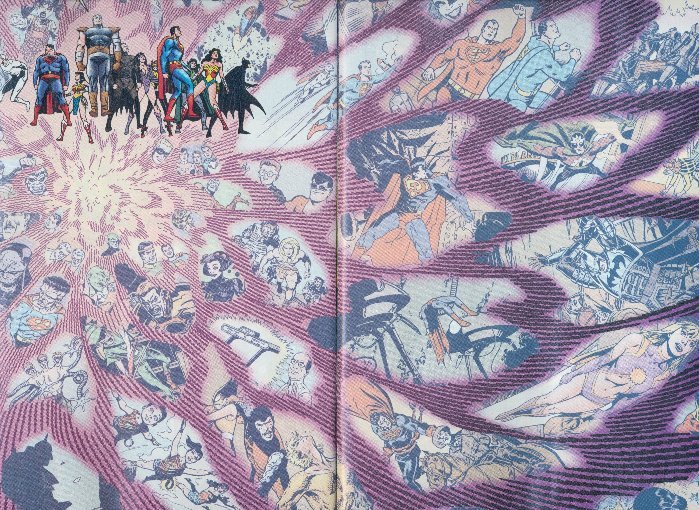
And despite the fact that Infinite Crisis ended three months ago, and DC has been publishing "New Earth" books for two months before that, we still don't know what the structure of the new DC universe is. We know that multiple Earths DID exist, it's been hinted that they still do, but it's also clear that Barry Allen, Jay Garrick, Billy Batson, Eel O'Brien, and Ted Kord were all born on the same earth, or at least everyone in the DCU remembers it that way. Similarly, the two page spread in Infinite Crisis #6 implied that EVERY comic DC ever produced, including the Zero Hour Legion and, ha ha ha, the Tangent Universe ARE also part of the New Earth, in some way. (My personal favorite part of Infinite Crisis #7 was the kids finding the Tangent Green Lantern on a beach).

So, was Hypertime really erased? Could it even be erased, considering it was just a description of the way comics were written anyway, an acknowledgment of the imaginary quality of the stories and the complexities of the world of ideas? Or have only our memories of Hypertime disappeared? For if GOOD ideas can cross from current to current, shouldn't BAD ideas be sluiced out, floating down the stream and getting lost in a sea of forgotten thoughts and half-formed dreams, never to be seen again?

Until, of course, one good writer has one good idea...