Showing posts with label Judd Winick. Show all posts

Wednesday, August 09, 2006

Well, this'll get people talking
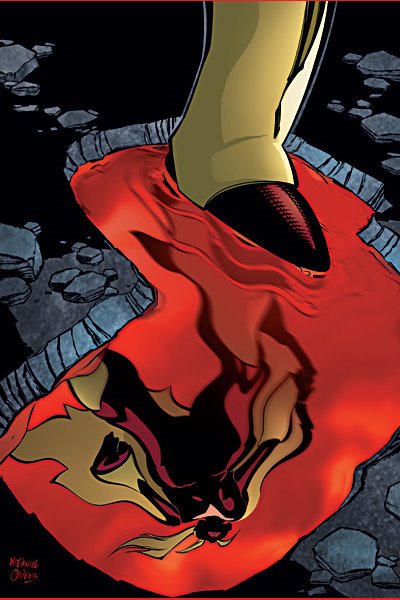
In a rare occurrence, I actually got my comics on a Wednesday, which means I can get the ball rolling on this.

In today's Green Arrow, noted lefty blowhard and sexist hypocrite Oliver Queen, mayor of Star City, admits to performing gay marriages NOT because he particularly believes love between two men or two women is just as real as love between a man and a woman, but instead he did it in order to court controversy and attention for his recently destroyed city (think Katrina).

Later he blackmails a businessman with the threat of prison rape. In his words, "Sadie Hawkins Dance, and the-worst-part-of-Deliverance prison."

Yeah, so on the one hand he's explicitly exploiting an under-served minority just to get national publicity, and on the other revealing his latent homophobia by claiming the worst part of prison is the gay sex (and not, y'know, the murder, the violent abuse, the lack of freedom...).

And to me, that's good writing. Yeah, Oliver's being massively dickish, but it's perfectly in character for him. He talks a good game, but he's NEVER lived up to the values he espouses. It's a nasty and accurate swipe at the national media, that will get bored of human tragedy after a month or two, but can't stay away from the gay. (See: Brokeback Mountain, Lance Bass, Batwoman...)

And, if I'm reading it right and I might not be, it's also a funny self satire, because if there's anyone who has exploited homosexuality in order to attract attention (and sell books), it's Judd Winick.

But, I'm not gay, so while I might not be offended by the material and attribute the homophobia on display to the character and not the writer, bloggers who are gay might be, and I'd like to hear what you think.

(In non-controversial news, Conner Hawke is fine, training, and waiting for his miniseries, Deathstroke has teamed up with the world's second most deadly assassin, and Mia Dearden is in fine fighting form, kicking ass, taking names, and talking back! So that's good.)

Tuesday, July 04, 2006

Top 5 Overlooked Comics of the Nineties #1

Over at the Comics Bin, they listed the The Ten Most Important Comic Books of the 1990s. You can read the list for yourself but all you need to know is that Valiant Comics and Harbingers grab the number one spot.

Reading his reasoning, you can see he judged comics only on their collectability (and even that is questionable). Whereas I would have looked at their influence, experimentation, and effect on the comics that followed.

It's easy to look at first issues and claim they made a change, either the first issue of new team or a new character being introduced, the kind of stuff that shoots up in price, but I wanted to look at the comics that CHANGED (superhero) COMICS, but could still be found for cover price in the back issue bins.

(I'm also a DC fanboy, so these are just DC titles. If someone wants to do the Marvel, Dark Horse, Image, or COMPLETE list, please let me know).

Today's entry:

Flash #53 (1991): The Pied Piper comes out! In 1991, Hartley Rathaway, who had been committing crimes since 1959 as the Pied Piper but had recently reformed, casually informed his friend, Wally West, the Flash, that he was gay. Wally's reaction? He ran away.

Since that time, Piper has been through a lot. The last hero standing against Kobra in Terminal Velocity, falling in love with his partner James, fighting a gay-baiting conservative presidential candidate, framed for the murder of his own parents, and exonerating himself in a Rogue War. And through it all he's been one of Wally West's closest and most trusted friends.

No, he wasn't DC's first gay superhero. And he didn't get as much press as Northstar would one year later. But he was neither an atrocious gay stereotype nor was his sexuality quickly buried and forgotten. His orientation was always present, but rarely the focus. Instead, he was one of the first gay characters who was a fully developed human being with complex motivations and background, of which being gay was only one part (less important, in the long run, than his being born deaf and rich).

But getting back to the issue at hand: yes, as a supporting character, Hartley's coming out isn't really about Hartley. It's about Wally's reaction, which is running away. This was of course a perfectly in character reaction, both childish and conservative. But Wally eventually comes to accept that his friend is still the same guy he always was, and the audience, through Wally, learns to accept homosexuality as well.

Compare this to the Brother's Keeper storyline by Judd Winick. (note: I have met Judd Winick and I enjoy a LOT of his work). In a slightly similar plot, Terry Berg, a co-worker of Kyle Rayner, Green Lantern, comes out to him. Kyle helps him adjust to being out, then goes into a rage when Terry is beaten in a hate crime. The problem with the story, as Ragnell pointed out, is that Kyle doesn't learn anything. He was okay with homosexuality before, he's okay with it after, he thinks people who gay bash were bad before, he thinks the same after. He doesn't learn anything, and therefore neither do we.

And so, I'd like to single out Flash #53, for adding an interesting new facet to an old character, for adding a fully formed gay character to the roster of DC superheroes, for setting up plot lines for the next 15 years, and for telling a fun little afterschool special all in one issue.

Tomorrow, overlooked comic #2: The glasses come off!