Showing posts with label Grant Morrison. Show all posts

Tuesday, May 08, 2007

Is it 2008 yet?

Grant Morrison does an exit interview for 52 and lets a few cats out of the bag:

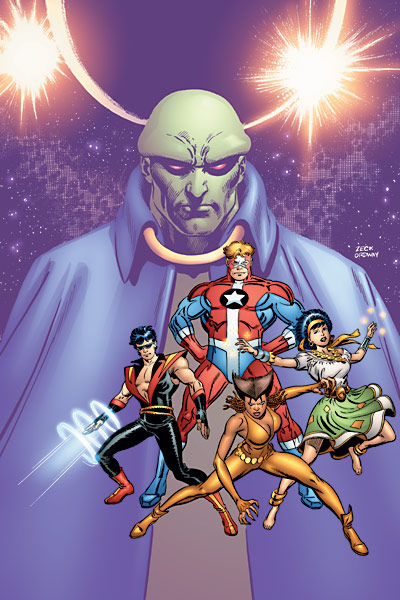
The same pitch also introduced two new Japanese pop-culture inspired superteams - the venerable monster-huntin' crew of Big Science Action and the Super Young Team (whose members include Most Excellent SuperBat, Big Atomic Lantern Boy and Shy Crazy Lolita Canary) - both of which will appear in my next big DCU project in 2008....

...Doc Magnus' Plutonium Man will probably turn up again in the forthcoming Metal Men series....

...If you miss Vic Sage as the Question, you should be able to follow the adventures of Vic's counterpart on the Charlton/Watchmen world of Earth 4...

That's right, the mother-f@#$ing WATCHMEN WORLD

There's also something about sex with a jellyfish. Oh just go read it.

Tuesday, April 17, 2007

JLA/Batman Syndrome

Hyper-Competency in Team Setting Disorder, or "JLA/Batman Syndrome", is a disease of writing in which an under-powered character, in order to be useful in a team setting with much more powerful allies, is written as much more capable than he is in his own titles. Symptoms include: heightened intelligence, strength and speed, the inability to make or appreciate jokes; a lack of fear; obsessive devotion to "The Mission"; prone to bouts of anger and frustration with his teammates for having neither the training nor commitment he has.

Named for Grant Morrison's handling of Batman in JLA (where a character that occasionally has trouble fighting more than four street punks at the same time could run headlong into four Superman-level Martians and beat them handily, off-panel), this malady has the paradoxical result of taking the most physically human characters and rendering them the most emotionally inhuman.

While Batman is the most famous sufferer of this disease, his sidekick Robin suffers from it that much worse. Batman is always somewhat distant, calculating, and scary, but Robin is much more cheerful and emotional, prone to crack jokes after a fight or freak out a bit when encountering the fantastic.

In fact, in his own title, Robin freaks out A LOT! Seeing a demon baring down on him, Robin gets scared. Losing a lead, he might doubt himself. Captured by the Joker, Robin might begin to panic. Not that his fear cripples him, he still saves the day, but it gives him a relatable moment. In his own title, Robin is allowed to be Tim Drake, teenager, high schooler, awkward dater, recent orphan, and all-around human being.

But put Robin on a team with a kid who runs at the speed of light or an Amazonian powerhouse, and JLA/Batman Syndrome kicks in. To prove that he has a right to stand with these young gods, these teen titans, Robin has to be written as more than human, a Nietzschean Übermensch, who does not let human concerns get in the way of his goal.

It would be neat if this was intentional on Robin's part, if Tim Drake was purposefully putting on an act to hide his insecurities and fears, but I've seen little evidence of that. Only once in Young Justice did I recognize the Tim Drake I knew from his own series. Forced to play baseball to stop a fleet of aliens from invading a planet based on 1930s Brooklyn, Robin just breaks down in the locker room, questioning not only his place in this cosmic and bizarre setting, but also his very sanity. But he realizes he has to suck it up and go back out there, because his team depends on him. That was something I could latch onto, something I could feel for.

But too often it is not an act at all, but the terrible writing disease tearing Robin in two. But there is a cure! Writers on team books just have to remember he doesn't have to be written as Batman-Lite. He can, in fact, be written as Robin, the Boy Wonder, the kid detective, the laughing daredevil, the little ninja, the human protagonist in a crazy world. These are all different, interesting, and, dare I say, FUN ways to approach the character, and they are all already present in his own monthly title. So please, let him be human again, and working together, we can make a better world.

Operators are standing by.

Thursday, November 30, 2006

Re: Boys #5

God dammit, Garth!

The first rule of burger joint is you DO NOT TALK ABOUT BURGER JOINT!

Why couldn't you have said Island Burger on 51st and 9th? Or, I don't know, Peter Lugar's or something. I mean, yeah, if you've set up in the Flatiron building, the Shake Shack really is at your feet, and that was a nice scene, but still... burger joint is crowded enough as it is without having every fanboy in Manhattan jamming the booths hoping to get a glimpse of you or Darick!

And while you're here, there's a few other things I'd like to tell you. First, pick up the GOD DAMNED PACE! I've paid good money for "my favorite heroes getting the crap kicked out of them" and we're only getting to that in issue 6? C'mon! That should have happened back in issue 4, or 3 even. By now the Seven should be already be moving against the Boys, or at least we should have been given a wider view of your world (how many super teams ARE there? and where are the super villains?)

And Lamplighter, your Green Lantern analogue that Homelander implicitly killed, is he really dead or merely crippled, so that he can join the Boys later when they bring down the Seven? And who was the guy A-Train replaced? Was he killed by the Homelander too?

That said, I am, in fact, enjoying the series, which drops just enough humanizing details in along with the obscene and ridiculous to keep me emotionally tethered even while pushing my envelope. But I may just switch to trades, which is, after all, how I read Preacher, so maybe that's what works best for you.

Thanks,

Steven

p.s. The Frenchman. That's Grant Morrison in a pair of goggles and a outrageous accent, isn't it?

Monday, October 30, 2006

Last Words (and Pictures)

Hey, I'm back. Miss me?

I want to talk about last pages. It's really the advantage of the singles over the trade. The shocking reveal. The nail-biting cliffhanger. The joke and freeze. Even the summation, moral, and coda. The great last page confirms "Yeah, you just read A Story, a real story, and don't it suck for you that you have to wait a whole 'nother month for what else we got in store." You lose that in the trade. Golden moments, like Superman and Lex Luthor plummeting to Earth in Up, Up, and Away, are frozen in time as you wait weeks for the next issue. In the trade, it's just another page in the middle of the book.

Yeah, it's arbitrary, a product of the medium rather than a creative choice, but good creators can make the boundaries work for them. I bought six comics last week* and all but one had BRILLIANT last pages. (The outlier was Boys #4, which is probably my new definition of "wait for the trade.")

Secret Six #5 employed the classic, reveal and cliffhanger one-two: forgotten character reappears, then immediately puts our heroes in mortal jeopardy. Now you have to read issue #6, the conclusion, to see how our "heroes" get out of this one. If they get out of this one.

52 #25 does the classic with a double twist. Not only does the mysterious mastermind behind the Island of Mad Scientists step forward to imperil Black Adam and Isis, his identity turns out to be a new twist on an old, buried character, and his particular threat references earlier clues in the series itself, drawing the disparate plots together.

Action Comics #844 has a reveal, but really the last page serves as a summation and conclusion. It ends the chapter being told. The story could conceivably just end on that last page, since it establishes a new but relatively stable status quo. Not that it will, because there's a "to be continued" hiding in the bottom right corner and the new status quo is too big a change to be confined to just one book.

Nextwave #9, plotwise, doesn't have that great a last page. Nothing's revealed. The heroes are in no more or less danger on the last page then they were six pages earlier. It certainly isn't the end of the story, or even the beginning of a new one. But it was a PERFECT last page. Because it contained a joke--a joke so powerful that I could not continue reading. That's right, Ellis and Immonen knew that anything read after that page would be lost in its massive wake, so they moved it to the end where it could do no harm to the rest of the story, while at the same time positioning the joke for maximum focus, making it more powerful than you can possibly imagine!

But of course, the comic of the week, my HANDS DOWN pick, is Seven Soldiers of Victory #1. And it had THREE great last pages. Sure it could have ended on page 37. With its narration directed at the reader and image and panels that recall the first page of the first issue of Seven Soldiers, it would have been a nice bookend. Or it could have ended with page 38, the twist ending. But like Nextwave before it, Seven Soldiers had a moment, an image so powerful that it FORCED itself to the last page. The moment certainly isn't the end of the story. It's not even a very important moment to the main plot.

But the image IS the story of Seven Soldiers. It's a monument to unending nature of comics, that every last page is an advertisement for the next issue, that every death and birth is there for later writers to undo and redo. It's an image that mixes the macabre with the sacred, the simple with the mysterious, the absolute mundane with the beyond fantastic. It's an image that says superheroes can do impossible things, and that's why we love them. It's a moment so great that there just can't be another page, even though it's a last page that SCREAMS "TO BE CONTINUED!!!" without saying a word. It has to be the last page, because after seeing that page, there's nothing left to say...

until next month...


*yeah, vacation doesn't stop the habit. Once, when traveling through Alaska, I made a stop at the world's most Northern Comic Book store to pick up Zero Hour #0, which was out that week.

Friday, October 20, 2006

Scatter-Thoughts

Going on vacation for a week, so new post for a bit.

In the meantime, I leave you with some random thoughts.

Hey, Robert Kirkman, if you want to read about "an inexperienced hero who would get beaten up constantly and probably die," check out this week's Robin. Or Birds of Prey. Or 52.


The only thing that would have made the page of new heroes shouting their stupid names better is if they had shouted them in Logo Font.


Speaking of, Red Tornado looked beyond the veil of universe and saw 52... what? My guess: 52 other universes (which, including the universe he was in at the time, would be a full pack plus a wild card). And they're coming.


If the conversation on superheroes and class is going to keep going, we might want to start defining our terms. I realize in my own arguments I'm getting thrown off my point a lot by confusing aristocracy, wealth, style, education, power, and morality. The original question was whether the superhero genre perpetuates the myth of aristocracy, that some people are just born to rule. That's shifted a bit into whether Batman fights social injustice and why aren't more superheroes classy, with claims of anti-intellectualism thrown in.


The anti-intellectualism claims really bother me, for some reason. There's this odd assumption that having an education, particularly a post graduate education, is synonymous with being upper class, an influential figure on the course of society, which just isn't true. Most of the academics I know toil in obscurity (and read this blog! Hey, Aaron, David, and Jeff)!. As Cole points out, Kal-El is not a lost prince of Krypton. He's the son of a smart but not highly respected scientist. Meanwhile, Bruce Wayne (who we all agree runs Gotham, yes?) never even went to college. And back in the real world... well let's just say that being a total and complete moron doesn't stop you from getting elected President.


Casanova is a heck of good read. As is 100 Bullets, which has started barrelling towards its conclusion.


Has it really been a month since ANY issue of Superman's three ongoings have hit the shelves? And I have to wait till December for more All-Star goodness? C'mon! I'm starting to feel like a Green Lantern fan over here.


Speaking of, sort of, Morrison Batman run filled-in by The Spectre team of Ostrader and Mandrake? Yeah, I'll take that.


Yes, I heard about NextWave. No, I'm not surprised. No, I haven't rent my garments nor gnashed my teeth. Yes, that will be one less Marvel title I'm buying. Yes, I'll probably pick up whatever NextWave limited series come down the pike. No, I'm not buying Thunderbolts.

Tuesday, September 12, 2006

I Think More Superheroes Should Die

(huh, I can already hear Dr. Polaris agreeing. Anyway...)


Superheroing is an inherently dangerous activity. Let's face it, the guys in the capes aren't just the police. A superhero is cop, fire fighter, and soldier in one, and what these professions have in common is that each is a person who saves lives by risking and sometimes losing his own. Add to that mortal enemies with world shaking power, and you're looking at people whose day to day living is very precarious.

But if you want me to believe that, at any moment, a superhero could die, then every now and then, one of them has to actually die. The stronger possibility of an unhappy ending is one of the major advantages of on-going, episodic fiction that comics should exploit better. Because when the bad guy puts the hero in his unescapable death trap and looks like he's going to get away, there's a chance he really IS going to get away, if only for someone else to capture him three or four issues later. That's the way to ramp up the DRAMA.*

Now, I don't mean to be morbid about it. I'm not in the "kill 'em, kill 'em all" camp. The deaths should be rare, if only so superheroes don't look like complete incompetants. And while they don't all need to be heroic sacrifices, like Barry Allen--they could be fatal mistakes, like Booster's recent demise, or victims of effective villains, like Vibe's or Blue Beetle's, or even the truly tragic cannon fodder, like Pantha--the deaths need to have an impact, on the plot and on the surviving characters. And because I like deaths to have impact, I'd prefer the dead remain dead, but I understand that any fantasy genre in which The Spectre is one of the oldest characters will have a looser definition of what death means.

And the deaths certainly shouldn't be advertised in advance. One, it's kind of creepy. Two, it robs tension from issues in which a death isn't advertised. I know everyone is going to make it out of an issue if it's not solicited "Someone makes the ultimate sacrifice." Three, it robs tension from issues in which a death IS advertised. Even if it's obvious Captain Lamb is going down with the ship, the death has a lot more impact if you thought there was a chance he could have made it.

And some characters, of course, can't be killed. The editorially protected icons, of course, are practically immortal. No reader would really want Batman (or even the Joker) dead, and more importantly, no one would ever believe he was really dead anyway, no matter how graphic the death. I would have said protagonists of on-going books were safe as well, but blowing up Oliver Queen to make way for Conner Hawke was one of the best moves Chuck Dixon made on his run of Green Arrow.

I though Peter Milligan and Mike Allred's X-Statics nee X-Force handled death brilliantly. Killing off 90% of the team (including the narrator) in the first issue served notice that neither the characters nor the readers could take the success of any mission for granted, and then played out the emotional effect of such a highly dangerous life would have, and then what the effect would be if some people, but only certain people, came back.

Now, I can already hear some objections, notably "comics are supposed to be escapist fantasy and I don't want to be reminded about things I find upsetting, like death." To which I say, "Stop reading superhero comics."

Seriously.

Batman watched a mugger shoot his parents. That's the basics. If you want to remove violent death from superheroes, you have to give up Batman. And Spider-Man. And Superman. And Captain America. Heck, get rid of World War II and all those nasty Nazis.

Superheroes is NOT an escapist genre, not if by "escapist" you mean "a genre in which you don't have to deal with anything in the real world you don't like." Superheroes is kind of the opposite of that, a genre in which VERY REAL PROBLEMS are exaggerated and distorted to be scarier, which somehow allows the reader to deal with these problems through metaphor and analogy. A superhero universe is a worse place to live, where everything we have to deal with exists, but with superpowers. (Cue President Lex joke)

The danger, the very real danger to their lives, the fact that just by signing up for the Justice League a hero puts a target on his back, the fact that they might die alone, or suddenly, and possibly in a painful, undignified way, and they DO IT ANYWAY...

well, to me, that's what makes them a hero.


*One of the reasons I didn't like Grant Morrison and Frank Quitely's Earth 2 was the idea that on "our" Earth, good can't lose. Well, that sucks all the tension out of the story.

Tuesday, August 29, 2006

Ooh, a Happy Little Superman Fan Am I

I don't talk about him nearly enough, but it should be stated that my favorite superhero is Superman. I love that guy.

I was a superhero fan LONG before I was a comics fan. I VIVIDLY remember seeing Superman III in the theater, having no idea why or how Superman was fighting Clark Kent, but loving every minute of it. That may in fact be my first memory (I know I just made half of you feel really old, and the other half sort of young). I loved The Super-Friends, and the late '80s Superboy show. I waited forever for Superman IV to come out ("Superman was going to fight for peace! Hooray"). Looking back, I know all of that was terrible, but when you're young...

Anyway, it didn't matter, because it had Clark Kent, who's just great. To watch Christopher Reeves, particularly in the first movie, play it, was to instantly get it. Here was a schlub, the last nice guy in a town where nice gets eaten for breakfast, in painful love with the girl who wouldn't give him the time of day. Basically, he's you, he's me. It doesn't matter if you're a boy or a girl. We all know what it's like to be ignored.

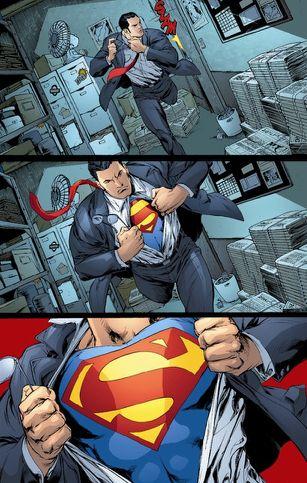
But Clark has a secret! He jumps into a broom closet, puts on the bright blue and red costume, fixes his hair, and does amazing things! All eyes on him, everybody loves him, or envies him. He's free! Free from his job, free from the law, heck, he's free from the laws of physics! He can do whatever he wants... and all he wants to do is help. And he doesn't WANT to be loved for helping... he wants to be loved for being the last nice guy. He wants to be loved for being Clark. How can you NOT love that guy? How can you not want to be that guy?

But... though I followed him from lousy movie through lousy TV show and back, I wasn't reading the comics. I kind of knew they were still publishing comics, and I know I had an issue or two growing up, and even though I loved comic strips in the newspaper, I just wasn't walking into a comic book store to pick up the latest heroic tale about my favorite Kryptonian.

Until one day when I was thirteen my dad handed me this comic as a spur of the moment gift; he had no idea what he was unleashing on the world: (after the jump!)


Yeah, that's right. I became a comics fan because of The Death of Superman. So you can all just shut up about media friendly stunt storylines because they can Goddamn get new readers into the store.

You can also shut up about making comics more "new reader friendly" by simplifying continuity. Have you read this issue lately? It's got Matrix Supergirl, Chief Henderson, Cat Grant, Kismet, Blaze, Byrne's Kryptonian imagery, Gangbuster, NONE of which I had ever seen before, and it ends with the introduction of FOUR completely new characters. Was I scared off by entering in the middle of a story? Confused and discouraged by all the characters I didn't know and plots circling around?

HECK NO! I was hooked! I wanted to know more about these characters. Who they were. How they related to Clark and what it meant about his return. I made my parents take me to the local comic book shop (a now-defunct branch of Golden Apple, if you live in the LA area), and we picked up the readily available Death of Superman and Funeral for a Friend trades (also Panic in the Sky, because our local comic book dealer flat out lied to my parents, but that's okay, because Panic is a better intro to most of the DCU anyway, and the store's out of business now anyway). And I was definitely in until at least the end of The Reign of the Supermen, and the moment Superman shatters the genocidal Cyborg, looking bad-ass and strong, in retrospect my first F*$% Yeah moment, that was it. I was in.


Because the Superman books acted as a pseudo-weekly, I quickly developed the habit of going to the store every week. Because I'm borderline obsessive compulsive, I learned to go every Thursday morning (it was the summer) then every Wednesday afternoon. (I'm better now, I can usually hold out until Friday, sometimes even Saturday. Guess I'm an adult.) And while I was in the store there was this big Batman storyline going on too, so I started picking up that, and it spread from there...

But I always read the Superman titles. (Well, almost always, the Dominus storyline drove me away, but Luthor trading his baby to Brainiac 13 for power brought me right back.) So why am I NOW such a happy Superman fan? Because for the first time, in a long time, the Superman titles are actually GREAT. I mean, in the thirteen years I've been reading comics, they've usually been good, or good enough. Even when the storylines seemed more designed to get attention than tell a good story (the engagement, the death, the return, the break-up, the wedding, blue, blue and red) there was some really good writers and artists turning out decent work. Writers like Karl Kessel and artists like Stuart Immonen and others. And it was fun... but it was never really GREAT. I'd pick it up because it was available at the store and I'd be amused for 15 minutes, but I realized I wasn't dying to read it anymore. I mean, before November 16th, 2005, who was really LOOKING FORWARD to the next issue of ANY Superman comic?

Guess what comes out tomorrow?

No, no, not that. Or rather, not JUST that. Action Comics #842 is coming out, the second part of adventure where, well, Aliens Steal Our Stuff. Seriously, I've been looking forward to this issue since just seeing the cover by Dave. Freaking. Gibbons. And Kurt Busiek, Fabian Nicieza and Pete Woods are knocking out of the park an old school crazy-ass Silver Age Superman adventure. It's funny to think this is from the same writer who wrote the last issue of Superman, which mostly had him sitting on a plane, reading a book and thinking about a conversation he had with Lana the other day, which was ALSO a great issue.

Three FANTASTIC ongoing comics starring my favorite, favorite, favorite character. Some of my favorite writers, great artists I'm only now beginning to appreciate, and an editorial staff devoted to making Superman, above and beyond anything else, FUN!

I'm just waiting for the wink.

Saturday, July 29, 2006

Ahead of Its Time

"What is this Hypertime that you speak of?"– Mark Waid at San Diego Comic-Con


Well, Mark, I'm glad you asked.

Hypertime was Mark Waid's [edit: Fine, FINE! and GOD OF ALL COMICS Grant Morrison's] attempt at replacing the parallel universe concept in the DC Comics universe.

Before 1986, most DC Comics were considered to take place in the same, "mainstream" universe and comics published by other comic book companies and even National comics published before the Silver Age were considered to take place in alternate dimensions, crossing over only through extraordinary measures. After 1986, that was changed so that ALL characters created for or acquired by DC Comics existed on the same Earth, which eased character interaction. (This, I consider, was a good thing, because crossovers are fun, create a richer history for the characters, and boost sales of the smaller titles through easier use of "guest stars.")

However, editorial mandate or not, DC Comics continued to publish books that did not take place officially in the DC Universe. Originally called "imaginary stories" and later branded as "Elseworlds," these stories took the familiar characters and either placed them in radically different settings or simply had events that would make an ongoing series difficult (such as, say, death). The most famous Elseworlds is Kingdom Come, by Mark Waid and Alex Ross, though The Dark Knight Returns and Watchmen could be considered Elseworlds as well.

On top of that, there were film, television, print and radio versions of all these superheroes out there, with varying degrees of fidelity to the source material.

The "problem" was that these stories, despite being unofficial, had a habit tying into the main universe. Following the The Dark Knight Returns, the "main universe" Batman began acting more and more like the dystopian, aging, paranoid, sadistic version. Following Kingdom Come, Alex Ross's character re-designs started to appear in the main books, as well as hints that, in fact, Kingdom Come was the future of the DCU. And the Batman Animated Series introduced two important new characters to the Batman mythos (Renee Montoya and Harley Quinn), as well as changing (and improving) the design and origins for most of the characters (notably Mr. Freeze).

Hypertime was an attempt to address this reality. Mark Waid's [edit: and Bald and Beautiful Grant Morrison's] concept had two major differences from the previous theory of the Multiverse.

The first is that it included EVERYTHING. Every imaginary story, every Elseworlds, every movie, musical, every possible appearance by anyone anywhere. Presumably, this also included works that DIDN'T involve DC characters directly, like comics published by Marvel and Dark Horse. It certainly included comics published by Wildstorm, which DC Comics purchased the same year Hypertime was introduced. DC Editor Mike McAvennie once described it to me as "All stories are equally imaginary."

The second difference was that, rather than parallel Earths, the different worlds crisscrossed all the time, feeding into each other. So if, say, Smallville introduced a Lex Luthor who grew up in Smallville, yes, suddenly the DC Universe Lex Luthor had a childhood in Smallville as well. Under the old version, the Smallville Lex would have had to literally tear open a hole in the fabric of time and space and take the non-Smallville Luthor's place in order for that to occur. Under Hypertime, that changed history just sort of happens.

On the macroscale, it meant that any story, anywhere, COULD be an in continuity story for any one particular issue of, say, Impulse. Even if it's a fifty year old comic, or published by the Marvelous competition, or if it's a 19th century proto-horror novel. On the microscale, it means that every individual issue is a current within the main stream, which may or may not affect the other currents. After all, as Kurt Busiek once said, "they're all fairy tales we pretend take place in the same world because it's more fun that way."

BUT... as the quote above suggests, in the wake of Infinite Crisis, Hypertime is concepta-non-grata at DC Comics now. In fact, writer and editor alike act as if Hypertime has been, ha ha ha, erased from time. And the reason is... Hypertime never really worked. No one [edit: Not even 12th level intellects Mark Waid and Grant Morrison] ever did anything particularly interesting with Hypertime. Mostly, writers just treated it as another word for Multiverse, with the added bit that it might include some of our favorite Elseworlds characters (such as one AWESOME (and criminally uncollected) Superboy story).

Why was that? My theory is that Hypertime was too metaphysical a concept. Quite frankly, it was just a description of the way the creative process actually works. If he or she sees a good idea, consciously or unconsciously a writer will incorporate that idea into their work. Acknowledging, in story, that that happens may reduce fanboy whining about what is or is not in continuity (Yes, it's all in continuity), it doesn't actually help tell a better story. (At least not one that I can think of.) And so it's become passe.

Or has it? DC has, for now, stopped their Elseworlds line, though if New Frontier, JLA Classified, Bizarro Comics, Solo and the ALL-STAR line are any indication, they haven't stopped producing comics that are outside established DC continuity. They also still publish the Vertigo books, some of which still have an ill defined connection to the Justice League world, as well as Wildstorm's superhero and non-superhero books.

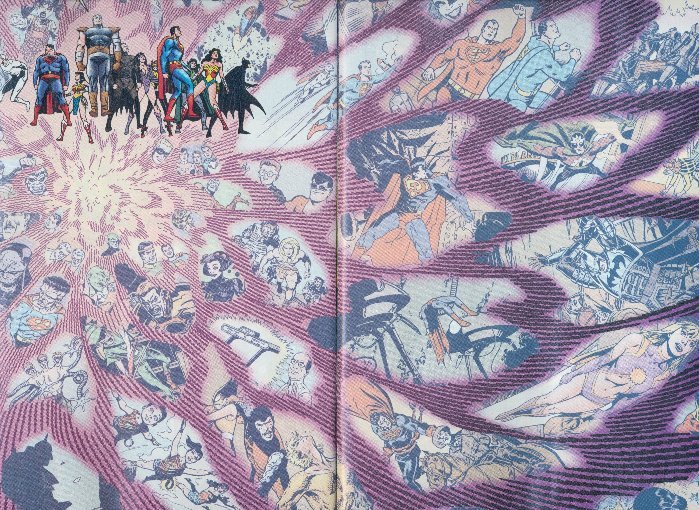
And despite the fact that Infinite Crisis ended three months ago, and DC has been publishing "New Earth" books for two months before that, we still don't know what the structure of the new DC universe is. We know that multiple Earths DID exist, it's been hinted that they still do, but it's also clear that Barry Allen, Jay Garrick, Billy Batson, Eel O'Brien, and Ted Kord were all born on the same earth, or at least everyone in the DCU remembers it that way. Similarly, the two page spread in Infinite Crisis #6 implied that EVERY comic DC ever produced, including the Zero Hour Legion and, ha ha ha, the Tangent Universe ARE also part of the New Earth, in some way. (My personal favorite part of Infinite Crisis #7 was the kids finding the Tangent Green Lantern on a beach).

So, was Hypertime really erased? Could it even be erased, considering it was just a description of the way comics were written anyway, an acknowledgment of the imaginary quality of the stories and the complexities of the world of ideas? Or have only our memories of Hypertime disappeared? For if GOOD ideas can cross from current to current, shouldn't BAD ideas be sluiced out, floating down the stream and getting lost in a sea of forgotten thoughts and half-formed dreams, never to be seen again?

Until, of course, one good writer has one good idea...

Tuesday, June 13, 2006

Tuesday Night Recommendation #4

JLA CLASSIFIED #22


Vibe, man.

Vibe!

and if you AREN'T Scipio...

JLA CLASSIFIED was the title that was my Justice League fix after JLA proper turned nigh-unreadable.

It is exactly what I think all comics should be. Self-contained stories that are only as much a part of continuity as they need to be: from the deeply grounded in history Gail Simone run to the possibly in continuity, possibly not Warren Ellis run, from the Seven Soldiers launching Grant Morrison run, to the tragic irony of the way WAY out of continuity Keith Giffen and J.M. DeMatties run, this title has been a wonderful playground where the writers can play with the toys they want, without having to worry about sharing them (or BREAKING them).

And it really has been ALL STAR, as these top writers have been matched with some of the finest (if sometimes under appreciated) artists in DC's stable. While Ed McGuinness's name might move some issues, Butch Guice, Jose Luis Garcia-Lopez, and Kevin Maguire are MASTERS of their craft and turned out consistently top-notch work.

And this, I am sure, will be no exception. Comic book veteran Steve Engelhart is teamed with the criminally under-appreciated Tom Derenick to tell the story of JLA: Detroit, the ill-fated attempt at turning the Justice League into the Avengers. It didn't work, mostly because the writing wasn't there to support them before.

I have a feeling that will change.

So pick up JLA: CLASSIFIED to support different format for storytelling, to support two pros in the field are just not given enough props, to support a team of under-developed characters just waiting for the right writer to bring them to life.

But mostly, do it for Vibe.

meng.

Tuesday, March 21, 2006

Supervillain and Writers

On my other blog, I posted about how factions of the Republican Party match up pretty well with Superman villains.

But thinking about them, the villains, I though about how I would write them. And I realized that I would writer each in the style of a different writer.

For example, Lex Luthor, I would try to write him a Garth Ennis would write him. Ennis's villains are all over the map, Starr, the head of religious secret society, Ma Gnucci, the harridan head of a crime family, God, but they share certain characteristics. One, they weild an incredible amount of authority over other people. They are supremely arrogant. And though they profess to have only the highest ideals, in reality they are motivated by survival and satisfying their most basic desires. All of which fit Luthor to a T. But more than that, Ennis knows how to write a complete bastard that we really, really, want to punch in the face. If Superman isn't at least tempted to throw Luthor through a wall or two, then he's not Luthor.

Brainiac, the alien intelligence, I would try to write as Warren Ellis. Ellis writes bastards too, but his bastards tend to be the hero. Ellis's problem is that, though he pretends otherwise, he cares about people. His best villains, therefore, are monsterous intelligences, like the Four from Planetary, forget their own humanity and consider other human beings noticeable only as resources and playthings. Brainiac not only is an alien, but he moves away from his own biological original form, and away from anything Ellis or the reader could feel any sympathy for.

Mr. Mxyzptlk (which I spelled right on the first try... I am such a nerd)

Anyway, Mr. Myxzptlk is a fifth dimensional imp who not only can do anything he wants, he knows he's in a comic book and can bully and cajole the editor into shaping the story as he would like. That kind of fourth wall breaking meta-commentary is right up the alley of Grant Morrison.
Those are the ones I can think of off the top of my head, and as far as I know, none of these writers have not written these characters.

Are there any other characters that should be written by certain writers, but haven't been yet?