Monday, April 16, 2007

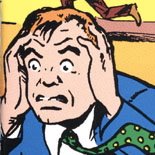
Oh you've GOT to be kidding me

SPIDER-MAN
Theatre
MUSICAL

AEA 29-HOUR REHEARSED READING
Director: Julie Taymor
Music and Lyrics: Bono and The Edge of U2
Musical Supervisor: Teese Gohl
Book: Julie Taymor and Glen Berger
Producer: Hello Entertainment/David Garfinkle, Martin McCallum, Marvel Entertainment
Casting Director: Telsey + Company
Rehearsals: Begin 7/2/07 in NYC
Reading: 7/12/07 and 7/13/07

Oh my God, they're ACTUALLY doing Kiss of the Spider-Man!

Sunday, April 15, 2007

Who Ya' Got?


OR


Wednesday, April 11, 2007

Who Wanted Him?

David Goyer, screenwriter of Batman Begins, has a sold a movie script to Warner Bros. called Super-Max, in which Green Arrow goes to jail and must team up with some of the supervillains he put there to escape!

That's a pretty strong premise, a story I'd like to read, but I'm curious why it's Green Arrow, of all superheroes, that's being sent up river in this movie. He's not exactly a name draw. In fact, Oliver Queen is down there with J'onn Jonzz, the Manhunter from Mars as least recognizable member of the Justice League, and no amount of guest turns on Smallville and Justice League Unlimited is really going to change that. For the vast majority of the movie going public, this will be their first exposure to the character.

So why use Green Arrow at all, and not some other, more famous superhero? My guess is that it was another hero at first. The plot seems fairly similar to Ed Brubaker and Michael Lark's Devil in Cell Block D, which is what I'm guessing Goyer originally pitched to the suits at Warner Bros.

Then one of the suits said,

Good story, but why should we buy the rights to Daredevil from Marvel and 20th Century Fox, when we already own the rights to these DC superheroes over here?

And Goyer said,
Okay, BATMAN goes to jail and must...

And another suit cut him off and said,
David, bubby, you're already writing us a Batman movie. How about someone else?

And Goyer thought and said,
How about a character who is like Batman in every way only more so?
It's not that I have a problem with Green Arrow. I actually think "superhero Robin Hood" a really cool and underused character concept. I just don't see the point in introducing him to the vast majority of the public in a film he's only in costume for the first five minutes of.

Why not use a more famous hero, like Green Lantern, who's instantly recognizable to MUCH more people? Or, if other heroes come with too much baggage to be exposed to the public and sent to jail, way not create an original superhero with whom you could do whatever you want?

In short, centering a film on Green Arrow, in which he's not called or dressed as Green Arrow for the majority of the film, assumes a public familiarity with the character that I just don't think is there.

Maybe I'm wrong.


p.s. Whether or not I actually see the film depends almost entirely on the director. Goyer is adept at translating comics to film, but the quality of his movies ranges from mediocre (Blade, directed by Stephen Norrington) to brilliant (Blade II, directed by Guillermo del Toro) to abysmal (Blade III, directed by, erm, David Goyer).

p.p.s. Green Lantern in jail image found on James Meeley's new site. Thanks, James!

Sunday, April 08, 2007

Rehabilitation

What is the true mark of success for a crime fighter? Is it solving crimes, or is it preventing crime from happening in the first place? Or is it something more?

For some years now, at least since The Dark Knight Returns if not earlier, a persistent fan criticism of Batman is that he just catches criminals, criminals that, thanks to the serial nature of comic books, will merely escape and commit more crimes. This critique seems even stronger as the Joker moved from being a colorfully clad bank robber back to his original conception of serial murderer. In light of those circumstances, says the criticism, Batman should just pull a Punisher and shoot the bastards in the head. It would save lives and a whole lot of time.

But what that criticism misses is that the criminals Batman hunts are, to him, human beings. Human beings with complex inner lives, capable of learning the error of their ways, capable of change and actually improving society. We, the readers, know that they are characters, villains who will play the villain roles forever, but Batman has hope.

And sometimes that hope is even rewarded. Catwoman. The Penguin. The Riddler. Three of Batman's most iconic foes have all, over the past fifteen years, basically abandoned a life of crime. Now, only Catwoman has taken a truly altruistic calling of protecting the East End of Gotham, but nightclub owner and private detective are not bad ways to make a living.

Think about the crimes Edward Nigma himself has solved. Think about the men and women employed, legally, at the Iceberg Lounge. Think about the lives Selina Kyle has saved in her role as midnight vigilante. (or for that matter, the life she gave birth to).

None of that would have been possible if Batman had just offed them the first chance he got.

A great story which hits this idea two ways sideways is the latest issue of Detective Comics. Not only does the main plot feature a Harley Quinn who sincerely wants to reform (or at least seems to), a key flashback is about how, while capable of killing, Batman's rogues are also capable of kindness, fear, sadness, and longing. And occasionally, acts of bravery.

Just as Batman himself has a lot of darkness in him, despite remaining a good guy, his enemies have some light hidden inside them. And given the choice between snuffing out that light in order eradicate the darkness, and letting that light remain in the hopes that it will someday shine through, Batman always chooses the later. Always.

Because Batman can solve crimes, or he can prevent crimes, OR, as a true mark of success as a crime fighter, he can help even his enemies become better people and actually improve the state of the world.

No point in throwing out the Harvey with the Two-Face.

Wednesday, April 04, 2007

For Kaitlin...

... who bought me Bone, who had a bad day, and just because:

Wonder Woman and kittens:


via Yet Another Comics Blog

Monday, April 02, 2007

Who the Hades is Wonder Woman?


I just don't get Wonder Woman. I don't understand her character. I don't get her appeal.

I get Superman. I get Batman. I get Catwoman, Batgirl, Black Canary, Captain Marvel, Mary Marvel, Supergirl, Power Girl, Big Barda, Manhunter. I understand these characters. I understand what attracts me to these characters (or other fans to these characters). I feel that I have a good idea of what they would and would not do, say and would not say.

But Wonder Woman? Clueless.

Which is to say, I have no idea how to write her, what her reactions to the world are. How would she react to criminal, a dictator, a monster, a killer, in a way that is noticeably different from Superman, or Batman, or any other member of the Justice League?

Even the usually awesome Justice League cartoon couldn't quite get a handle on her, as her character slides from naive teenager in season one (worrying what she is going to say to her mother after running away from home) to angry warrior woman in the first season of Justice League Unlimited to Ambassador and inspirational Leader in the last season.

Who is this woman?

I understand her appeal as an icon, a symbol of women's power. I understand the appeal of a wonder woman, a being who steps out of myths in the "real" world, bringing a era of gods and monsters with her.

But who IS Diana, clay golem, Amazon princess, ambassador for peace, warrior for Justice? What does she like? What does she fear? What amuses her? What angers her? Gods, I don't even know her favorite cookie!

I've heard this complaint before, and people have said the problem is that Wonder Woman doesn't have a civilian identity, a place she can go to be human (arguably, this is what the new Wonder Woman series is about, but it's hard to tell). But I call shenanigans on that! There are plenty of superheroes with negligible civilian identities, but that doesn't mean they lack character!

Take the late Superboy. From 1993 to 1998, he had no name other than Superboy! A clone of Superman, a superhero literally since conception, no part of his background has anything civilian or human to it... but that didn't mean his character couldn't be defined, or his strengths and weaknesses, triumphs and tragedies couldn't be relatable.

Similarly, J'onn J'onzz, the Martian Manhunter, is a shape shifting telepath, FROM MARS, who witnessed the death of his entire planet. We shouldn't come close to understanding him, but we do. We understand his loss, his alienation, his anger, his wry humor, his love for Chocos.

So what the hell is wrong with Wonder Woman? Why can't I know her, why can't I get her? Is there just too much there? Too many writers over too many years imposing their unique visions of a strong woman onto one character, until the original is lost? What is her core, her essence? What the heck is going on?

Thursday, March 29, 2007

Essentials

I'm curious about the recommended reading lists attached to the 2 page origins in the back of 52.

What criteria was used to determine "essential storylines"? Are these the stories you have read to understand these characters? Are these the best stories told using the character? Or are they just what's been collected into trade paperbacks, recommending the individual issues only as a last resort?

Take last week's recommended reading for Batman, for example. It's hard to argue with Batman: Year One on that list. It's not only THE definitive origin for Batman for the last twenty years, it's also a hell of a good story. But The Bat-Man in The Batman Chronicles is hardly the same character written now, and Batman: The Greatest Stories Ever Told isn't one coherent storyline at all (though I guess the individual issues collected could be considered essential).

But the real standout on the list is The Dark Knight Returns. It's the only storyline recommended so far that is absolutely out of continuity, a story set in the dark alternate future of 1986. Reading that book will NOT get anyone not familiar with Batman up to speed with the character currently starring in Detective Comics.

And yet...

No book* in the last 20 years has had such an effect on how Batman is written as Dark Knight Returns. Batman as obsessive, as fanatical, violent, asshole-ish, all comes from Frank Miller's depiction of what Batman would be like when he's old enough to have a late life crisis. So while reading the book won't give you the history of Bruce Wayne, you DO kind of HAVE TO read it to understand the history of Batman as a character.

But then ANY book could be Essential, if it has a profound effect on a character. Watchmen is essential reading for all the Charlton characters running around the DCU, especially the Question, Blue Beetle, or Captain Atom (hmmm....). All Star Superman will almost certainly become essential. And Kingdom Come, for good or ill, is absolutely necessary to read to understand why the DCU looks the way it does.

I guess it's just further proof that saying this story changes everything and this one changes nothing means nothing, and that any story could be the one that really takes characters to somewhere new. So why worry whether it lines up with other depictions. It's all Hypertime anyhow...


*arguably, Dini and Timm's Batman: The Animated Series is an even bigger influence, but the recommended list seems limited to books.

Monday, March 26, 2007

It GLOWS?


That kind of love requires a shot of penicillin!

Friday, March 23, 2007

Anti-Neutral

In this post, I argued that in modern context, a character who is straight, white, and male is read as a blank slate, neutral, with no connotations attached to him. It's racist, sexist, and heteronormative, but it's true. Asked to describe the Spirit in issue one of Darwin Cooke's series, a character calls him a "big blue average with a distraction stuck on his face." He's not, of course. He's tall, well muscled, has brown hair. But he's straight, white, and male, and therefore "average."

A "big blue average with a distraction stuck on his face" is also a pretty good description of The Question. He has a mask that erases his face, takes away his features. His schtick is that he really could be anyone. That is, anyone who is a straight white man...

But that's not true anymore, is it? That Question, the Vic Sage question, died, and his replacement is, a ha ha, Renee Montoya.

A Gay Latin Woman.

A gay latin woman with no face.

Does that work? I'd be really happy if it did, because it'd mean that being gay or being a latina is NOT your identity or your definition. That the face, the individual, is what's important, and take that away and Montoya becomes nobody, could be anybody.

Could this be the new neutral?

Wednesday, March 21, 2007

DAMN YOU, GAIL SIMONE!

I wanted to do that!

I had a really good idea for it too, involving Norse mythology, a Doomsday scenario, the legendary all Sub-Zero version of Suicide Squad (Captain Cold leads Mr. Freeze, the Icicle, Killer Frost and others into battle), and a vision quest for the unlikeliest of heroes!

But nooo-ooo! You have to go and do it first, just to get people to read Birds of Prey 104. Like it wasn't enough that it features round one of the long anticipated Big Barda/Knockout slobberknocker! (Well, long anticipated by me, anyway). You have to throw in an, er, event fans have been asking for for literally a decade.

You're just, you're just greedy! That's what you are!

Pbbbbbt!