Showing posts with label Kingdom Come. Show all posts

Thursday, March 29, 2007

Essentials

I'm curious about the recommended reading lists attached to the 2 page origins in the back of 52.

What criteria was used to determine "essential storylines"? Are these the stories you have read to understand these characters? Are these the best stories told using the character? Or are they just what's been collected into trade paperbacks, recommending the individual issues only as a last resort?

Take last week's recommended reading for Batman, for example. It's hard to argue with Batman: Year One on that list. It's not only THE definitive origin for Batman for the last twenty years, it's also a hell of a good story. But The Bat-Man in The Batman Chronicles is hardly the same character written now, and Batman: The Greatest Stories Ever Told isn't one coherent storyline at all (though I guess the individual issues collected could be considered essential).

But the real standout on the list is The Dark Knight Returns. It's the only storyline recommended so far that is absolutely out of continuity, a story set in the dark alternate future of 1986. Reading that book will NOT get anyone not familiar with Batman up to speed with the character currently starring in Detective Comics.

And yet...

No book* in the last 20 years has had such an effect on how Batman is written as Dark Knight Returns. Batman as obsessive, as fanatical, violent, asshole-ish, all comes from Frank Miller's depiction of what Batman would be like when he's old enough to have a late life crisis. So while reading the book won't give you the history of Bruce Wayne, you DO kind of HAVE TO read it to understand the history of Batman as a character.

But then ANY book could be Essential, if it has a profound effect on a character. Watchmen is essential reading for all the Charlton characters running around the DCU, especially the Question, Blue Beetle, or Captain Atom (hmmm....). All Star Superman will almost certainly become essential. And Kingdom Come, for good or ill, is absolutely necessary to read to understand why the DCU looks the way it does.

I guess it's just further proof that saying this story changes everything and this one changes nothing means nothing, and that any story could be the one that really takes characters to somewhere new. So why worry whether it lines up with other depictions. It's all Hypertime anyhow...


*arguably, Dini and Timm's Batman: The Animated Series is an even bigger influence, but the recommended list seems limited to books.

Wednesday, January 10, 2007

Fixing Civil War

I was enjoying Marvel's Civil War. The basic premises, a conflict between security and individual rights played out as a literal battle between established superheroes, and how honorable people can end up violently disagreeing over important issues, are very strong and the art is very pretty. However, there have been MAJOR problems that have turned me off the whole thing.

And it didn't need to be that way. Here's how I would solve the problems of Civil War. (Nope, no hubris here).

1. The production delays. Yes, these are a problem. And whether by delaying the whole series until the late summer, to give Steve McNiven more time to draw, or calling in a fill-in artist, or simply not delaying other major titles so as not to spoil the shocking, shocking (ultimately, not that shocking) reveals, the delays should have been anticipated and dealt with. Personally, I would have disentangled it from the Marvel universe proper until it was resolved or almost resolved.

2. More to problems in the story itself, I'd make the Superhero Registration Act damned specific. Right now it's a vague mess. And if the debate is security vs. privacy, which it should be, the law should be a strongly enforced anti-vigilantism law, because, honestly, if you're using your mutant powers to bake cupcakes, who cares, but if you're just a regular joe using M-60s to mow down Mafia goombas, I think the police would like a word with you. Then the debate becomes whether superhumans have the right to take the law into their own hands without accountability to the public, and then, if you agree that they need to be watched, well, quis custodiet ipsos custodes?

3. As a corollary, the opening incident needs to be the direct result of the superhero committing a crime in the name of justice, and innocent people dying because of it. As it stands now, the New Warriors, funded by a television company and being documented by their own news crew, failed to stop a bad guy from killing lots of people. It is hard to see how the New Warriors could have been MORE public and MORE accountable, considering most of them died trying to save lives and there is still a major corporation that can be sued for damages, and being restrained by the law would NOT have prevented the explosion.

If I were writing Civil War, the Stamford Incident would have been caused by any of Marvel's monstrous or murderous anti-heroes beating Nitro to death, releasing his explosive energy in a civilian setting. In my dream scenario, it's Ghost Rider, who uses his penance stare to make Nitro go boom, so that only he remains in the burnt out field, charred bodies all around him. (Now he has to lam it on his bike every time the super authorities catch up with him, but can he out run his own guilt? But that's my pitch for a GR ongoing, and I digress...) So instead of heroes dying before they can prevent a mad man from killing, we have an immortal demon chasing vengeance regardless of the human cost... and THAT could get some people talking about new laws and new enforcement.

4. Captain America is the conscience of the Marvel Universe. Once he picked a side, it was all over. So I'd switch Captain America's and Spider-Man's positions, making Spider-Man the anti-reg leader and Cap the conflicted supporter/patsy of Iron Man. Yeah, it's America torn by Civil War, but even with the cliché, it works. It also makes more sense that Tony Stark would court his old friend and long-time ally, the universally beloved World War II hero Steve Rogers, to be the face of his campaign, rather than the publicly reviled Spider-Man, who Tony Stark may have worked with before but barely knows. And I could imagine Cap. America, Iron Man, and Reed Richards (the daddies of MU) making a good case that the kids can't just run around breaking things unsupervised.

It also puts Spider-Man in a more interesting position. More than anyone else (except maybe Matt "Daredevil" Murdock) Spider-Man knows the dangers of having his identity exposed. At the same time, Peter is hardly used to working on a team. What will he do when he has the power and responsibility of leading others into battle? Is openly flaunting a law putting his family in less danger or more? It also opens up class questions (Rich (Iron) Man/Poor (Spider) Man) and age gap issues.

5. I wouldn't put all the assholes on one side. The pro-registration side could have a very strong case, if they were not also so into throwing their friends into concentration camps, hiring mass murderers to hunt down people who have broken no laws but disagree with them, and play Odin by trying to clone gods. Not that superheroes can't make mistakes or be wrong, but shouldn't both sides be guilty of doing terrible things? Wouldn't it make more sense for the side without public and government support to be doing the more desperate, ethically questionable things? (so far, the worst thing they've done is let the Punisher save Spider-Man's life).

6. And less "shocks". The conflict is strong enough to carry seven issues without reveals like Thor, Clone of Thunder, the all new Suicide Squad Thunderbolts, and Dark Speedball. All that does is distract from the main idea, the underlying moral conflict. I know it's the major crossover, tying into tons of books and launching more than a few series, but the story would be better served by paring down the "moments" and leaving more space for character work and emotional beats.

So, to re-cap,

1. Cut it off from the rest of superhero books, for now.

2. Clarify that the debate is over vigilantism, and who watches whom.

3. Have the catalyst explosion be caused by over-zealous, not incompetent, super "heroes."

4. Put the moral center of the universe in the center of the conflict.

5. Morally compromise both sides, especially the less powerful side.

6. Get rid of the stupid stuff.

Oh, wait, that's Kingdom Come.

Saturday, July 29, 2006

Ahead of Its Time

"What is this Hypertime that you speak of?"– Mark Waid at San Diego Comic-Con


Well, Mark, I'm glad you asked.

Hypertime was Mark Waid's [edit: Fine, FINE! and GOD OF ALL COMICS Grant Morrison's] attempt at replacing the parallel universe concept in the DC Comics universe.

Before 1986, most DC Comics were considered to take place in the same, "mainstream" universe and comics published by other comic book companies and even National comics published before the Silver Age were considered to take place in alternate dimensions, crossing over only through extraordinary measures. After 1986, that was changed so that ALL characters created for or acquired by DC Comics existed on the same Earth, which eased character interaction. (This, I consider, was a good thing, because crossovers are fun, create a richer history for the characters, and boost sales of the smaller titles through easier use of "guest stars.")

However, editorial mandate or not, DC Comics continued to publish books that did not take place officially in the DC Universe. Originally called "imaginary stories" and later branded as "Elseworlds," these stories took the familiar characters and either placed them in radically different settings or simply had events that would make an ongoing series difficult (such as, say, death). The most famous Elseworlds is Kingdom Come, by Mark Waid and Alex Ross, though The Dark Knight Returns and Watchmen could be considered Elseworlds as well.

On top of that, there were film, television, print and radio versions of all these superheroes out there, with varying degrees of fidelity to the source material.

The "problem" was that these stories, despite being unofficial, had a habit tying into the main universe. Following the The Dark Knight Returns, the "main universe" Batman began acting more and more like the dystopian, aging, paranoid, sadistic version. Following Kingdom Come, Alex Ross's character re-designs started to appear in the main books, as well as hints that, in fact, Kingdom Come was the future of the DCU. And the Batman Animated Series introduced two important new characters to the Batman mythos (Renee Montoya and Harley Quinn), as well as changing (and improving) the design and origins for most of the characters (notably Mr. Freeze).

Hypertime was an attempt to address this reality. Mark Waid's [edit: and Bald and Beautiful Grant Morrison's] concept had two major differences from the previous theory of the Multiverse.

The first is that it included EVERYTHING. Every imaginary story, every Elseworlds, every movie, musical, every possible appearance by anyone anywhere. Presumably, this also included works that DIDN'T involve DC characters directly, like comics published by Marvel and Dark Horse. It certainly included comics published by Wildstorm, which DC Comics purchased the same year Hypertime was introduced. DC Editor Mike McAvennie once described it to me as "All stories are equally imaginary."

The second difference was that, rather than parallel Earths, the different worlds crisscrossed all the time, feeding into each other. So if, say, Smallville introduced a Lex Luthor who grew up in Smallville, yes, suddenly the DC Universe Lex Luthor had a childhood in Smallville as well. Under the old version, the Smallville Lex would have had to literally tear open a hole in the fabric of time and space and take the non-Smallville Luthor's place in order for that to occur. Under Hypertime, that changed history just sort of happens.

On the macroscale, it meant that any story, anywhere, COULD be an in continuity story for any one particular issue of, say, Impulse. Even if it's a fifty year old comic, or published by the Marvelous competition, or if it's a 19th century proto-horror novel. On the microscale, it means that every individual issue is a current within the main stream, which may or may not affect the other currents. After all, as Kurt Busiek once said, "they're all fairy tales we pretend take place in the same world because it's more fun that way."

BUT... as the quote above suggests, in the wake of Infinite Crisis, Hypertime is concepta-non-grata at DC Comics now. In fact, writer and editor alike act as if Hypertime has been, ha ha ha, erased from time. And the reason is... Hypertime never really worked. No one [edit: Not even 12th level intellects Mark Waid and Grant Morrison] ever did anything particularly interesting with Hypertime. Mostly, writers just treated it as another word for Multiverse, with the added bit that it might include some of our favorite Elseworlds characters (such as one AWESOME (and criminally uncollected) Superboy story).

Why was that? My theory is that Hypertime was too metaphysical a concept. Quite frankly, it was just a description of the way the creative process actually works. If he or she sees a good idea, consciously or unconsciously a writer will incorporate that idea into their work. Acknowledging, in story, that that happens may reduce fanboy whining about what is or is not in continuity (Yes, it's all in continuity), it doesn't actually help tell a better story. (At least not one that I can think of.) And so it's become passe.

Or has it? DC has, for now, stopped their Elseworlds line, though if New Frontier, JLA Classified, Bizarro Comics, Solo and the ALL-STAR line are any indication, they haven't stopped producing comics that are outside established DC continuity. They also still publish the Vertigo books, some of which still have an ill defined connection to the Justice League world, as well as Wildstorm's superhero and non-superhero books.

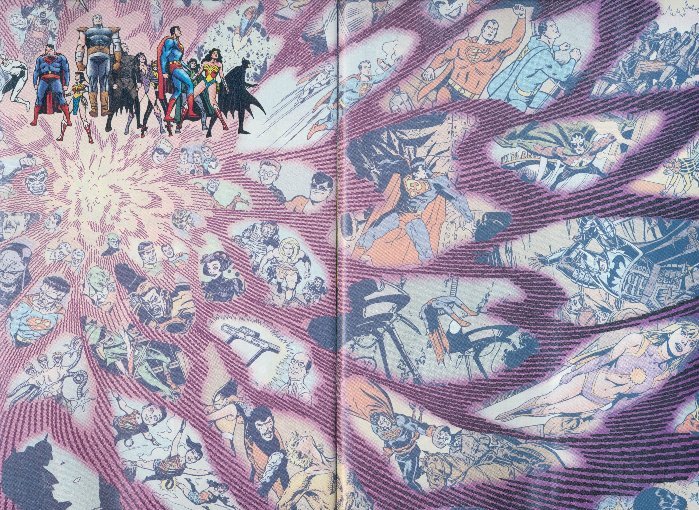
And despite the fact that Infinite Crisis ended three months ago, and DC has been publishing "New Earth" books for two months before that, we still don't know what the structure of the new DC universe is. We know that multiple Earths DID exist, it's been hinted that they still do, but it's also clear that Barry Allen, Jay Garrick, Billy Batson, Eel O'Brien, and Ted Kord were all born on the same earth, or at least everyone in the DCU remembers it that way. Similarly, the two page spread in Infinite Crisis #6 implied that EVERY comic DC ever produced, including the Zero Hour Legion and, ha ha ha, the Tangent Universe ARE also part of the New Earth, in some way. (My personal favorite part of Infinite Crisis #7 was the kids finding the Tangent Green Lantern on a beach).

So, was Hypertime really erased? Could it even be erased, considering it was just a description of the way comics were written anyway, an acknowledgment of the imaginary quality of the stories and the complexities of the world of ideas? Or have only our memories of Hypertime disappeared? For if GOOD ideas can cross from current to current, shouldn't BAD ideas be sluiced out, floating down the stream and getting lost in a sea of forgotten thoughts and half-formed dreams, never to be seen again?

Until, of course, one good writer has one good idea...