Tuesday, October 31, 2006

Happy Halloween Judeo-Christians!

First off, yes, in '99 I went as Clark Kent. It helps if you already have the glasses, a suit, and superman t-shirt, and a fedora to really complete the look.

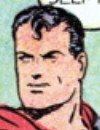
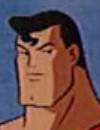
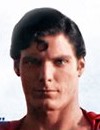
Which brings up the spit curl, Superman's "cheating cape." The little "S"-shaped hair thing that hangs in front of his face.


Because it's NOT really a spit curl. A spit curl is plastered with gel to the forehead. What Superman has is a loose forelock. It gives him a "boyish charm," (thanks, BB) like he's so busy saving lives that he doesn't have time to comb all his hair. It just happens to form the shape of an "S." It just happens to ALWAYS form the shape of an "S." In comics, you can do that.

But you can't in real life. Not on film, or television, or your Halloween costume. A loose forelock is lucky to curl attractively at all, let alone a symbolic double curve. Mine would go straight up, my brother's would endlessly curl into itself. So the make-up artist plasters that sucker down with a beehive of wax.

Which looks WRONG. And it looks wrong because it looks like CLARK gave himself that ridiculous hair-do BEFORE RUSHING OFF TO SAVE SOMEONE. So the hair "S" goes from a sign of how much Clark values people over his hair to how much Clark values his hair over people.

The dick.

Anyway, I thought was another example of one of those things that works in comics, but just doesn't when transported to other media. Flight, psychic ability, transformation, those cross over fine. But size changing capes and meaningful haircuts? Not so much...

Monday, October 30, 2006

Last Words (and Pictures)

Hey, I'm back. Miss me?

I want to talk about last pages. It's really the advantage of the singles over the trade. The shocking reveal. The nail-biting cliffhanger. The joke and freeze. Even the summation, moral, and coda. The great last page confirms "Yeah, you just read A Story, a real story, and don't it suck for you that you have to wait a whole 'nother month for what else we got in store." You lose that in the trade. Golden moments, like Superman and Lex Luthor plummeting to Earth in Up, Up, and Away, are frozen in time as you wait weeks for the next issue. In the trade, it's just another page in the middle of the book.

Yeah, it's arbitrary, a product of the medium rather than a creative choice, but good creators can make the boundaries work for them. I bought six comics last week* and all but one had BRILLIANT last pages. (The outlier was Boys #4, which is probably my new definition of "wait for the trade.")

Secret Six #5 employed the classic, reveal and cliffhanger one-two: forgotten character reappears, then immediately puts our heroes in mortal jeopardy. Now you have to read issue #6, the conclusion, to see how our "heroes" get out of this one. If they get out of this one.

52 #25 does the classic with a double twist. Not only does the mysterious mastermind behind the Island of Mad Scientists step forward to imperil Black Adam and Isis, his identity turns out to be a new twist on an old, buried character, and his particular threat references earlier clues in the series itself, drawing the disparate plots together.

Action Comics #844 has a reveal, but really the last page serves as a summation and conclusion. It ends the chapter being told. The story could conceivably just end on that last page, since it establishes a new but relatively stable status quo. Not that it will, because there's a "to be continued" hiding in the bottom right corner and the new status quo is too big a change to be confined to just one book.

Nextwave #9, plotwise, doesn't have that great a last page. Nothing's revealed. The heroes are in no more or less danger on the last page then they were six pages earlier. It certainly isn't the end of the story, or even the beginning of a new one. But it was a PERFECT last page. Because it contained a joke--a joke so powerful that I could not continue reading. That's right, Ellis and Immonen knew that anything read after that page would be lost in its massive wake, so they moved it to the end where it could do no harm to the rest of the story, while at the same time positioning the joke for maximum focus, making it more powerful than you can possibly imagine!

But of course, the comic of the week, my HANDS DOWN pick, is Seven Soldiers of Victory #1. And it had THREE great last pages. Sure it could have ended on page 37. With its narration directed at the reader and image and panels that recall the first page of the first issue of Seven Soldiers, it would have been a nice bookend. Or it could have ended with page 38, the twist ending. But like Nextwave before it, Seven Soldiers had a moment, an image so powerful that it FORCED itself to the last page. The moment certainly isn't the end of the story. It's not even a very important moment to the main plot.

But the image IS the story of Seven Soldiers. It's a monument to unending nature of comics, that every last page is an advertisement for the next issue, that every death and birth is there for later writers to undo and redo. It's an image that mixes the macabre with the sacred, the simple with the mysterious, the absolute mundane with the beyond fantastic. It's an image that says superheroes can do impossible things, and that's why we love them. It's a moment so great that there just can't be another page, even though it's a last page that SCREAMS "TO BE CONTINUED!!!" without saying a word. It has to be the last page, because after seeing that page, there's nothing left to say...

until next month...


*yeah, vacation doesn't stop the habit. Once, when traveling through Alaska, I made a stop at the world's most Northern Comic Book store to pick up Zero Hour #0, which was out that week.

Saturday, October 21, 2006

THE RETURN

I know I said I was going on vacation, and I swear it's this last post then I'm gone, but how could a pass up the opportunity mention the Earth-New return of...

GO GO CHECKS!

Friday, October 20, 2006

Scatter-Thoughts

Going on vacation for a week, so new post for a bit.

In the meantime, I leave you with some random thoughts.

Hey, Robert Kirkman, if you want to read about "an inexperienced hero who would get beaten up constantly and probably die," check out this week's Robin. Or Birds of Prey. Or 52.


The only thing that would have made the page of new heroes shouting their stupid names better is if they had shouted them in Logo Font.


Speaking of, Red Tornado looked beyond the veil of universe and saw 52... what? My guess: 52 other universes (which, including the universe he was in at the time, would be a full pack plus a wild card). And they're coming.


If the conversation on superheroes and class is going to keep going, we might want to start defining our terms. I realize in my own arguments I'm getting thrown off my point a lot by confusing aristocracy, wealth, style, education, power, and morality. The original question was whether the superhero genre perpetuates the myth of aristocracy, that some people are just born to rule. That's shifted a bit into whether Batman fights social injustice and why aren't more superheroes classy, with claims of anti-intellectualism thrown in.


The anti-intellectualism claims really bother me, for some reason. There's this odd assumption that having an education, particularly a post graduate education, is synonymous with being upper class, an influential figure on the course of society, which just isn't true. Most of the academics I know toil in obscurity (and read this blog! Hey, Aaron, David, and Jeff)!. As Cole points out, Kal-El is not a lost prince of Krypton. He's the son of a smart but not highly respected scientist. Meanwhile, Bruce Wayne (who we all agree runs Gotham, yes?) never even went to college. And back in the real world... well let's just say that being a total and complete moron doesn't stop you from getting elected President.


Casanova is a heck of good read. As is 100 Bullets, which has started barrelling towards its conclusion.


Has it really been a month since ANY issue of Superman's three ongoings have hit the shelves? And I have to wait till December for more All-Star goodness? C'mon! I'm starting to feel like a Green Lantern fan over here.


Speaking of, sort of, Morrison Batman run filled-in by The Spectre team of Ostrader and Mandrake? Yeah, I'll take that.


Yes, I heard about NextWave. No, I'm not surprised. No, I haven't rent my garments nor gnashed my teeth. Yes, that will be one less Marvel title I'm buying. Yes, I'll probably pick up whatever NextWave limited series come down the pike. No, I'm not buying Thunderbolts.

Thursday, October 19, 2006

Plutocrat

In my People's Superman post, I mentioned that Superman being an anti-aristocratic hero is an exception to the rule, that most superheroes are aristocratic in both background and behavior, and the best example of that is...

Batman.

Yes, Batman.
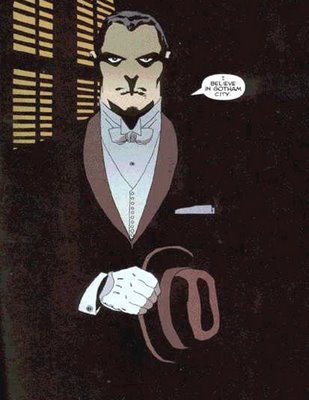
Batman isn't just "the man," Bruce Wayne is also The Man. He's a rich, white, handsome man who comes from an old money family and is the main employer in Gotham. He owns half the property in the city. In a very real sense, Gotham belongs to him, and he inherited all of it.

Accordingly, Batman has an enormous sense of entitlement. Batman just assumes he's right in every situation. It's his city. If he doesn't like you, he'll tell you to leave. If Batman thinks you're guilty of a crime, he'll put on his pointed white hood black mask and beat the crap out of you. Laws? Civil rights? Due process? Those are for other people. Yes, the people may have elected a mayor, pay taxes to employ the police. Batman could work with them, but they're all corrupt, weak, not as good as him. (Except Gordon. Batman has generously determined that Gordon is worthy to contacted, though he always disappears before Gordon's done talking, just to remind Gordon who's the bitch in this relationship.)

And look at who he fights! Superman fights intergalactic dictators, evil monopolists, generals, and dark gods. Batman fights psychotics, anarchists, mob bosses, the mentally frail, and environmentalists. Superman fights those who would impose their version of order on the world. Batman fights those who would unbalance the order he imposes on Gotham.

Consider the Penguin. He's a criminal, a thug. But what really distinguishes him is his pretensions to being upper class. The tux, the monocle. The fine wine and fine women. Running for mayor. He tries to insinuate himself with actual socialites, some of whom are attracted to his air of danger, but most of whom are repulsed by his "classless" manners. And when his envy and resentment of his "betters" turns to violence, Bruce steps in to teach him his place.

And it's not just Mr. Cobblepot. Hugo Strange, Black Mask, Facade, Catwoman, all villains from lower class backgrounds who want to be upper class, who want to hobnob with the rich and famous at one of Bruce's fabulous fetes, but just can't pull it off (well, Catwoman can, but Selina's in a class all by herself). Even Harvey Dent, before he became Two-Face, envied and resented his friend Bruce Wayne, because Wayne had money and Harvey had to work for everything he got. And then there's the villains who have a vendetta against C.E.O.'s of powerful corporations, either for revenge (Mr. Freeze, Clayface) or out of principle (Ra's al Ghul, Poison Ivy). There's a class war going on in Gotham, and Batman has taken the side of the rich.

Like Superman, there's an Arthurian "king-in-hiding" element to Batman's origin. "Banished" from Gotham by the death of his parents, Bruce Wayne returns to redeem his land and reclaim his throne. But instead of reclaiming it from usurping uncle or foreign invader, Batman must take Gotham back from a rising underclass.

And Batman doesn't even like the upper class he belongs to, either! Shallow, petty, boring, vain. They know nothing of the pain and suffering he sees every night when he hunts killers through the slums of Gotham, every day when he closes his eyes. He mockingly refers to himself as a "plutocrat" in last week's JLA: Classified, dismissing both value of plutocrats and the intelligence of a dictator who courts them. But does he dislike his wealthy peers because they don't appreciate how wealthy they are? Or is it because they aren't wealthy enough to appreciate how much responsibility he has?

And even if he thinks they're upper class twits, he really doesn't do anything about it. He leaves them in place, protects them from harm, flirts with and beds them. They're not the bad guys, after all. It's all those poor evil people. The one's who keep crashing the gate, who happened to be accidentally hurt in the hunt for profit. No reason Batman should try to protect them, keep them from getting crushed under the weight of capitalism.
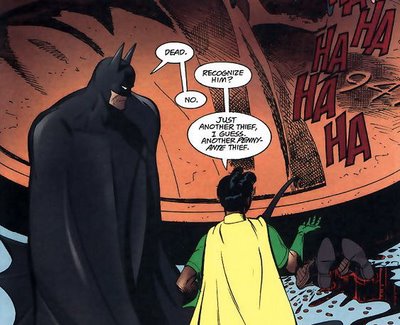


They're just "penny-ante". And Bruce is a plutocrat!

Wednesday, October 18, 2006

Tuesday, October 17, 2006

Mission: Bullpossible


"He's got...lifeless eyes, black eyes, like a doll's eye."

or

Seen here carefully constructing his war machine

or

"And don't wear red!"

or

I bet Giraffo's behind this, somehow.


(thanks, Brandon, for meme and image)

Neutral

Hey Everyone! How ya been?

First up, thanks for the links, anonymous posters on The IMDB and Television Without Pity message boards. With your help, I cracked the 10,000 mark. (and while I appreciate being considered an "expert" on Lois Lane, the idea of "Chlois" just creeps me out to no end, possibly because it sounds too much like "Clor".)

And thanks to Ragnell for conscripting me into Beefcake/Cheesecake Week. It saves me the trouble of having to come up with a separate post. (and HOLY! Is this the kind of traffic you get everyday?)

This response from Robert Kirkman to the strong criticism of the death of Freedom Ring got me thinking. Kirkman cops to being too clever by half, basically, taking two really good ideas for a superhero ("being superpowered isn't enough to make you a superhero" and "being gay is not the beginning and end of defining a character") and muddling them both by combining the two. While clearly not his intention, a very clear interpretation of the result is that Freedom Ring was killed because he was gay.

What I started thinking about was how Kirkman could have told the first idea without getting into trouble. (The idea of a superhero actually suffering and sacrificing to do his job, obviously, interests me.) And I realized the only way he could have done it is if Freedom Ring was a straight white male.

If Freedom Ring was black, or Hispanic, or Asian, or if he were a she, then Kirkman might have been accused (rightly accused) of implying that Freedom Ring was incompetent because he was black, because she was a woman.

But no one would reasonably say he would have died because he was male, or white, or straight. For storytelling purposes, a straight white male is neutral, contains no value that informs or overwhelms other, subtler personality traits.

It reminds me of something I read in... a book whose title escapes me now, but I'll remember later a book by Douglas Hofstadter. It said that you can't start a joke "a woman walks into a bar..." unless the joke was about her being a woman. If the punch line is "I was talking to the duck" then the listener is left wondering why you specified the lead as a woman. This does not happen if you say "a man walks into a bar..." "Man" is a blank template, and if his sex is not essential to the story, no one tries to figure out why you brought it up. For some reason, "man" is less specific that "woman."

Which is crap, of course. In reality, being straight, being white, or being male, DOES inform character just as much as being gay, black or female. So those traits SHOULD inform the writing and reading of characters just as much traits that aren't "neutral". Which is to say a little, but not entirely.

The solution, I feel, is just having more and more varied characters who are gay (or who are black or Hispanic or who are women), so that the "value" of "gay" is weakened until the unique person shines through.

But it does put Kirkman in a bind for writing a character "who happens to be gay," right now. Without counter-examples of competent gay superheroes to compare Freedom Ring to, it's hard to argue that the failure and the gay have NOTHING to do with each other.

He certainly shouldn't have told the story at Marvel, which has so few gay characters. It would have been better, but not much, in the DC universe, where at least Obsidian, Piper, Montoya, and Maggie Sawyer kick ass.

But in the Wildstorm Universe, where the two baddest bastards on the planet also happen to bone each other, Freedom Ring's story would have taken on an entirely different meaning. There, the lesson would be "being superpowered AND gay isn't enough to make you a superhero." And that's a story I can support.

Wednesday, October 11, 2006

J.L.U.N.

Ahh, that's better. Now I feel like I have some room to breath. Certainly my posts with big images, like my recent post on the myth of aristocracy look a lot better now. And I followed through on my promise of adding a greatest hits section (based on hits and links).

Went to the store today. A slow week for me. The most enjoyable comic was 52, which enjoyably progresses a plotline or three. Nothing surprising, (except maybe the religion bit), but well executed, particularly the tan line. I mean, the line about the tan.

Whatever.

But the most interesting comic, the one that stuck, was JLA Classified #28. Howard Chaykin started from the same basic premise as Gail Simone's run (Justice League intervenes in international politics) and goes in a very different direction. There's a lot of smart writing going on there. The two fictional South American nations featured supposedly have radically different ideologies, one communist, one capitalist, but the rhetoric does little to disguise the fact that they are nearly identical dictatorships. (Though I should note the capitalist dictator welcomes "plutocrat" Bruce Wayne with open arms, while the communist opens up to, of course, that old leftist Clark Kent.) And even though it's clear they're both bad guys, it's not black & white whether the Justice League is doing more good than harm by intervening, which is nice. There's even a crack about the American comics industry that's both nicely done and awfully mean.

The art's good, not great. Tom Nguyen really does make every penciller's work look like Doug Mahnke, but weak Doug Mahnke. And it's a three or four issue story at most, unfortunately told over six issues. But it's a good solid Justice League story where Wonder Woman and Batman actually hit people instead of bitching at each other from across a table, so I'd recommend picking it up.

In other news, Earth Prime has in fact bled into the DC Universe, as Infinite Crisis the book shows up in Gotham book stores. And as before, what is fiction here becomes non-fiction there.

But if Superman, Batman, and Wonder Woman are missing, how did the writer learn what happened on the moon?

Damn it, Frey! Not again!

Tuesday, October 10, 2006

Ch-Ch-Ch-Changes!

So I've upgraded to Beta Blogger and, except for an inability to figure out how to hide full posts behind jumps, everything seems to be working fine.

I've taken the opportunity to tweak the blog a bit, adding some of my (non-comics) blogging friends to the blogroll.

Also, since I haven't updated the old blog since starting this one, I've decided to just go ahead and make this the one and only, so expect a few OT posts (though the majority will still be comics).

I'm also planning on adding a "Greatest Hits" section to the side-bar, so that the random reader who follows a link to a particular post can see others they might enjoy. Any suggestions? Posts you particularly liked? The kind of post that made you say "That's it, he's going on the list!"

In other news, last night I was at The Big Quiz Thing. Question #3 was "What strange 60s superhero team consisted of Chief, Robot Man, Elasti-Girl, and Negative Man?".

Needless to say, we came in first.