Showing posts with label J. Jonah Jameson. Show all posts

Thursday, June 29, 2006

Thursday Thoughts #1

First off, a big shout out to When Fangirls Attack! for the link love. Not only was the link accompanied by a strong recommendation to read (aww, thanks guys!), it also boosted my visitor count.

Seriously considering turning this into a feminist comics blog, just to keep up the stream of readers.

But no comments yet. Not even from James Meeley. James, if it helps, I really did enjoy your wife's list of good or bad superheroes to date. That was some funny stuff right there. Not sure how it fits into your belief that "a super hero comic is not the platform for 'exploring sexual identities'", particularly the bit where she suggests Namor would be bad in the sack or that Ralph Dibny could inflate his body parts "the right way," but whatever. I guess as long as it's not two dude holding hands.

On another note, did you know I bought comics today? A crapload of them. Too many to review tonight, but I did break down and buy Civil War, which I had only been skimming in my local comic book shop.

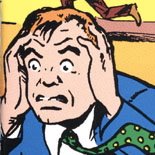
You know what? It's really good. The art is amazing. The shot of the Patriot leaping through the air, just a quiet little WOW moment in the midst of a lot of talking heads. Fantastic. And the writings been good too. Not as strong in the dialogue or characterization (besides Tony, no one seems to have second thoughts about the side they've chosen.) But Spider-Man unmasking on national television? J. Jonah Jameson fainting? Yeah, right here and now I'm willing to say that's better than anything that happened in Infinite Crisis, and coming from DC fanboy like me, that's saying something.

My only major complaint is that they stacked the deck to one side. I mean, I understand Iron Man's position, in the abstract I already agree with it. And if it was Iron Man, military industrialist and former secretary of defense, vs. Daredevil, defense attorney and vigilante, you would have a classic debate between the government's need to protect its citizens vs. the individual's right to privacy and autonomy, balanced by two characters of roughly the same popularity. And if Iron Man had Spider-Man as a proxy, Daredevil could have used Wolverine.

But once Captain America took a side, the moral debate was over. (I don't remember where I first read that. If you remember, or you wrote it, could you tell me in the comments section?) Cap's right. He's always right. He's Marvel's equivalent of Uncle Sam. Heck, he IS Captain America. So once he chose the anti-registration side, the debate was over. At that point, it becomes clear that there is more going on here than good people violently disagreeing over the best solution to a difficult, complex problem. Once Cap picks a side, it means there is something else, something ANTI-AMERICAN about the other side, something driving the heroes to war.

And once that element is introduced (and please let me be wrong about that), the actual, meaningful debate will be over. And THAT would suck.

Course, Millar could surprise me. Captain America could express some doubts about his decision. Spider-Man's life could improve now that he's taken true responsibilities for his actions. And if Cap's side does turn out to be the wrong side, and Captain America realizes this and Learns a Lesson, I'd be willing to declare Civil War the best cross-over miniseries I've ever read.

Wednesday, June 21, 2006

J. Jonah Jameson Was Right

A week late and a buck short but...

So the big news LAST Wednesday was about Spider-Man publicly unmasking in Civil War #2.

A lot of bloggers were really upset about this move, because it "ruined" the character. I argued that publicly unmasking actually made a lot of sense, because:

a) instead of being an unaccountable vigilante acting outside the law (J. Jonah Jameson's perfectly justified objection to Spider-Man), he's taking personal responsibility for the choices and mistakes he's made and will make as Spider-Man. It also allows him to testify at trials, be called in to help the police, and in general be a BETTER protector of the city;

and b) he's not exposing himself and his loved ones to any MORE danger, he is actually helping PROTECT them. Now they know WHY they are being targeted by villains who ALREADY KNOW who he is AND he's scaring off the villains who might want to attack Mary-Jane, supermodel, but not want to mess with Spider-Man, Avenger.

Furthermore, I pointed out there are several successful superheroes in the Marvel-verse whose true identities have never been secret, specifically the Fantastic Four.

I feel that masked vigilante heroes only make sense when, in the case of Robin Hood, Zorro, Batman and V, the hero FUNDAMENTALLY does not trust the established authority. Spider-Man, who is very civil hero, clearly DOES trust in the power of the press and government to protect and help people, so why is he hiding his identity from them?

But Carla at Snap Judgments made a good point. I've addressed the literal arguments against unmasking Spider-Man, but not the metaphorical ones. That Spider-Man, the story and character, lose a lot of their power if Peter Parker is a public hero. And while I agree that this drastically changes the character and story, I don't think it hurts the character at all.

Let's look at Spider-Man metaphorically. Peter Parker is an Average Joe, maybe a little smarter and harder working than most (he had TWO after school jobs, not counting the vigilantism and pro-wrestling). He's low on cash, gets ignored by girls and picked on by bullies.

Spider-Man is his secret talent, the place he can go where he's not only strong and fast, but also funny, admired and feared! And when you consider that Peter was bitten by that spider when he was 15 but was NEVER known as Spider-Boy, you can see that the mask didn't just hide his identity, it also hid Peter's age. As Spider-Man, he was treated as an adult!

So when Peter was a teenager, the duel identity made a lot of sense. He had a talent and a secret life he loved, but one his Aunt would NEVER have approved of, and respect and admiration from a public that would NEVER have taken him seriously if they knew how young he was. Think of a rock singer who hides her talent from her parents, because they don't approve of that kind of music, and hides her age from the band because they'd tell her to go home if they learned she was in high school.

But as an adult, the duel identity becomes metaphorically problematic. You have to ask who is he hiding his true self from, since he's not doing a very good job of hiding it from the Green Goblin and Venom. He's hiding who he is from his friends, the government, and the public at large.

Going back to the singer, if a 25 year old teacher decided to pursue her rock career, would she hide her background because her parents still didn't approve? Or would she say "No, I'm an adult and I'm proud of my talent, AND I'm proud of being a teacher, and I don't care what anyone else thinks"?

Unmasking is a very adult way of taking responsibility for his life and saying to the world, "I am Spider-Man, and I'm proud of what I do." If you're going to argue that he shouldn't take that kind of adult responsibility for his life, that he should hide who he really is from friends and foes alike, then you have to argue that Peter should never have turned 18, graduated from high school and moved out of Aunt May's house. And MAYBE THAT'S TRUE.

But personally, I believe that the strength of an ongoing story like Spider-Man is character growth, that stories build on what came before but shouldn't reproduce them. Growth necessitates change, and it won't always be positive, but, to me, it makes a better story.

That's not to say I don't have specific problems with the context of the unmasking. I think the debate in Civil War, whether super-powered people should be registered and contained by the government, is one-sided (no, they shouldn't) and just off the much more interesting debate, whether all CRIME-FIGHTERS (like, say, the Punisher) should be registered and contained by the government. And* I wish that this change didn't come hot on the heals of three major changes to his powers, living arrangements, and costume, all within the last two years. Each one of those changes is big enough that you kind of wish the writers had two or three years to play out the implications and new story possibilities before the next BIG CHANGE.

But you know what? I like it, and I want Marvel to keep this as the status quo for as long as possible. I think a Peter Parker who tries to have both a normal life and still hold up his great responsibilities, allowing everyone he knows to know why he is the way he is, could show a more complex and interesting character than the repetitive "Oh noes, how can I save day and not reveal who I really am to the people who love me and think that know me so well" stories that got worn out by Superman long before poor Peter Parker picked-up his power.


*Edited after actually buying and reading Civil War. Turns out the debate is exactly what I wanted it to be, just one-sided.