Thursday, October 21, 2010

Batman: The Animated Series Re-Watch: Episode Twenty and Twenty One: Feat of Clay


Plot: On orders from the ruthless industrialist, movie actor Matt Hagen impersonates and frames Bruce Wayne for attacking Lucius Fox, using a face cream that allows him to reshape his face. But Hagen is addicted to the cream, and when he tries to steal it, Daggett's men drown him in it. Instead of killing him, the cream turns him into the monstrous, shapeshifting Clayface, who swears revenge on the man who destroyed his life.

There's been a few Clayfaces in the comics, and this version is actually a combination of the first two. His name and powers are taken from the second Clayface, but his personality and origin are closer to the first Clayface, Basil Karlo (get it?), a movie actor who tries to get revenge on the studio that ignored him. Roland Daggett, on the other hand, is a Batman: the Animated Series original, though in character and appearance, he greatly resembles Norman Osborn, the civilian identity Spider-Man villain the Green Goblin. Like Rupert Thorne, Daggett gets called in whenever the script calls for "evil businessman."

When I started, I decided to review these two-part episodes as one story, but in this case I wonder if I should review them separately, because the first part is pretty boring, while the second part is fantastic.

Structurally, this story resembles Two-Face, but where as the first part of Two-Face allowed us to get into Harvey Dent's head, see where he's coming from, see why he makes the mistakes that led to his downfall, before getting to "The Revenge Plot" in part two, Matt Hagen's barely in the first part of Feat of Clay, really only two scenes where he's himself, and what we see isn't very compelling.

Hagen is violent, selfish, vain, impetuous (read: stupid), and abusive to Teddy, his best friend, stand-in, roommate, and I'm just going on circumstantial evidence, boyfriend. (Undoubtedly, Teddy plays the same role Harvey's fiance Grace played). Teddy implies it's the magic face cream (Renuyu) that's making Matt crazy, but since we never see him without it, we never have a reason to like Matt, so it's not a tragedy when we find Matt turned into a puddle of mud at the end of the episode.

Meanwhile, most of the first episode follows Batman's assbackward attempt to clear Bruce Wayne. The chase sequence where Batman flies a plane through a tunnel to impale a car might be impressive looking, but it's both pointless (he gets no information) and needlessly risky, considering he does get the information he needs in the second episode using nothing more than a precariously placed jar of sea water. Add to that he gets arrested sneaking into Lucius Fox's hospital room, and you have to wonder if they're going to take that "World's Greatest Detective" mug away from him.

But then we get to the second episode, and things pick up immediately. One wonders why it's a two-part episode anyway, why they couldn't just have started with the already transformed Clayface coming for his revenge on the businessman who caused his accident, except that then the episode would be Heart of Ice again, but really, would that be so bad?

Clayface is the most dangerous villain Batman has faced so far, since NOTHING Batman does hurts him in anyway. He can't punch him, kick him, drop him off a roof. Gas probably wouldn't do anything. And in the end, they reveal electricity has no effect either. If only Batman could "freeze" him somehow, maybe using some kind of a "freeze" gun powered by "freeze" technology. But where would he get something like that?

But I digress. Besides being invulnerable, Clayface can become anybody or anything. He likes to impersonate authority figures, cops, doctors, Bruce Wayne, big women in mumus in talk show audiences, which done right could make a paranoia infused episode that would make See No Evil feel like a walk in the park. This episode only hints at those possibilities, preferring to play Clayface BIG, an unstoppable mudslide that just steamrolls Batman for an entire episode.

The animation of Clayface is fantastic. When he's shapeshifting while fighting, the animation is fluid and heavy, so each impact is felt. But when he changes his face, from human to his muddy self, or his "death" scene, spinning wildly from form to form, the face tears and rips in painful looking ways. His transformation on stage before attacking Daggett directly, BURSTING out of his female form, is one of the great entrances on the show.

And how about a hand for Ron "Hellboy" Perlman as the voice of Clayface? Yeah, in the first part, he only plays the part of a jerk, but in the second, he gets to be the voice of a jerk who is also a demi-god and starting to really enjoy being superpowerful. Ed Asner also is nicely menacing as Roland Daggett, which is who Ferris Boyle would be if he didn't even pretend to be humane. The surprisingly strong voice work comes from Ed Bagely Jr., who plays Daggett's germophobic Alfred. The interrogation scene where Batman takes total advantage of his phobia works because of Bagely's delivery, trying desperately to be brave in the face of both Batman and unspeakable disease.

The only really false note in the second episode is the revelation that electricity has no effect on Clayface. Sure, it's there to set-up his inevitable return, but, if Hagen was faking his death, it's not at all clear why he would do that. We're supposed to think that seeing images of all the roles he played freaked Clayface out so much he lost control, but clearly he has enough control to create a fake Clayface shell and escape when no one is looking. And if he's free and alive, it's unclear why he stops going after Daggett. Instead of opening up for the possibility of Clayface coming back, the revelation that he's alive and well just unresolves the plot, but oops, we're out of time, so that's all the story you get for today. Boo.

Wednesday, October 20, 2010

Batman: The Animated Series Re-Watch: Episode Nineteen, Prophecy of Doom


Plot: when Bruce Wayne's friend Ethan Clark tells Bruce that a psychic saved him from a series of disasters, Batman suspects this Nostromos is actually causing the disasters in a scheme to steal a lot of money. Turns out Batman's right.

This episode is a mixed bag of some good ideas that don't quite gel into a good story. That's probably because the villains, Nostromos and his right hand man Lucas, are not very compelling villains. Lucas is a non-entity who is surprisingly good at fighting Batman. And Nostromos might have been a fun parody of Marvel's Dr. Strange, but he comes across as a watered down mix of Dr. Orpheus and Zorak.

Nostromos lacks interest because we know right away that he's a fraud. We see the time bomb that sinks the gambling ship, so we know that was sabotage. Ethan's daughter Lisa states her suspicion that Nostromos is behind the disasters almost immediately. Maybe if they had teased the possibility that Nostromos was in some way legit, he would be more compelling. And there no reason he couldn't be, considering that Batman fought an invisible man two episodes ago.

Which is kind of a shame, because there are a lot of good ideas here. For one thing, this is the first time we really explore the social circle Bruce belongs to, and it's not a pretty picture: uniformly white, overweight, and utterly credulous. These are people like Bruce who have inherited their wealth ("old conservative stock"as Ethan says) and spend their days gambling on cruise ships and worrying that society will collapse. When informed that "the Great Fall" will happen soon, instead of telling the world to possibly prevent it, they form a "Secret Brotherhood" to protect their own wealth and be in a better position to rebuild society, as if they did not have all the power already.

There's also a subtle critique of religion. Nostromos's con has very strong religious tones, from the cultish hooded robes his followers wear, to the prosthelytizing Ethan does on Nostromos behalf. Even when the jig is up, and Nostromos is threatening his life and the life of his daughter, Ethan protests "I believed in you. You saved me," as if Nostromos is his personal messiah. When Bruce quotes Shakespeare at the end, "the fault lies not in the stars, but in ourselves," that's the voice of reason saying Ethan, and no one or thing else, is responsible of Ethan's life.

The most interesting character here then becomes Lisa Clark, voiced by Heather Locklear, who rejects Nostromos and pleads with her father to be reasonable. In many ways, Lisa acts the way Bruce would, if Bruce didn't pretend to be an idiot when he's in civilian clothes. She resemble Julie Madison, Bruce's original fiancee from the comics, as the heiress who wants to do more than inherit her wealth, and might have been an good on-going love interest for Bruce, but she's never seen again after this episode.

This episode is full of missed opportunities like that. After almost being killed, Bruce decides to run a con on the con-man, which might have been fun. But the con only lasts for one scene where Bruce can't even pretend to be surprised when Nostromos flies. When dropped into a spotlight, Batman and Lucas are animated in a Sin City-esque high contrast, black and white style and when the models of planets start crashing into each other, the music becomes a riff on Mars, the Bringer of War by Gustav Holst. But both of these moments last just long enough to see what they're doing, but are not explored in anyway. Even Batman being an entertaining dick, flinging Nostromos around on his string like a puppet or dropping a planet on him, could have been done better, perhaps embarrassing Nostromos in front of all of his followers, and not just the one he was about to kill anyway.

And then there's the questions that just take you out of the episode. Why does Batman change into his bat-costume BEFORE escaping a plummeting elevator? Why con his way into the Secret Brotherhood when he could just tail Ethan there, as Lisa does? Why are the rings on the model of Saturn honed razor sharp? These are little things, but in an episode as weak as this, it just brings the whole thing down. So, in the end, what could have been a great episode ends up being eh, at best.

One final note, the Gotham Observatory is modeled on the Griffith Park Observatory, famously seen in Rebel Without a Cause. We last saw it in Christmas with the Joker, where it had been turned into a giant cannon. Presumably that was cleaned out before Nostromos moved in.

Tuesday, October 19, 2010

Batman: The Animated Series Re-Watch: Episode Eighteen: Beware the Gray Ghost


Plot: When a series of bombings seem inspired by an episode of young Bruce Wayne's favorite show, Batman seeks the help of the actor who played his childhood hero. Meta-commentary ensues.

Oh my god, you guys, this episode. I mean, as good as this show is, not every episode inspires a lot of analysis. There's only so many ways to say child abduction = bad or Heart of Ice is an awesome episode (though it is). But this episode...

Even on just a textual level, there's a lot going on. We are seeing where Batman got the idea to be a superhero, and how much being Batman is the way a child would react to the tragedy of crime. We've already seen, repeatedly, how Batman inspires children to be heroes. Here we see how he himself was inspired as a child.

In fact, Batman comes off a little crazy in this episode. He seems to have trouble telling the difference between an actor and the character the actor plays, addressing notes to the character and getting huffy when the actor, patiently, explains that he's not really that character. And that's before we learn the the Batcave is Bruce's re-creation of the set of the Gray Ghost, and that he has a Gray Ghost shrine hidden in a closet. 

And of course the villain of the piece is also a man-child, obsessed with toys and nostalgia, even using toys to commit his crimes, so he can buy more toys. When he ends up blowing up all of his own toys, he resembles no one so much as Poison Ivy, except Poison Ivy took it better.

Simon Trent, the actor trying to put the Gray Ghost behind him, comes across as the most adult character in the episode, worrying about the rent and trying to play other parts. However, the resolution to his character arc is that he embraces his history and wears his costume again with pride. This creates dueling morals: the villain is bad because he cannot put away childish things, but the heroes are good because they revel in them. 

But that's the surface. Because the Gray Ghost isn't just Bruce Wayne's inspiration, he's a stand-in for all of the pulp heroes that inspired Bob Kane and Bill Finger to create Batman, particularly Zorro and the Shadow. Everything about his design marks the Gray Ghost as a 40s film serial hero. He has the upbeat horns theme music (similar to another modern take on the 40s hero, Indiana Jones). His posters are him towering over art deco buildings in a very Shadow-esque manner. Even the opening to his TV show is the way a live action show would do the opening sequence to Batman: the Animated Series (shot of the sky, pan down to crooks, hero appears to beat the crooks, dramatic pose), including the fact that in the 40s, THEY USED NARRATORS AND TITLE CARDS TO TELL YOU WHAT SHOW YOU'RE WATCHING.


Looked at in that light, we're seeing a passing of the torch, one generation of pulp hero paying respect to the last. We can see the transition from the Gray Ghost's stylized clothes (that are things people might actually wear) to the full effect costume (with pointy ears) of Batman. We also see that Batman has effectively replaced the older characters, assumed their place in the public psyche, so that they are forgotten. But Batman hasn't forgotten, and he still thinks they can help him. 

But then the creators of the show went one step further, and cast Adam West as the Gray Ghost! Now, it's no longer about Batman teaming up with the Shadow, it's about Batman teaming up with older Batman. 

Still with me? Because the show has one more screw to turn. The villain is Bruce Timm. Yes. Bruce Timm, creator, executive producer, and director of Batman: the Animated Series, is the voice and the model for the villainous Mad Bomber.  

So the Mad Bomber isn't just a man-child, he's exactly the kind of fanboy who would create this show, obsessive in his recreation of the past (the toy cars he uses resembles the Batmobile from the old show), but with a need to make it darker by incorporating his Twilight Zone toys into the game and knocking the head of his Batman doll. So we have campy Batman and Batman teaming up to fight against the forces that made this very show. 

Interpretations of Batman, from the Dark Night Returns to the Burton films even to the Animated Series itself, had been running away from the "Bam Pow" silliness of Adam West's Batman, but this episode turns that around. It basically says "yeah, last episode was about a father kidnapping his daughter, but he was invisible and called Mojo at the time, so we're not too serious". 

We can read Bruce's reaction to the Gray Ghost, going from hero worship, to disillusionment and disgust, and going back to qualified worship, as the way a lot of Batman fans feel about the old show: as kids they loved it, as teenagers they hated it, and as adults they love it again, for what it is. This episode is about this version of Batman looking at the goofy, campy 1966 version and saying, "I would not be what I am today without you." 

Other notes:

Casting Adam West adds another layer to the story, because Simon Trent becomes not just any actor, he's Adam West, and Christopher Reeve, and George Reeves, and every actor who played a superhero and couldn't find work afterwards. His impoverished state at the beginning reflects how superhero actors and superhero stories themselves have trouble being taken seriously by the mainstream (man, if only you could tell him to wait fifteen years).

The animation in this episode is off-model. It's a lot more dynamic, and the chase sequences have real energy, but at the same time, the bodies and machines are rubbery, and when the Batmobile goes over a hill, it bends with the road.

It's funny watching Batman feel nostalgic and watch his favorite childhood show while I am, um, feeling nostalgic and watching my favorite childhood show. I'm pretty sure at this point if you held up another mirror I'd fall into it.

And finally, in a blink and you'll miss bit of foreshadowing, Simon Trent shares the cover of People (another fine Time Warner product) with Matt Hagen: Man of a Million Faces. He's an actor with a completely different problem, but we won't meet him for a couple of episodes.

Monday, October 18, 2010

Batman: The Animated Series Re-Watch: Episode Seventeen, See No Evil


Plot: Kimmy's invisible friend Mojo is real and robs jewelry stores. That's because he's actually Kimmy's father Lloyd Ventrix in an invisibility suit, and he's going to kidnap Kimmy if Batman can't find a way to stop him.

Hands down, this is one of the darkest, creepiest episodes of Batman: the Animated Series. Partly, that's due to the natural terror of an invisible villain, one who could be in the room RIGHT NOW. The animators pull out every trick they can to let you know where the man you can't see is, the dog that barks at nothing, the swinging gate that holds still a split second too long, panning the camera along a path, all things that you might see on any day, and they let your mind fill in the man who isn't there. That's before getting to the more overt stuff like the footprints in concrete, floating dolls, and Batman getting the stuffing knocked out of him.

But above and beyond the fantastic elements, the chilling part of this episode is the very real child abduction plot, along the lines of Be a Clown, but more so. Maybe that's because as a supervillain, the Joker always has an element of unreality to him, so his child abduction episode is a little more distant. On the other hand, most child abductions are committed by family members, so Lloyd is a villain that not only can exist in real life, but does. (And I appreciate that he IS Kimmy's father and not a stranger. If parents need to be needlessly scared someone is going to take their children, they should at least be scared of the right people).

Michael Gross captures the unsettling nature of Lloyd extremely well. Even at his nicest, when he's playing Mojo for Kimmy, there's a need to impress, to control Kimmy's emotions. When he grabs Helen's arm and shouts "Look at me!", we don't need to guess why she divorced him and got a restraining order (a good character moment: Kimmy is afraid of Lloyd when he's a stranger, but when he tells her he is her father, Kimmy is EVER MORE afraid of him). He even needs to impress Batman. He could just run away, or beat up Batman in silence, but he needs to gloat, to show Batman that he's the better man. 

(Also creepy, Michael Gross was the father on Family Ties. Did the casting director for this show pick the nicest guy on every 80s sitcom to play the most disturbing villains? Is that how Bull ended up as Two-Face?)

The unsettling feeling is sustained by the music. For the Mojo scenes, we get a high pitched xylophone with a dread inducing cello underneath. This feeling is only made worse when we transition from "Land of the Perfect Day" music out of Peter and the Wolf for the Helen and Kimmy scenes back into the disturbing theme. In the finale, when Kimmy is talking to her new "imaginary" friend Batman, the cellos have been replaced with Batman's fanfare horns, so we know that everything is alright, unless you're a criminal.

For such a dark episode, it also contains some of the series funniest and silliest gags, as if the writers desperately needed to balance the show. The guard, biting his lip waiting to use the bathroom while Bruce Wayne changes, only to be smacked in the face when Batman dramatically emerges. The construction worker's "who me?" face when Batman yells at a seemingly empty room. The bum who, seeing Batman clinging to the top of an invisible car, turns to his friend and says, "I didn' know he could fly, too."

Oh yeah, the invisible car. That is very well pulled off. Not just the animation of Batman flying around the streets of Gotham, or letting scratches in the invisibility coating let the car appear slowly, but just the reveal that the car could turn invisible, this car that we've seen since the beginning, that's the same color as the un-activated invisibility suit, is a great way to both set up and surprise the audience while elevating the threat of the villain for the final confrontation.


Also, I have so much respect for how the writers show Batman is smart, rather than tell. He's immediately and constantly throwing smoke bombs and paint into the air to mark Ventrix, while in some shows, and I'm looking at you, Smallville, it takes the hero an hour to arrive at the same solution. Batman doesn't let a little thing like the impossibility of the situation stop him from kicking some ass, all leading to a fight under a leaking water tower and the most badass delivery of "Peek a boo" ever in Western civilization.

And finally, the episode introduces Lucius Fox, who was created in the comics to answer the question, "If Bruce Wayne pretends to be an idiot, how does Wayne Enterprises stay in business?" While Wayne owns the company, Lucius is the de facto head. Also, Lucius is the only one who know Bruce is not the idiot he pretends to be, though he probably does not suspect what Bruce actually does at night. In the Animated Series, Bruce is shown to be more active at the company, so Lucius is just second in command. That does leave the question of when does Bruce Wayne sleep, but maybe that's thinking too hard.

Friday, October 15, 2010

Batman: The Animated Series Re-Watch: Episode Fifteen and Sixteen: The Cat and the Claw


Plot: Trying to protect a stretch of wildlife, Catwoman discovers a terrorist cell led by Red Claw, and reluctantly teams up with Batman to stop them.

As a character, Catwoman's as old as the Joker (both dating to Batman #1) and has had as many different interpretations over the years. While she's always a thief, morally she's ranged from purely selfish motives to a more Robin Hood approach to being basically a female Batman. Sometimes she works completely solo, other times she's the head of a gang of crooks. Sometimes she fights Batman in a dress and cape, sometimes in leather bondage gear, sometimes in a catsuit that actually looks reasonable for climbing around the sides of buildings. Sometimes she's perfectly sane, and sometimes she's batshit crazy. Sometimes she's purely adversarial to Batman, sometimes she's his partner, and usually these some romantic tension between them. 

The Animated Series Catwoman basically split the difference on most of these issues. This Catwoman steals from the rich to give to the kitties, placing her on just the wrong side of moral alignment. Selina has a secretary, Maven, who apparently lives with her , as well as a lawyer, but her only accomplice on her crimes is her cat Isis. Catwoman can also, apparently, talk to cats, including a mountain lion . She wears a form fitting bodysuit, but it's not the stitched together leather outfit from Batman Returns, though she has taken Michelle Pfeiffer's blonde hair (in all other versions, Selina Kyle has black hair). And unlike the Joker and the Penguin, this episode is explicitly the first time Batman and Catwoman have met. 

I just wish these episodes were better. The Catwoman parts are great, really. Musically and visually, they recall Hitchcock films (especially the car chase in Part II) with snappy patter masking mounting tension. Batman and Catwoman are immediately flirting, even as they are leaping off rooftops, both shocked and pleased that they can keep up with each other. The first act chase is delightful, and ends with a great moment copped from Batman: Year One, Batman risking his life to save a cat. 

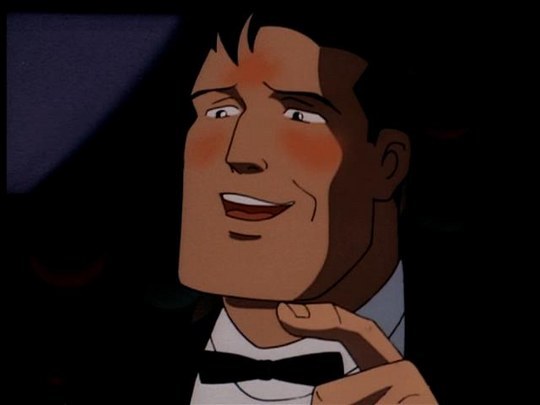
The double duel identies set up a beautifully complicated love... triangle? Quadrangle? Basically, Bruce Wayne is immediately infatuated with Selina Kyle (we even get to see Bruce blush), but Catwoman only has time for Batman, and neither side knows the true identity of the other. You have to let your disbelief suspend a bit for the usual secret identity questions (don't they recognize each other's voice? or chin?) but it's a fun dynamic, especially since we never see Bruce have to pursue anyone else in the series. 

And when Batman rejects Catwoman explaining that "the thing between us" is "the law" (a line so painful even Catwoman winces), we get a nice reminder that she is a bad guy because she throws him off a building even though he JUST SAVED HER LIFE.

The problem with the episodes is entirely in the "claw" part of The Cat and the Claw. Another Batman: the Animated Series original (though she bares a passing resemblance to the villain Chesire), Red Claw just isn't that interesting. She's called a "terrorist," (and kudos to the show for using that term in a cartoon), but we don't know her cause at all. Her only demands are money. She's very taken with herself being a terrorist who is also a woman (which Batman dismisses with the line "I'm an equal opportunity crimefighter"), but aside from being a woman, there's nothing else to her character. At all. Just Cobra Commander with an exposed shoulder.

She's there to contrast with Catwoman (Batman's match who is a woman), but she's such a strawman that nothing is really said. Maybe they should have used the female villain they've already established, Poison Ivy. Like Ivy, Catwoman is motivated by environmental concerns. Like Harvey Dent, Bruce Wayne throws himself into his relationship with Selina without much thought. However, Catwoman is entirely sincere in her beliefs, while Ivy destroys the plants she's trying to save to kill Batman. And Selina is mostly sane. When a company tries to buy the land she's trying to protect, Selina threatens to sue, to bring down every environmental group on them, and finds evidence that they're lying to the public. Poison Ivy, on the other hand, waits five years and then poisons the man who had the idea for the building, over a rosebush she's already saved. Catwoman would have been much better defined with a stronger character for contrast.

Also, this story didn't need to be two episodes long. More happens in 20 minutes of Heart of Ice than happens in 40 minutes here. (Unfair comparison? More happens in The Underdwellers than happens here). Really, I wish the first Catwoman episode was entirely about Batman and Catwoman. Surely that story could have been written.

Thursday, October 14, 2010

Batman: The Animated Series Re-Watch: Episode Fourteen: Heart of Ice


I have to admit, I was dreading reviewing this episode. It was my favorite, it's the one that won an Emmy, as is voted best episode in fan polls. But it's entirely possible the Suck Fairy had visited in the last eighteen years. I'm happy to report that it just isn't so. Heart of Ice is great.

Plot: Batman investigates a series of "freezing" attacks on GothCorp, and discovers Mr. Freeze, who blames CEO Ferris Boyle for the death of his wife.

While the visual design of Mr. Freeze is basically unchanged from the comics and 1966 TV show (a robot suit with a glass dome over the head and a freeze gun), Batman: the Animated Series totally reinvented the character of Mr. Freeze for his episode. Or, rather, invented, because he didn't really have a character before. He was just a criminal who committed ice crimes the same way the Penguin commits bird crimes. His emotionless behavior and tragic origin story were invented by director Bruce Timm and writer Paul Dini (respectively) for this episode. (This is in fact the first episode Timm directed and Dini wrote). Dini in particular was inspired by Boris Karloff and Vincent Price movies to make Mr. Freeze's motivation the death of his wife Nora, and turn the episode into a ghoulish vengeance from the grave story.

And so for the fourth time we get the revenge plot, where supervillain tries to get revenge on non-supervillain, and Batman gets in the way (we'll see it a lot). The difference this time is that, unlike the Scarecrow, who was totally in the wrong, and Two-Face, who was totally in the right, Mr. Freeze is kind of right and kind of wrong.

When he was Dr. Victor Fries, he was trying to do a good thing, save his wife and possibly countless lives, and Boyle's a dick, valuing Nora's life at less than three million dollars and directly causing the accident that kills Nora and traps Fries in his frozen condition. On the other hand, Fries was stealing from the company to pay for the experiment and as Mr. Freeze he would kill everyone in the building to get revenge on Boyle. So Batman is understandably torn.

And it's crucial too that, in this episode of Batman, BATMAN is the protagonist, something he hasn't been since The Forgotten, when he mostly had amnesia, or The Underdwellers before that. This episode is about how Batman reacts to someone else's vigilante crusade, one whose motives overlap with his own. In that respect, the key choice is when Batman lets Freeze escape so he can go back and save the semi-frozen hood that Mr. Freeze left to die. Batman cannot NOT care about people. Which makes it a much bigger moment at the end when he DOES leave Boyle half-way frozen, (with a cold delivery of "Good night, humanitarian"). It's clear that Batman feels Boyle deserves much worse than the common criminal, and is willing to let Freeze have some of his revenge.

And that's the contrast of the three main characters. Boyle, voiced by Mark "the Joker" Hamill by the way, makes a big show of compassion, literally adding "the People Company" to his company logo, but it doesn't take much to make his mask slip and reveal the heartless bastard at his core. Mr. Freeze is the opposite. He claims to be emotionless, that all feeling has been frozen dead inside him, specifically he claims he has no more tears to shed, and yet, there they are, at the end of the episode, as he thinks about how he failed his wife. Batman, if anything, is closer to Mr. Freeze, on the surface emotionless, but fueled by both anger and compassion to seek justice.

Narratively, Dini and Timm pull out some interesting tricks. The opening title card is incorporated into the show itself for the first time, as the camera pans from the text to Mr. Freeze's snowglobe. The "flashback" for the origin story is actually a tape Dr. Fries was recording when Boyle broke into his lab (though as Timm points out in the commentary, Dr. Fries must have set up 14 or so cameras to get all the coverage, and someone else must have come in and edited the tapes together). In the first act, Batman creates a computer model of the giant ice cannon Mr. Freeze uses in the third, a superheroic example of Chekov's axiom.

They also do a good job of making both Batman and Mr. Freeze competent competitors. Batman deduces Freeze's next target before Freeze strikes, Freeze successfully fights him off and escapes by leaving a man behind. Batman discovers Freeze's true identity, Freeze surprises and captures Batman (because he apparently built his secret frozen base in the basement of GothCorp, which is either brilliant or stupid but it sure is ballsy as hell). Even to the end, when Batman has dismantled the freeze cannon and knocked out Freeze's crew (one using his signature over the shoulder backhanded punch), he can still only flail uselessly against Freeze's unstoppable robot suit (thank God for Alfred and obvious targets like unprotected glass domes).

One thing I noticed this time is that even though this Mr. Freeze is the more serious, darker, more complex character, he is still constantly making cold puns. Right from the beginning, "Revenge is a dish best served cold," "That's Mr. Freeze to you," "warm regards," "the cold eyes of vengeance," "the icy touch of death," he's pretty unrelenting. Mostly, he gets away with it because Michael Ansara voices Freeze with an emotionless deadpan (aided by production work to give his words a metallic echo) which lends these incredibly cheesy lines with menace and weight. If anyone deserves credit for turning one of Batman's silliest villains into one of the most emotionally resonant, and making Heart of Ice one of the best episodes of Batman: the Animated Series, it's Ansara.

Wednesday, October 13, 2010

Batman: The Animated Series Re-Watch: Episode Thirteen: I've Got Batman in My Basement


Plot: Sherman Grant, junior detective, must protect a comatose Batman from the Penguin using Home Alone tactics.

To my mind, the Penguin is forever tied with the Riddler, Catwoman, and Two-Face as Batman's number 2 adversary. The writers of Batman: the Animated Series must have felt similarly, as the Penguin is one of only two villains who never get an origin story (the other being, of course, the Joker). It is just assumed that, like Sherman, everyone in the audience can recognize the Penguin on sight, and basically know what his deal is. The writers play on that familiarity, and, as they use Thorne whenever they need "generic mob boss," the Penguin is brought into play whenever the script calls for "an established Batman villain."

That is to say, episodes with the Penguin are almost never about the Penguin. They are about someone else, like for example a boy caught between him and Batman. There's only so much time to establish a new character, and if you're focusing on a new ally, then the villain has to be someone already established to be a threat. But any of Batman's other established villains would warp the story around them. On the other hand, the Penguin, for all his affectations, is very direct, he's a sane man, who wants money, and is willing to kill for it. Established, recognizable threat, but not one that requires too much attention.

That is NOT to say the Penguin is boring or uninteresting. On the contrary, he's one of the more well-rounded villains Batman has (sorry). Just as Poison Ivy uses both evil botany and seduction, the Penguin has two unrelated gimmicks: his affinity for birds (he uses a vulture to steal an egg) and his trick umbrella (from which he draws infinite weapons). Design-wise, this Penguin draws a lot from Batman Returns, a general egg shape and flipper-hands.

His personality, however, is very different. In the Animated series, the Penguin affects the air of an upper crust aristocrat, looks down on the Grant's home for being "bourgeois", always dresses in his finest clothes, tux, monocle, top hat, cigarette holder, as if he is eternally off to the opera, and quotes poetry at his thugs. But it's an act. He gets the quotes wrong. He's prone to malapropism (unless he meant to call Batman a "castrated rooster" when he calls him a "capon crusader"). And it's probably been awhile since he was anywhere near a theater. It's like he's desperately trying to claw his way into Bruce Wayne's social circle, but we've seen what they look like, how they dress and act, and we know the Penguin is getting it wrong.

One element that's in the story bible that I believe never made it into the show is that he still lives with his mother, and tries desperately to keep her from finding out he's actually a criminal. When he goes to jail, for example, he explains he's off on a trip to South America for the Audubon Society and will be out of contact for a few months. And that's the heart of the character, the infinite distance between the schlub he is and the man he pretends to be.

What were we talking about again? Oh yeah, this episode, which isn't really about the Penguin at all. This episode is about Sherman Grant, who is basically Encyclopedia Brown. He has his Sally, in tomboy and bodyguard Roberta, and even his own Bug Meaney, two of them, actually, named Frank and Nick. What he doesn't have is a police detective father (or any father) to bring home cases or any neighborhood clients. But he's curious, and he knows enough to recognize a South American vulture and know it means something mysterious is happening, which is a good start.

Once again, we come back to Batman being an inspiration to children, giving them the confidence to take on bullies, and then supervillains. Sherman needs Roberta to save him from Nick and Frank at the beginning, but is able to yell at them when he needs to protect the Batmobile. And he leads the charge against the Penguin, even if it only just barely slows the Penguin down.

I wish he was a little smarter, actually. He only figures out how to turn on the Batmobile by button mashing (great security there, Bruce) and it's Roberta who figures out how to work the petals and steer at the same time. His reasoning for not calling the cops (they'd unmask Batman) is plausible, but ultimately foolish, and he doesn't decipher what Batman wants from his car until after Frank stumbles upon the pills clearly labelled "Antitoxin." Maybe I'm asking too much of 11 year olds, or as a world weary Roberta says, "Men."

One interesting line is that Sherman not only recognizes the Penguin on sight and has a Joker poster in his crime basement, he also knows about the Batcave. It's hard to see, from the episodes we've seen so far, how anyone other than Bruce, Alfred, and Dick would know anything about Batman having a secret crime fighting base, let alone one in a cave. The only other person we've seen in the cave is Man-Bat, so maybe Kirk Langstrom talked after he returned to humanity. Or maybe Batman just cannot shut up about his sweet crib. Who knows? I certainly don't.

This is also the fourth time someone has tried to gas Batman (Fear, Laughing, Tear, and I guess Poison). One would think he'd learn to just keep the gasmask on.

So, an enjoyable romp about kids learning to fight crime. All in all, good fun.

Tuesday, October 12, 2010

Batman: The Animated Series Re-Watch: Episode Twelve: "It's Never Too Late"


Plot: Crime boss Arnold Stromwell believes his son is yet another victim of his on-going mob war with Rupert Thorne. But Batman shows him that his son is rehab for his addiction to the drugs Stromwell himself sold, and then offers him a chance at redemption.

First off, Thorne? Again? Didn't we just see him carted off to jail? *Checks* Yes, yes we did. Clearly, this episode should have come earlier in the season, as Thorne is the head of all gangs in Two-Face, but here he's an upstart taking on the more established boss. Or it might have made sense to make Stromwell the upstart, taking advantage of Thorne's weakness after Two-Face crippled his operation.

On the other hand, back to back, the strengths of this episode are a lot clearer in juxtaposition to the previous one. As in Two-Face, the protagonist is not Batman, but rather Thorne's criminal rival. However, instead of spending his time on the side of the stage flailing uselessly about, here Batman is a master manipulator, putting Stromwell's son, ex-wife, and brother into place, saving Stromwell's life, then guiding him along like a pointy-eared version of the Ghost of Christmas Present and protecting him from Thorne's goons long enough to have his moment of conversion. And unlike with Two-Face, we have every reason to believe that Stromwell really has repented, and that Batman's plan worked.

This episode really plays up Batman's role as a demon on the side of good. He's hiding amongst the gargoyles when we first see him in costume, he's actually called a "dark angel" by the hippiest bum I've ever seen, and the first thing Stromwell sees when he opens his eyes is Batman standing in front of a sheet of flame like the devil himself. In the final sequence, where Batman takes out Thorne's men one by one, Batman is playing the movie monster, the unseen thing in the shadow that you don't notice until it's too late. Twice, in fact, we see Batman taking out a hood from the hood' point of view, making the explicit point at the viewer is not Batman, could not hope to be Batman, and if you are thinking about a life of crime, Batman, the dark avenger, will hit you in the face.

Really, the audience for this episode is supposed to identify with Stromwell, which is admittedly a little difficult. Unlike Two-Face, he's not seeking justice. He has no problem with Thorne taking advantage of people. He just doesn't want the competition. He's clearly rationalized his career as a drug dealer by saying he doesn't make anyone take drugs. And even after seeing the effect of his drugs on his son, he doesn't feel the need to repent or make up for his mistakes. There doesn't seem to be anything to save.

However, he must feel some guilt. Why else would he locate his headquarters a short walk away from where his brother Michael saved him from being hit by a train only to be hit himself? The sight of any train makes Stromwell break out in a sweat remembering that day, and yet he placed himself where he had a constant reminder of his greatest mistake. It becomes clear that it's not that Stromwell doesn't want to reform, it's that he thinks he can't, that he's done too much wrong in his life already.

Arnold Stromwell was created for the series, and like Thorne he's a mafioso type with an Anglo-name. However, in this episode, the writers' desire not to create a stereotype butts up against gangster movie conventions. Stromwell's brother is priest, suggesting Stromwell is Catholic. And "Pete's", where Thorne tries to have Stromwell killed, is an Italian restaurant (with "the best cannoli" according to food connoisseur Det. Bullock). And of course, the Mafia are Italian. Everything would just make more sense if Stromwell was Falcone. But whatever.

This episode also marks Batman: the Animated Series complete move into the never-was past. Not only are TVs now black and white, but flashbacks travel even further back. Young Arnold and Michael are dressed like turn of the century newsies.

Monday, October 11, 2010

Batman: The Animated Series Re-Watch: Episode Ten and Eleven: Two-Face


And so we come to the Two-Face storyline, and, appropriately enough, the first two-part episode. Normally, I don't like two-parters, because I feel most TV stories don't "earn" the extended length, or use the break between episodes well, but I think this one works quite well, especially as each episode has a separate and complete plot:

Part 1 has the Fall of Harvey Dent: When Mob Boss Rupert Thorne tries to blackmail Dent with evidence that Harvey suffers from multiple personality disorder, he unleashes Harvey's bad side and scars half of his face for life, not necessarily in that order.

Part 2 has the Rise of Two-Face: After six months of systematically dismantling Thorn's organization, Two-Face is ready to end Thorne for good. But Thorne is ready to strike back, using Harvey's former fiancee Grace Lamont as a pawn.

So, Two-Face is one of Batman's oldest foes, dating back to 1942. His origin in the comics is basically the same as what's presented here, district attorney, face scarred for life by the criminal he was pursuing, causing a mental breakdown and the release of a second personality obsessed by chance vs. justice, duality, and the number 2.

The major change here, picking up from the Two-Face origin story that had just been published in Batman Annual #14 (1990), is that Harvey already had multiple personality disorder before he was scarred. This is a big improvement over previous versions (or even Christopher Nolan's take on the character in The Dark Knight), where one tragedy seems to make a perfectly good and sane man crazyevil over night.

In this version, Harvey had created a second personality because he represses his anger after mistakenly believing he put another boy in the hospital. That's kind of silly and frankly a rare example of toning down the Batman mythos for the child audience. In the comics, Harvey's insanity is born out of physical abuse at the hands of his alcoholic father, a much darker but more satisfying explanation (also more realistic, as child abuse can cause split personality, but one really shouldn't be looking to Batman for realism).

Two-Face serves as a walking reminder of the time Batman failed, the man he did not save, and boy is that true here. Over two episodes, Batman is singularly ineffective. Not only does he let Harvey become horribly scarred (as he inevitably must), Bruce also failed to notice for five years that his close friend of suffered major mental problems. And then Batman is unable to stop Two-Face's six month rampage through Gotham City. By contrast, when the Joker escaped from Arkham Asylum on Christmas morning, Batman had him back in his cell in time for Boxing Day. Batman even dreams about his failure (and the Wayne's make their THIRD appearance in eleven episodes. Yeesh, that's enough, Dead People).

No, Batman is pushed to the side for two episodes for our real protagonist, Harvey Dent himself. It's Harvey that chooses to keep campaigning rather than commit himself to a mental hospital, Harvey that goes to see Thorne even though he knows nothing good can come of it, Harvey that leaves behind Grace to lead a life of crime (yes, we get it, writers, very subtle). Two-Face that takes apart Thorne's operation, Two-Face that finds the evidence to convict Thorne, and Two-Face that tries to re-unite with Grace only to be betrayed. Batman isn't even the antagonist, since when he does show up, he's usually fighting on Two-Face's side against Thorne's men.

It's a question why Batman is even trying to stop Two-Face. Yes, like Scarecrow or Poison Ivy, Two-Face is motivated by revenge, but unlike them, he's totally justified. Thorne is a gangster who blackmailed him, destroyed his career and his face, and threatens the life and security of everyone in Gotham. And Two-Face goes after Thorne it in a very Batman-esque manner, attacking Thorne's operations, crippling his finances, and ignoring his lawyer's rights to privacy by rifling through his files. Even his plan to finally get rid of Thorne is admirably restrained.

Why wouldn't Batman do all that? In fact, why hadn't Batman ALREADY done all that, instead of wasting six months researching multiple personality disorders. Except for possibly at the end, when Two-Face is about to shoot Thorne, Two-Face is a better Batman than Batman is.

Again, Richard Moll deserves a shout out for his superb voice work. When Harvey becomes Two-Face, his voice is actually a synthesis of Harvey's normal voice and the voice of his other half "Big Bad Harvey." BB Harvey's voice is deep with an animal growl. Two-Face's voice has the same growl, but is high enough to feature sadness and longing (which BB Harvey is incapable of) without actually returning to Harvey's voice.

The animators also do an excellent job. The design for Two-Face is probably their most impressive translation of a character from comics to television. In the comics, Two-Face's suit is a combination of a plain right half and a garishly ugly left half. Here, it's simplified to just black and white. While that may have just been to save time and money on animation, the effect is much more striking. And furthers the conclusion that Batman just has the best dressed rogues gallery ever.

They also play the reveal of Two-Face's face perfectly, teasing it out, making us think we'll see it once, when the doctor takes off the bandages and recoils in horror, twice, when Two-Face, in his growly voice, demands to see a mirror (in an homage to Burton's first Batman movie), and then finally they show us his face, lit by lightning, when Grace comes to visit. But, in fact, we had ALREADY seen his face, very briefly, again lit by lightning, when Harvey is hypnotized by his therapist. Two-Face was always there, he was just waiting to get out.

Other notes: Last time we saw Harvey Dent, five episodes ago, he was ready to propose marriage to a woman he had only known for a week (it didn't work out). Now he's engaged to a different woman (though he hasn't set a date). Either Harvey is just the marrying kind, or the episodes are doing funky things with time jumps (like jumping from Christmas to April Fool's Day over the course of two episodes). There are time jumps within the episode too, jumping from mid-way through the campaign to election night, and then six months later. If Batman: The Animated Series is supposed to be in strict chronological order, we've already witnessed a year and a half in the life of Batman (so it's probably best that we don't).

Also introduced in this episode is Rupert Thorne, who shows up in the Animated Series whenever the story calls for a generic mob boss. Here, he replaces Sal Maroni as the man who scarred Harvey Dent. In the comics, however, Thorne was a corrupt politician, not an out-and-out gangster. I think it's interesting that instead of an Italian as crime boss (the canonical choice would be Carmine Falcone), the writers of the Animated Series chose a character with a very Anglo name. This was probably to avoid stereotyping, even if he still resembles Marlon Brando as Don Corleone.

Grace is the more problematic character: everything about her is a throwback to 1942. Her only goal is to marry Harvey Dent (though she's totally willing to wait for him to set the wedding date). Her only actions are to support his campaign and recovery (though not enough not to faint upon seeing his ugly face), then betray him (to be fair, she thought she was betraying him to the police, not to Boss Thorne), then be the love that will save Harvey (unsurprisingly, she's never seen again). It's a good thing they've already introduced Montoya, because between Grace and Poison Ivy, you have to start wondering about the Batman writers' relationships with women.

Before the second episode, a narrator says "Previously, on Batman..." This shouldn't be noteworthy, except that it's the first time we learn the official name of the series ("Batman"), as no title is seen in the opening credits. I'll continue to refer to the series by the accepted nomenclature of Batman: the Animated Series, which distinguishes it from the 1966 live-action series and all of the movies, even though there's been several Batman animated series before and after this one. (I can't even say Batman, the GOOD Animated Series, since the current one, Brave and the Bold, is pretty fun).

And finally, when Two-Face lingers over a photo of Grace, we get a close-up of his wallet, and can see he has a credit card issued to Two-Face. Man, they'll give credit to anyone these days.

Friday, October 08, 2010

Batman: The Animated Series Re-Watch: Episode Nine: Be a Clown


Hey, remember when I said The Underdwellers would be better if they used an established Batman villain? Turns out I was right.

Plot: Feeling neglected by his father, Mayor Hamilton Hill, Jordan Hill runs away from his own birthday party in the back of the hired clown's van. Unfortunately for Jordan, the clown is actually the Joker in disguise. Hijinks ensue.

In Christmas with the Joker, the Joker represented the ever-present threat and the attention seeker. Here, we are dealing the Joker as a tempter and a corrupter. Just as Batman is an inspiration to Frog in The Underdwellers (and, presumably, Robin), it turns out the Joker can be an inspiration too. He represents the freedom to runaway from it all and join the circus. Though, in the Joker's case, "it all" includes the law, morality, and sanity itself.

Notably, this inspiration is a by-product of his actions. The Joker doesn't set out to kidnap the Mayor's child and turn him against his father, that happens accidentally. In comparison, his actual plan of sneaking into the Mayor's house and blowing up his guests is remarkably straight forward.

But once the Joker learns what happened, and begins to realize the potential in creating a protege, the creepiness of the episode begins to ratchet up. We actually see the Joker make up his plans as the episode progresses, first simply teaching Jordan magic tricks to keep him entertained, then deciding to use him as bait to lure Batman into a trap, and finally forcing Jordan to watch Batman drown while the Joker stands behind him, squeezing his shoulder. The mythical parents who watch cartoons with their kids must have been freaking out at that point.

The Joker, accidentally and then intentionally, makes a mini-version of himself, a demonstration that anyone could be as bad as himself in the right circumstances, which is a recurring theme for the Joker from The Killing Joke to The Dark Knight. The Animated Series explores this theme further with the character of Harley Quinn, particularly her origin episode Mad Love, and then takes the disturbing implications of the Joker's attempt to make his own Robin to its extreme in the Batman Beyond movie, The Return of the Joker. But back to Jordan.

Jordan follows the Joker because, unlike Mayor Hill, who knocks aside Jordan's magic props to drag him to the party, the Joker doesn't seem to care about impressing people, he just wants to do his magic tricks. Ironically, the Joker is in fact obsessed with impressing people (as established in Christmas with the Joker) and craves Mayor Hill's attention even more than Jordan does, but Jordan doesn't realize that until the Joker tells him "there is no trick." The Joker is just a killer.

Even after Jordan rejects the Joker and runs away, the creepiness only increases. He already rejected one father for a new one. Rejecting the second father-figure leaves him alone in a terrifying world where nothing makes sense, everything is too big, and a monster is hunting him down. Even twenty years later, the sound of the Joker following Jordan while clack clack clacking his cane along the picket fence sends chills down my spine.

Which leads to the big moment of the episode, when Batman asks Jordan to trust him. At this point, Jordan has been betrayed by two father figures, and the second chased him onto a runaway rollercoaster while throwing exploding cupie dolls at Batman (in a scene taken from The Dark Knight Returns #3). Now a scary man in a black mask, who his father and the Joker insist is a bad man, is asking Jordan to rely on him, or he will die. It's impressive Jordan is able to even get out of his seat. But not only does his bravery save his own life, it earns him the highest honor, the Bat-thumbs up.


Other things to note: I'm pretty sure the Joker would have succeeded in blowing up the party if he hadn't put his face on the dynamite and thus given himself away. But then, he wouldn't be the Joker.

I'm also pretty sure that the full bearded Prociutto is actually Alan Moore, who wrote the Killing Joke.

For the third time in as many episodes, the Joker has Batman at his mercy and decides not to just shoot him in the face. I'm starting to get the feeling that he's not serious about this killing Batman thing.

And this is the first episode where Batman fails to capture the villain in the end. The Joker simply falls into the water. We don't see him escape, but we can't assume he drowned either. At least Batman actually kicked him this time, and the Joker didn't just trip, again.